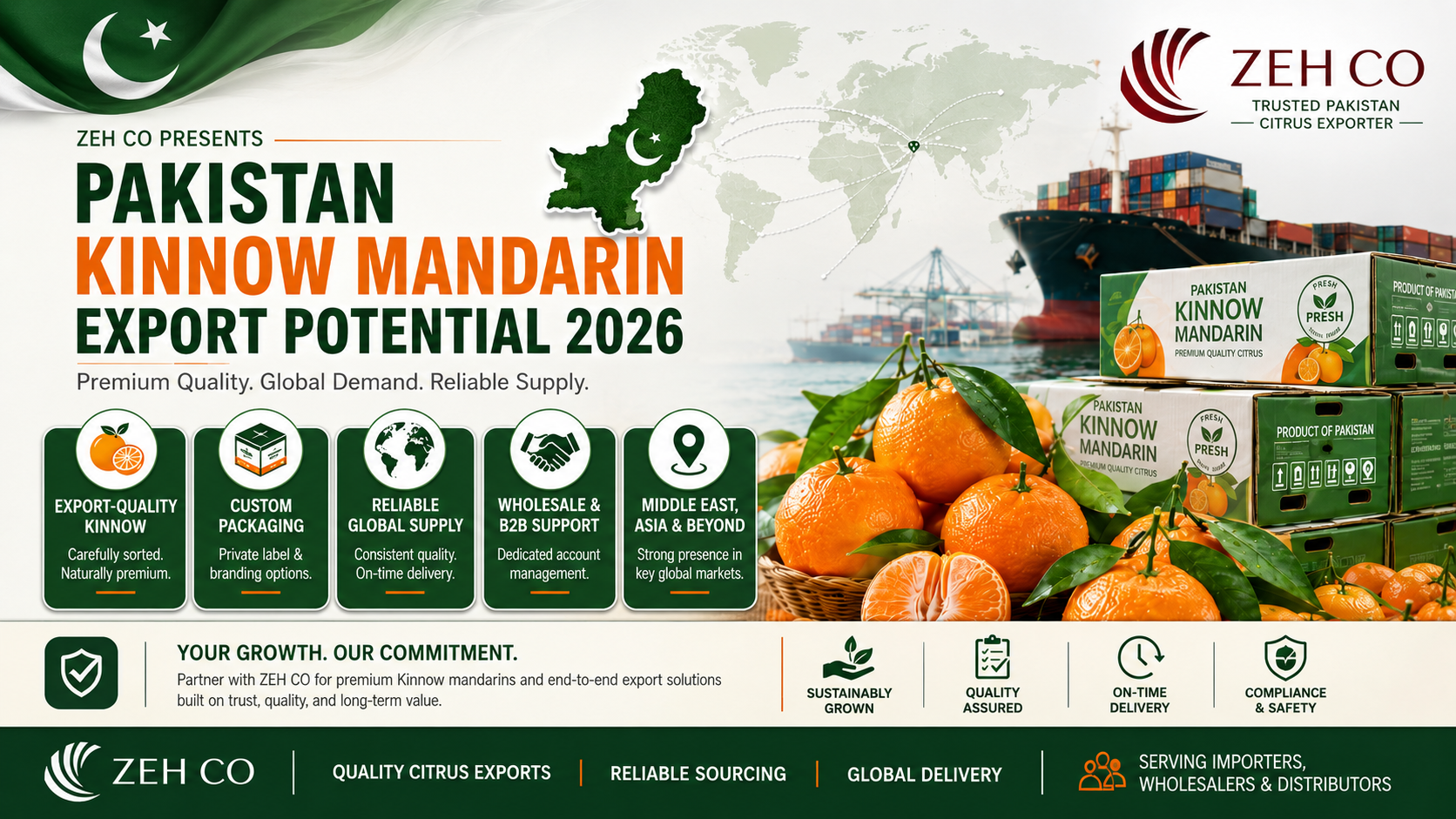
Pakistan Kinnow Mandarin Export Potential in 2026
Pakistan’s kinnow industry enters 2026 with strong production, established international demand and significant opportunities for market diversification. However, converting this production strength into sustainable export growth will require better citrus varieties, improved quality control, efficient cold-chain logistics and stronger access to premium markets.
Pakistan’s Flagship Citrus Export
Kinnow is a high-yield mandarin citrus and one of Pakistan’s most important horticultural export products. Its attractive orange colour, high juice content, distinctive sweet-and-tangy flavour and competitive pricing have created steady demand among international fruit importers, wholesalers, supermarkets and juice-processing companies.
Pakistan’s citrus industry is centred mainly in Punjab, particularly the Sargodha and Bhalwal regions, where orchards, citrus-processing plants, cold stores and export packing facilities form an established supply chain.
For the 2025–26 season, Pakistan’s kinnow crop was estimated at approximately 2.7 million tonnes, compared with about 1.7 million tonnes during the previous season. Exporters set a target of 300,000 tonnes, expected to generate around US$110 million. In the preceding season, Pakistan exported approximately 250,000 tonnes worth US$95 million.
These figures show that Pakistan has a large production base, but only a relatively small portion of the crop is currently exported. This gap represents substantial untapped potential for growers, exporters, processors and international buyers.
Strong Export Momentum in Early 2026
Pakistan’s kinnow exports demonstrated resilience during the opening phase of 2026. According to official government figures, the country earned approximately US$40 million from kinnow exports within 45 days, covering December 2025 and the first half of January 2026.
This performance was achieved despite the closure of the Afghan market, traditionally an important regional destination for Pakistani citrus. Exporters and government trade bodies redirected shipments towards the Middle East, Southeast Asia and other non-traditional markets.
The successful redirection of consignments highlights an important opportunity for Pakistan: reducing dependence on a limited number of neighbouring markets and building a more diversified international customer base.
Major Export Markets for Pakistani Kinnow
The Middle East remains the strongest immediate opportunity for Pakistani kinnow exporters. Markets such as the United Arab Emirates, Saudi Arabia, Oman, Qatar, Bahrain and Kuwait offer advantages including shorter transit times, established Pakistani trade relationships and strong demand for affordable fresh citrus.
Southeast Asian markets also present considerable potential. Pakistani exporters have already supplied kinnow to destinations including the Philippines and other Asian markets. Shipments at the beginning of the 2025–26 season were directed to the Middle East, Sri Lanka and the Philippines, demonstrating active regional demand.
Pakistan is also working to expand citrus exports towards:
- Russia and Central Asian countries
- Uzbekistan and other regional markets
- Africa
- The European Union
- New destinations in Southeast Asia
The Ministry of National Food Security and Research has identified Central Asia, Russia, the Middle East, Africa and Europe as priority areas for citrus market development. Government measures include simplified procedures, additional laboratory accreditation, exporter registration and improved phytosanitary facilitation.
Competitive Advantages of Pakistani Kinnow
Pakistan has several natural and commercial advantages that support kinnow export growth in 2026.
Large Production Capacity
A crop estimated at 2.7 million tonnes provides enough supply to serve both domestic and international markets. Large-scale production also allows exporters to offer different grades, fruit sizes and packaging options according to buyer requirements.
Distinctive Flavour and High Juice Content
Pakistani kinnow is known for its rich aroma, strong citrus flavour and high juice percentage. These characteristics make it suitable for fresh consumption as well as juice, concentrate and beverage processing.
Competitive Export Pricing
Compared with citrus supplied by several premium-producing countries, Pakistani kinnow can be offered at competitive prices. This is particularly attractive for wholesale markets, food-service distributors, traditional fruit markets and price-sensitive retail segments.
Strategic Location
Pakistan has relatively convenient shipping access to the Gulf, South Asia, Southeast Asia and parts of Central Asia. Sea freight from Karachi and regional land routes can support competitive delivery where logistics and border conditions remain stable.
Established Processing Infrastructure
Export-oriented citrus clusters already have washing, waxing, grading, packing and cold-storage facilities. Further investment in modern equipment and internationally recognised certifications could substantially increase exportable volumes.
The Need for Seedless and Improved Mandarin Varieties
The greatest long-term challenge for Pakistan is its continued reliance on an old, seeded kinnow variety. Although the traditional fruit remains popular in regional markets, many premium supermarkets and consumers increasingly prefer mandarins that are seedless, easy to peel, uniform in colour and available for longer marketing periods.
Industry specialists have recommended introducing varieties such as:
- Seedless kinnow
- Kinnow Gold
- Kinnow Late
- Mandarin Nova
- Mandarin Clementine
Experts estimate that Pakistan could increase kinnow export earnings to approximately US$400 million within five years by adopting improved citrus varieties and upgrading supply-chain efficiency.
The government has also accredited post-entry quarantine facilities to support the introduction of disease-resistant, seedless and higher-yielding citrus varieties.
This transition will not replace traditional kinnow immediately. Instead, Pakistan can develop a diversified citrus portfolio in which conventional kinnow serves regional and processing markets while seedless mandarins target premium retail buyers.
Quality and Compliance Requirements
The export potential of Pakistani kinnow depends heavily on meeting international quality and phytosanitary standards. Buyers increasingly require documentation covering orchard practices, pesticide use, residue limits, traceability, hygiene and packing-house operations.
Exporters seeking higher-value markets should prioritise:
- GlobalG.A.P. or equivalent farm-level compliance
- HACCP and food-safety systems in packing facilities
- Pesticide-residue monitoring
- Complete orchard-to-shipment traceability
- Accurate grading by fruit size, colour and external condition
- Proper washing, waxing and pre-cooling
- Strong refrigerated storage and transportation
- Phytosanitary certification according to destination-country rules
Pakistan’s official fruit and vegetable export strategy identifies weak cold-chain infrastructure, high post-harvest losses, limited traceability and difficulty meeting strict food-safety requirements as major restrictions on export growth.
Opportunities in Value-Added Citrus Products
Pakistan’s export strategy should extend beyond fresh kinnow. Lower-grade fruit that does not meet premium fresh-market specifications can still be commercially processed into:
- Kinnow juice
- Frozen or concentrated citrus juice
- Packaged beverages
- Citrus pulp
- Marmalade
- Peel powder
- Citrus essential oil
- Animal-feed ingredients
- Pectin and other industrial by-products
Value addition can reduce fruit wastage, extend product shelf life and create export opportunities outside the short fresh-fruit season. Pakistan’s government has specifically identified juices, concentrates and essential oils as higher-return products with international potential.
Diversification beyond traditional kinnow into mandarins, tangerines, clementines, oranges, lemons and grapefruit could ultimately help Pakistan develop a broader citrus-export industry. Government officials have estimated that Pakistan’s total citrus exports could potentially reach US$1 billion through varietal diversification, improved certification and value-added processing.
Key Challenges Facing Exporters
Despite the positive outlook, several obstacles may limit Pakistan’s kinnow export performance in 2026.
Ageing orchards, climate pressure, pest and disease exposure and inconsistent fruit quality can reduce the percentage of fruit suitable for export. High freight rates and limited refrigerated logistics may also weaken competitiveness in distant markets.
The temporary loss or restriction of regional trade routes demonstrates another risk. Although exporters successfully redirected shipments following the Afghan market closure, alternative routes can be longer and more expensive.
Pakistan must therefore focus on long-term commercial resilience rather than relying only on bumper production. Consistent export success requires reliable logistics, market-specific packaging, confirmed buyer programmes and strong pre-shipment quality control.
Export Outlook for 2026
Pakistan’s kinnow mandarin export potential in 2026 remains strong but conditional. The country has the production volume, recognised flavour, processing capacity and regional market access needed to expand exports. Early-season earnings also demonstrate that international demand can remain stable even during trade-route disruptions.
The strongest short-term opportunities are likely to remain in the Gulf, South Asia and Southeast Asia. Central Asia, Russia and African markets offer additional room for growth, while access to premium European markets will depend on seedless varieties, residue compliance, traceability and cold-chain performance.
Pakistan can move from being primarily a high-volume supplier to becoming a higher-value citrus exporter by modernising orchards, introducing internationally preferred mandarin varieties, improving packaging and investing in value-added processing.
Conclusion
The 2026 season presents an important opportunity to reposition Pakistani kinnow in international markets. A large crop and strong early export earnings provide a positive foundation, but production alone will not guarantee long-term growth.
Exporters, growers and government institutions must work together to improve fruit quality, develop seedless varieties, strengthen phytosanitary compliance and diversify markets. With these improvements, Pakistani kinnow can generate significantly greater foreign exchange and establish a stronger presence in the global mandarin trade.
ZEHCO supports international buyers seeking Pakistani kinnow and other fresh agricultural products with competitive sourcing, export packaging and shipment options tailored to wholesale and commercial requirements.