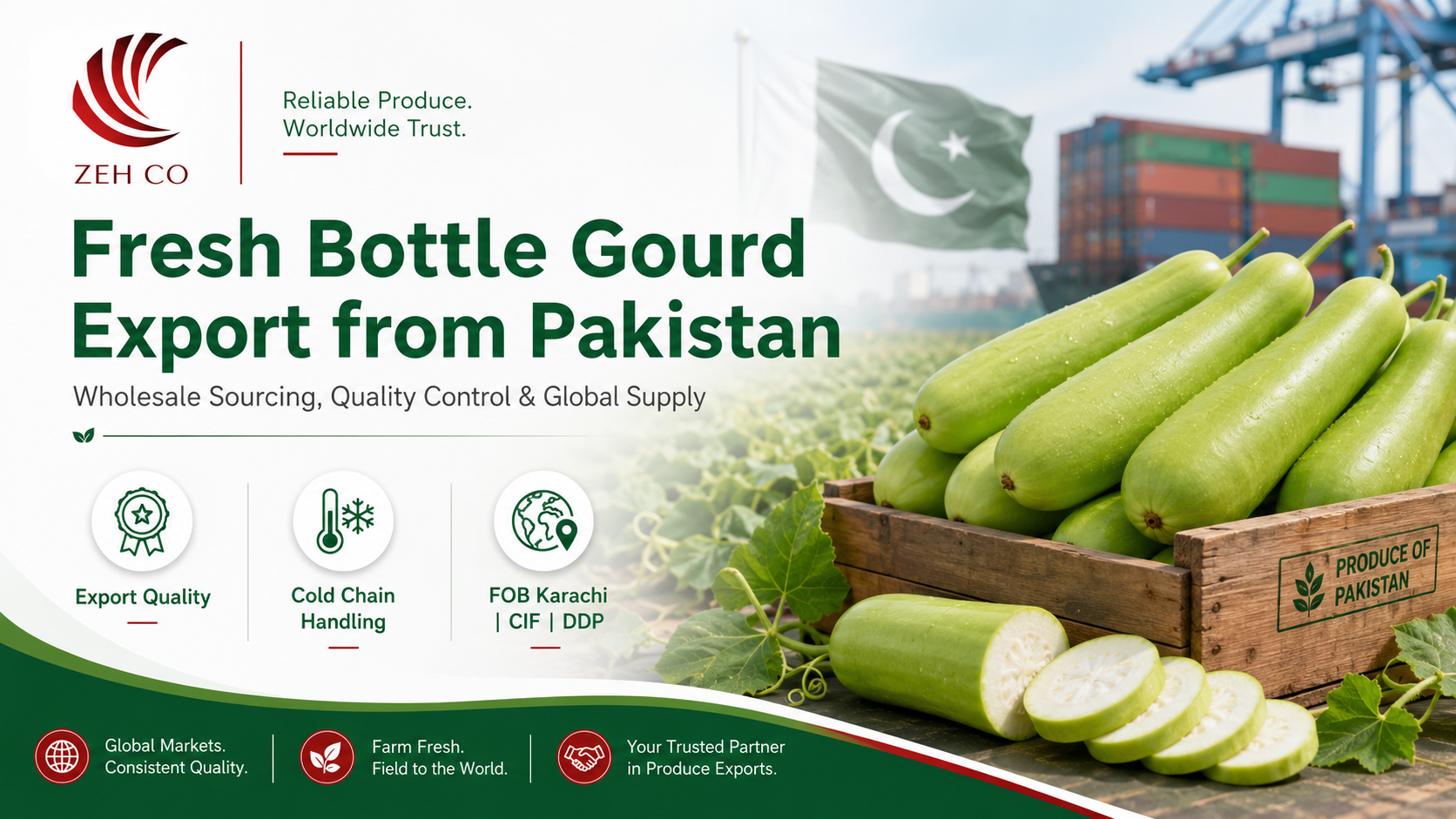
Fresh bottle gourd export from Pakistan gives international wholesalers access to a familiar South Asian vegetable that serves ethnic supermarkets, fresh produce distributors, restaurants, catering suppliers and foodservice buyers. Commonly known as lauki, dudhi or calabash, bottle gourd is highly perishable and must be purchased through a specification-led process. Importers should evaluate maturity, appearance, residue compliance, pack-house hygiene, packaging strength, transit time and temperature management before confirming a commercial order.
Why Importers Source Fresh Bottle Gourd from Pakistan
Pakistan has established farming and trading networks for cucurbit vegetables, including bottle gourd, bitter gourd, pumpkin, cucumber and related produce. For overseas buyers, the commercial advantage is not simply availability; it is the ability to consolidate bottle gourd with other Pakistani vegetables under one procurement program. Mixed vegetable orders can reduce supplier-management work and help distributors maintain a broader assortment for South Asian, Middle Eastern and multicultural retail markets.
Bottle gourd demand is usually driven by communities that use it in curries, stews, lentil dishes, soups and prepared foods. Because buyers often sell it as a fresh specialty vegetable rather than a long-storage commodity, consistency and speed are more important than purchasing the lowest farm-gate price. A reliable exporter must coordinate harvesting, grading, packing, documentation and dispatch so that the product arrives with acceptable firmness and marketable appearance.
Fresh Bottle Gourd Export from Pakistan: Buyer Specifications
A purchase contract should describe the required product in measurable terms. Broad instructions such as “export quality” create room for disagreement because size, maturity and appearance preferences differ by market. The importer should approve a written specification, reference photographs and packaging format before production is allocated.
Maturity and External Appearance
Export-grade bottle gourds should generally be young, tender and firm, with a fresh green surface suitable for the destination market. Buyers commonly reject fruit showing excessive maturity, hard seeds, yellowing, shrivelling, soft areas, cracks, cuts, bruising, insect damage, decay or heavy surface marks. The stem condition, skin colour and firmness should be checked during grading because these indicators influence shelf presentation.
Size, Shape and Count
Bottle gourds can vary considerably in length, diameter, shape and unit weight. The buyer should therefore specify an acceptable size range and whether the order requires long straight gourds, medium-sized units or a mixed commercial grade. Carton count alone is not sufficient unless the permitted net weight and unit-size tolerance are also stated. A pre-shipment sample or packing photograph helps both parties confirm expectations before loading.
Residue and Food-Safety Requirements
Pesticide maximum residue limits are destination-specific. Importers should provide the applicable market standard, any restricted active-ingredient list and the required laboratory-testing protocol before the crop is packed. The exporter should maintain farm or supplier traceability, spray records where available, lot identification and test reports requested in the sales contract. Under the WTO Sanitary and Phytosanitary framework, importing countries may establish science-based food-safety and plant-health measures, so the destination requirement must be checked for every program rather than assumed from a previous shipment.
Harvesting and Pack-House Quality Control
Harvest timing has a direct effect on tenderness, appearance and transit performance. Bottle gourds intended for export should be harvested carefully to avoid skin punctures and compression damage. Produce should be protected from direct sunlight after harvesting and transferred promptly to a clean handling area. FAO post-harvest guidance notes that exposure to high temperatures can reduce the marketable life of fresh produce, making field shade and rapid movement into the packing process commercially important.
At the pack house, the consignment should pass through receiving inspection, sorting, trimming where required, cleaning under an approved hygiene procedure, surface drying, grading, weighing and packing. Damaged or overmature units should be removed instead of being hidden in lower carton layers. The lot code should connect the final package to the packing date, supplier or farm group and inspection record.
Hygiene Controls
Fresh vegetables can be contaminated through soil, water, dirty equipment, packaging surfaces or poor worker hygiene. Exporters should use potable or otherwise suitable water where washing is part of the process, maintain clean food-contact surfaces, control pests in the packing area and prevent finished cartons from contacting dirty floors. Codex maintains a specific Code of Hygienic Practice for Fresh Fruits and Vegetables, providing a useful international reference for primary production and post-harvest handling systems.
Inspection Evidence for the Buyer
Professional importers should request a practical pre-shipment evidence pack. This may include dated photographs or videos of the actual lot, random carton weight checks, size measurements, packing-list quantities, carton markings, lot codes, temperature records where applicable and laboratory reports agreed upon in the contract. Independent inspection can also be arranged for higher-value orders or first transactions.
Packaging Requirements for Bottle Gourd Shipments
Packaging must protect the product from pressure, abrasion, moisture damage and excessive movement while allowing suitable ventilation. Depending on the destination and transport method, exporters may use ventilated corrugated cartons, produce boxes or buyer-approved reusable plastic crates. Internal paper, sleeves or separators may be considered when the surface is easily marked, but every packaging addition should be tested for ventilation and moisture behaviour.
Overfilling cartons can bend or bruise the gourds, while underfilling allows movement during handling. Carton strength must match pallet stacking, humidity exposure and the total distribution route. FAO packaging guidance identifies containment, protection and communication as core packaging functions and emphasizes resistance to cold-storage and moisture conditions in fresh produce supply chains.
Recommended Carton Markings
- Product name: Fresh Bottle Gourd or the destination-market name
- Country of origin: Pakistan
- Exporter and importer identification
- Net weight and, where required, gross weight
- Pack date or production code
- Lot or traceability code
- Storage and handling instructions
- Any mandatory language, barcode or regulatory marks required by the buyer
Cold Chain and Transport Planning
Cold-chain planning should be based on the product condition, packaging, shipment duration, destination climate and buyer’s distribution system. A temperature setting should never be copied blindly from another vegetable because different crops respond differently to low-temperature exposure. The exporter and importer should agree on the target handling range after reviewing product trials, route duration and the receiving market’s operating conditions.
The most important controls are removing field heat appropriately, avoiding long delays at ambient temperature, maintaining airflow, preventing condensation from uncontrolled temperature changes and recording conditions during transit when required. Temperature loggers can provide objective evidence, particularly for trial consignments. The importer should also confirm receiving procedures because a well-managed export journey can still be compromised by clearance delays, unrefrigerated staging or slow movement into distribution.
Air Freight
Air freight is suitable for urgent programs, premium retail demand, smaller consignments and markets where short transit time is essential. Buyers should compare the higher freight cost with the expected freshness, selling price and reduced inventory risk. Carton dimensions and chargeable weight must be considered when negotiating the delivered price.
Sea Freight and Regional Movement
Sea freight may be commercially attractive for larger volumes, but it requires validated shelf-life performance, suitable reefer planning, strong packaging and predictable clearance. Nearby regional destinations may also be served through multimodal or road-linked routes where legally and operationally available. Before scaling, the parties should conduct a trial shipment using the exact variety, maturity, pack style and route planned for regular orders.
Export Documentation and Phytosanitary Compliance
Fresh vegetable exports must comply with the importing country’s plant-health conditions. Pakistan’s Department of Plant Protection states that export procedures include fulfilling the phytosanitary requirements of the destination market, while plant exports are regulated through phytosanitary certificates issued according to importing-country requirements and relevant trade arrangements.
The exact document set depends on the destination, payment method and shipment mode, but a commercial file may include the sales contract or purchase order, commercial invoice, packing list, phytosanitary certificate, certificate of origin, airway bill or bill of lading, inspection or laboratory certificates, and any import permit or additional declaration required by the buyer’s authorities. Importers should verify permit conditions before dispatch because a certificate issued at origin cannot correct a missing market-access requirement after arrival.
How Buyers Should Request a Commercial Quotation
A useful request for quotation should contain enough information for the exporter to calculate product, packaging, compliance and logistics costs accurately. Buyers should provide the destination city and port or airport, required weekly or monthly quantity, preferred size and grade, net weight per package, packaging material, label design, pallet requirement, residue-testing standard, shipment mode, Incoterm and target delivery schedule.
Prices may change with crop availability, quality grade, packing material, labour, inland transport, air or ocean freight and documentation requirements. For this reason, buyers should compare quotations based on the same specification and Incoterm. A low FOB price cannot be compared directly with a CIF or DDP offer that includes additional freight, insurance, clearance coordination or delivery responsibilities.
Suggested Trial-Order Checklist
- Approve the written quality specification and reference images.
- Confirm carton size, net weight, ventilation and label artwork.
- Verify import permits, phytosanitary conditions and residue limits.
- Agree on the inspection method and acceptable tolerance.
- Confirm the Incoterm, payment terms and claim procedure.
- Use a temperature logger when cold-chain performance must be validated.
- Review arrival condition before increasing recurring volume.
Common Import Risks and How to Reduce Them
One of the most common risks is a difference between the buyer’s expected size and the exporter’s commercial grade. This problem can be reduced by including permitted length, diameter, unit weight and carton-weight tolerances in the purchase order. Reference photographs should show both acceptable and unacceptable products.
Another risk is loss of firmness or appearance during transit. Importers should examine the complete route rather than focusing only on flight or sailing time. Farm-to-pack-house movement, waiting time before loading, customs clearance, airport or port handling and final distribution all affect arrival quality.
Packaging failure can also cause avoidable claims. A carton that performs well in a small sample may collapse when palletized, exposed to humidity or stacked for a longer journey. Exporters should test the complete package under realistic loading conditions and ensure that ventilation openings remain unobstructed.
Documentation errors can delay clearance and reduce the remaining selling period. Product descriptions, weights, package counts, consignee details and certificate information should be reviewed against the purchase order before dispatch. Any destination-specific import permit or additional declaration should be shared with the exporter early enough to arrange inspection and certification.
Payment Terms and Claim Management
Payment terms should reflect order value, transaction history, product perishability and the responsibilities assigned under the selected Incoterm. First-time buyers and exporters may use an advance payment, a partial advance with balance against shipping documents, a letter of credit or another mutually accepted banking arrangement.
The contract should also define how quality claims will be handled. It should state the inspection deadline after arrival, evidence required from the buyer, sampling method, acceptable tolerance and whether the product must be preserved for an independent survey. Claims supported only by selected photographs can be difficult to evaluate, so buyers should provide carton numbers, lot codes, weight records, temperature data and representative evidence.
Because fresh produce naturally changes after harvesting, responsibility must be linked to the agreed specification, shipment condition and Incoterm. A clear written claim procedure protects both parties and supports a long-term trading relationship.
Why Work with ZEH Co
ZEH Co is a Pakistan-based B2B exporter established in 2011, serving international importers, wholesale buyers and procurement teams. The company can coordinate fresh produce sourcing with quality, packing and export-documentation requirements and offers commercial terms including FOB Karachi, CIF and DDP, subject to destination feasibility and order details.
For buyers managing multiple product categories, ZEH Co can also discuss consolidated sourcing across Pakistani fruits, vegetables, grains, Himalayan salt, leather, textiles, gloves and humanitarian supplies. This broader portfolio can simplify supplier communication, although every fresh produce item should retain its own quality specification, traceability and shipping plan.
Before providing a detailed offer, ZEH Co may request the buyer’s required quantity, destination, preferred grade, package size, shipment method and applicable import requirements. Supplying these details enables the exporter to prepare a more accurate quotation and recommend a suitable trial-shipment plan.
Conclusion: Building a Reliable Fresh Bottle Gourd Supply Program
A successful fresh bottle gourd export from Pakistan program depends on clearly defined maturity, size, appearance, residue, packaging and transit standards. Importers should begin with a controlled trial, evaluate arrival quality and document every agreed specification before moving to recurring shipments. By combining disciplined farm selection, pack-house inspection, phytosanitary compliance, suitable packaging and realistic logistics planning, buyers can reduce claims and build a more dependable wholesale supply chain with ZEH Co.