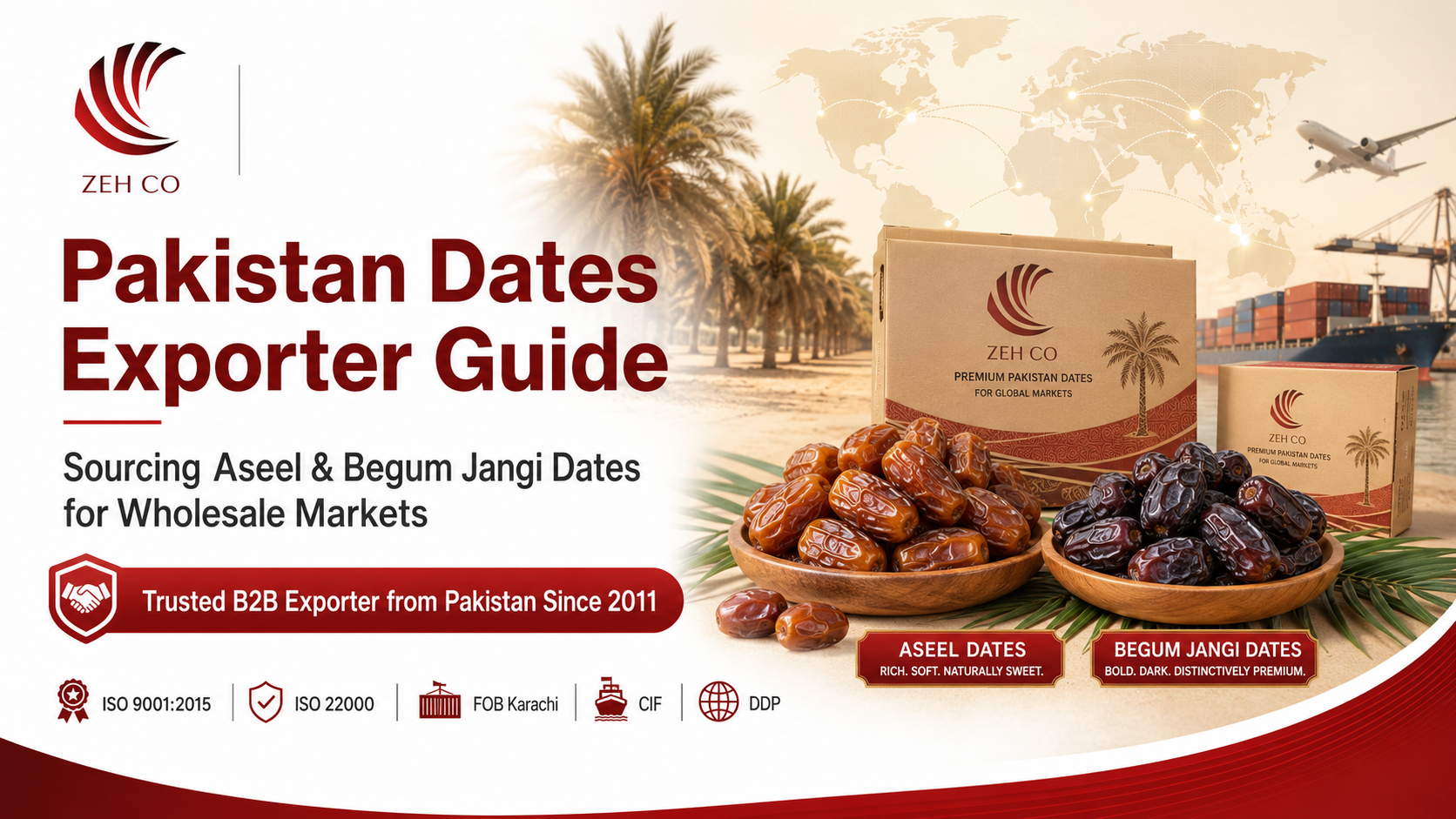
Choosing the right Pakistan dates exporter is essential for importers that require consistent quality, reliable packaging, proper documentation, and commercially workable shipping terms. Pakistan produces several date varieties suitable for wholesale distribution, food processing, retail packing, confectionery production, and seasonal demand during Ramadan. Among the most commercially relevant varieties are Aseel dates from Sindh and Begum Jangi dates commonly associated with the date-growing regions of Balochistan.
International buyers should evaluate more than price when purchasing dates in bulk. Variety, moisture level, size, maturity, defect tolerance, packaging format, shelf-life expectations, destination-country regulations, and shipment conditions can all affect the final value of an order. This guide explains the main factors importers should review before sourcing Pakistani dates.
Why Work with a Pakistan Dates Exporter?
Pakistan has established date-growing regions with access to both semi-dry and dry date varieties. This allows suppliers to serve different buyer segments, including wholesale food distributors, supermarkets, ethnic grocery chains, ingredient manufacturers, bakeries, hospitality suppliers, and private-label brands.
A professional exporter can coordinate sourcing, sorting, processing, packing, inspection, export documentation, and freight arrangements through one supply channel. This is particularly valuable for international importers that cannot directly supervise farms, packing facilities, inland transportation, and port procedures in Pakistan.
Buyers can also choose shipping arrangements according to their operational model. ZEH Co offers FOB Karachi, CIF, and DDP terms, subject to destination, order size, product specifications, and applicable import requirements. Clear Incoterms help both parties define responsibility for freight, insurance, customs clearance, and delivery.
Main Pakistani Date Varieties for Wholesale Buyers
Aseel Dates
Aseel is one of Pakistan’s most commercially important date varieties. It is primarily associated with Sindh and is valued for its naturally sweet flavour, elongated shape, firm texture, and suitability for both direct consumption and industrial processing.
Depending on harvesting stage and processing method, Aseel dates may be supplied in different moisture and texture categories. Softer grades can be sold for retail consumption, while firmer or drier grades may be preferred for pitting, chopping, paste production, bakery ingredients, energy bars, syrups, and confectionery manufacturing.
Aseel dates can also be processed into value-added products such as date paste, diced dates, pressed date blocks, pitted dates, date powder, and bulk ingredients. Importers planning further processing should provide exact requirements for moisture, pit tolerance, particle size, texture, and packaging.
Begum Jangi Dates
Begum Jangi is a distinctive Pakistani date variety commonly sourced from Balochistan. It is generally recognised for its rich taste, firm body, and attractive natural appearance. The variety can appeal to buyers seeking traditional Pakistani dates for wholesale markets, specialty retail channels, seasonal promotions, and ethnic food distribution.
Because agricultural products naturally vary by crop, location, harvesting period, and storage method, importers should approve recent samples or shipment photographs before confirming a large order. Commercial specifications should be agreed in writing rather than relying only on the variety name.
How Importers Should Define Date Quality Specifications
A quotation for bulk dates is only useful when the requested quality is clearly defined. Two offers for the same variety may differ significantly because of size, moisture, cleanliness, crop condition, defect allowance, packing material, processing level, and inspection requirements.
Wholesale buyers should specify the following points when requesting an offer:
- Variety: Aseel, Begum Jangi, or another requested Pakistani variety.
- Product form: Whole dates, pitted dates, pressed blocks, chopped dates, paste, powder, or another processed format.
- Texture: Soft, semi-dry, or dry, depending on the intended market.
- Size grade: Small, medium, large, or a defined count or weight range.
- Moisture requirement: Especially important for processing performance and shelf stability.
- Defect tolerance: Limits for damaged, discoloured, crushed, immature, fermented, or insect-affected fruit.
- Pit tolerance: Required for pitted or processed dates.
- Crop year: Current crop or another agreed production period.
- Packaging: Bulk cartons, food-grade bags, retail packs, or private-label packaging.
- Destination standards: Labelling, language, testing, pallet, and documentation requirements.
A detailed specification sheet reduces misunderstandings and enables suppliers to quote a product that matches the buyer’s actual application. Importers purchasing dates for industrial processing may prioritise moisture consistency and price, while premium retail buyers may focus more heavily on appearance, uniformity, skin condition, and presentation.
Sorting, Cleaning and Quality-Control Requirements
Dates intended for export should pass through an organised sorting and handling process. The exact procedure depends on the product form and buyer requirements, but it may include receiving inspection, removal of foreign material, visual sorting, size grading, cleaning, pitting, moisture adjustment, metal detection, packing, carton coding, and final inspection.
Importers should ask how the exporter controls contamination risks, damaged fruit, insects, foreign matter, packaging integrity, and lot traceability. Where required, laboratory testing can be arranged according to the product, destination, and agreed contract. Test requirements may include microbiological parameters, pesticide residues, moisture, or other food-safety criteria requested by the importing country or customer.
ZEH Co operates under an export supply framework supported by ISO 9001:2015 and ISO 22000 certifications. Buyers should nevertheless communicate all market-specific standards before production because certification does not replace destination-country regulations, customer specifications, or shipment-level inspection requirements.
Bulk Packaging and Private-Label Options
Packaging affects product protection, storage efficiency, freight cost, shelf presentation, and customer acceptance. Bulk buyers commonly request food-grade inner liners packed inside export cartons. The final carton weight should be selected according to handling practices, warehouse requirements, and the risk of compression during transport.
Retail-focused importers may require smaller consumer packs with customised branding. Depending on order quantity and packaging availability, private-label options may include printed pouches, trays, tubs, boxes, stickers, barcode labels, nutritional information, and multilingual product descriptions.
Before printing private-label packaging, the importer should approve the artwork, product name, net weight, ingredients, origin statement, storage instructions, nutritional panel, barcode, importer details, date format, and mandatory destination-country declarations. Packaging production should not begin until all regulatory text has been confirmed by the buyer.
Common Packaging Considerations
- Food-grade materials suitable for direct contact with dates
- Strong outer cartons for stacking and container movement
- Inner protection against moisture, dust, and contamination
- Lot numbers and production or packing dates for traceability
- Ventilation or sealing selected according to product condition
- Pallet configuration compatible with buyer warehouses
- Retail labelling that complies with the destination market
Shipping Pakistani Dates to International Markets
Dates are generally more stable than highly perishable fresh fruit, but shipment planning remains important. Product moisture, packing type, storage history, container condition, transit time, climate, and destination handling can influence quality on arrival.
For commercial sea shipments, buyers should confirm whether a standard dry container or temperature-controlled solution is appropriate for the selected product. The decision should be based on the date variety, moisture level, season, route, expected transit time, and customer shelf-life requirements.
Air freight may be considered for samples, urgent orders, premium retail launches, or limited seasonal quantities. However, air cargo has a higher cost per kilogram, so the commercial viability should be assessed against product value and delivery urgency.
ZEH Co can quote on FOB Karachi for buyers managing their own international freight, CIF for buyers requiring freight and insurance to the destination port, or DDP where operationally available and legally workable. Buyers should identify the destination port, airport, or delivery address when requesting a freight-inclusive quotation.
Export Documents Buyers May Require
Documentation requirements vary by destination, payment method, product format, and customer. Providing the final document list before shipment helps prevent clearance delays and discrepancies between shipping papers and import permits.
A typical dates export shipment may require:
- Commercial invoice
- Packing list
- Certificate of origin
- Bill of lading or air waybill
- Phytosanitary certificate where applicable
- Fumigation certificate where required
- Health or sanitary documentation where applicable
- Insurance certificate under relevant shipping terms
- Laboratory report or certificate of analysis when agreed
- Halal certificate if requested by the buyer or market
The importer remains responsible for confirming the current import rules in the destination country. Product registration, label approval, import permits, maximum residue limits, food-safety standards, and documentary requirements should be checked before the exporter prepares the shipment.
Questions to Ask Before Confirming a Dates Order
A reliable purchasing decision requires commercial and technical verification. Buyers should request a formal quotation containing enough detail to compare offers accurately.
- Which crop and production area will supply the order?
- Is the quoted product whole, pitted, cleaned, graded, or processed?
- What moisture, size, and defect specifications are included?
- What is the minimum order quantity?
- What bulk and retail packaging options are available?
- Can a sample or recent product video be provided?
- What is the production and packing lead time?
- Which inspections or laboratory tests are included in the price?
- What payment terms are available?
- Which Incoterm and destination are covered by the quotation?
- What documents will be issued with the shipment?
- How will complaints or specification differences be handled?
Importers should avoid selecting a supplier solely on the lowest price. An unusually low quotation may exclude grading, testing, export-standard cartons, documentation, inland logistics, palletisation, or other services needed for a successful shipment.
How ZEH Co Supports International Dates Buyers
ZEH Co is a Pakistan-based B2B export company established in 2011. The company works with international importers, wholesalers, distributors, procurement teams, and private-label buyers across the UAE, China, Germany, Italy, the United Kingdom, the United States, Russia, South Korea, Vietnam, Turkey, and other markets.
For dates inquiries, buyers can submit their required variety, quantity, grade, packaging, destination, and preferred Incoterm. The sourcing team can then evaluate product availability, suitable processing options, packing requirements, shipment planning, and commercial feasibility.
For the most accurate offer, importers should include their company profile, destination country, estimated order volume, target price level, preferred packaging, required certificates, and intended product use. This information helps distinguish whether the order is intended for premium retail, wholesale distribution, food service, repacking, or industrial processing.
Conclusion: Choosing a Reliable Pakistan Dates Exporter
Working with an experienced Pakistan dates exporter gives international buyers better control over variety selection, commercial grading, quality standards, packaging, documentation, and logistics. Aseel dates are particularly versatile for retail and processing applications, while Begum Jangi dates can provide a distinctive option for traditional and specialty markets.
Successful sourcing begins with a precise specification. Buyers should define the variety, product form, moisture, size, defect tolerance, packaging, testing, destination regulations, and shipping terms before confirming an order. ZEH Co supports wholesale dates sourcing from Pakistan with FOB Karachi, CIF, and DDP options based on the buyer’s destination and commercial requirements.