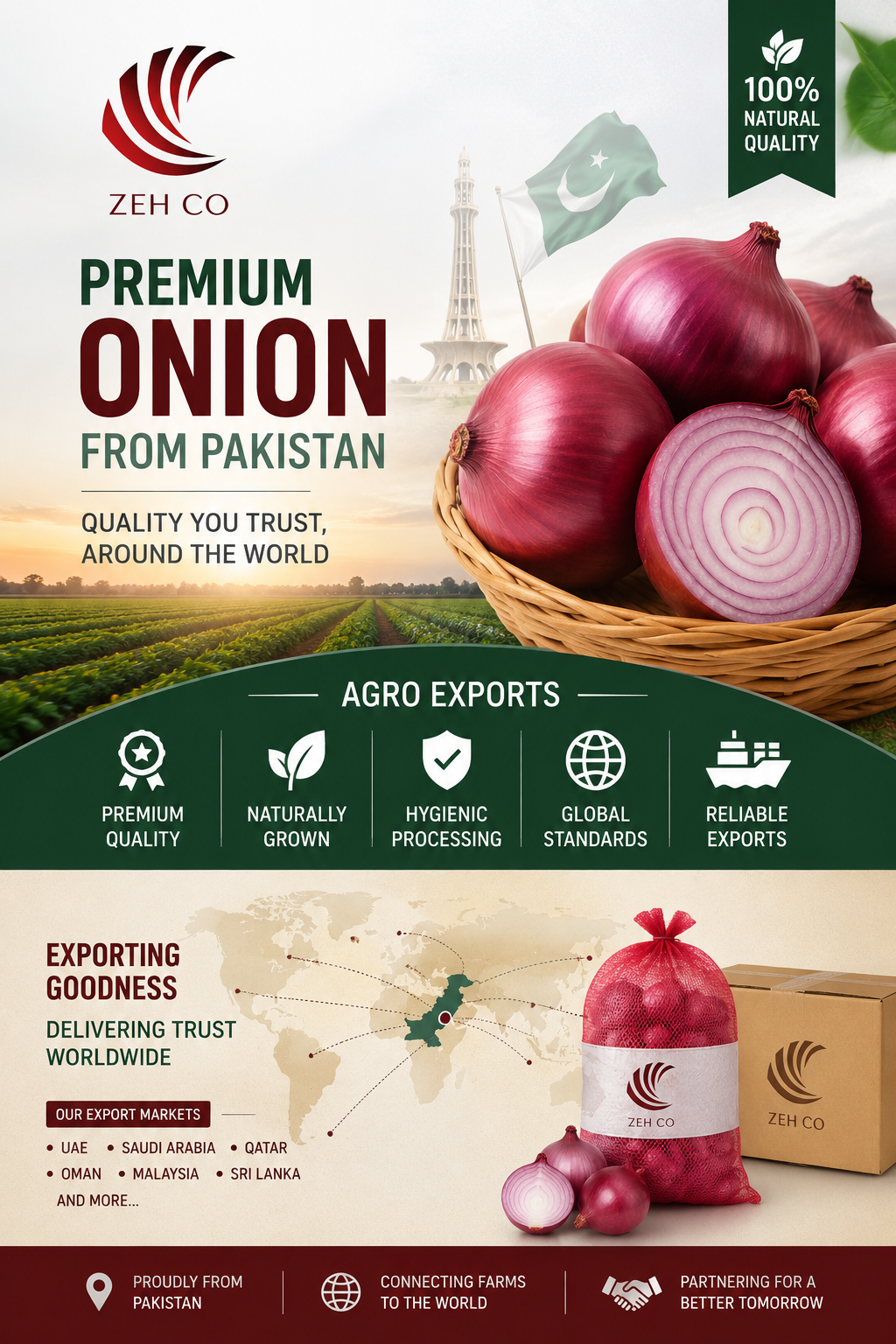
Fresh red onion export from Pakistan provides international importers, food distributors, supermarket suppliers, and wholesale produce traders with access to a widely consumed vegetable suitable for retail, foodservice, processing, and institutional markets. Pakistan’s onion-producing regions can supply commercially attractive red onions with firm bulbs, strong color, and flexible packaging options. However, successful importing depends on more than obtaining a competitive quotation. Buyers must carefully define size, maturity, curing, packaging, inspection, shipping, and documentation requirements before confirming an order.
This guide explains the main commercial factors international buyers should evaluate when sourcing Pakistani red onions. It also outlines how ZEH Co International supports B2B customers through product coordination, export documentation, quality checks, and shipping arrangements under FOB Karachi, CIF, and DDP terms.
Why Importers Source Red Onions from Pakistan
Red onions are an essential food commodity used by households, restaurants, catering companies, vegetable processors, and food manufacturers. They are purchased throughout the year for fresh consumption, cooking, pickling, dehydration, sauce production, and prepared-food applications. This broad demand makes onions an important category for produce importers seeking products with consistent turnover.
Pakistan has established agricultural production areas in Sindh, Balochistan, Punjab, and other regions. Harvest timing varies by location, helping exporters coordinate supplies from different production zones. For overseas buyers, this regional diversity can provide additional sourcing opportunities when local crops are unavailable, domestic prices increase, or alternative origins face seasonal supply gaps.
Pakistani red onions are generally recognized for their reddish-purple outer skin, pungent flavor, and suitability for wholesale vegetable markets. Product characteristics can vary by variety, growing area, harvest period, curing method, and post-harvest handling. Importers should therefore purchase according to an agreed specification rather than relying only on the general description “red onion.”
Fresh Red Onion Export from Pakistan: Key Quality Requirements
Quality expectations differ between wholesale markets, supermarkets, foodservice distributors, and processing companies. A shipment accepted in a traditional produce market may not meet the presentation standards of a premium retail chain. A detailed product specification helps the exporter select, grade, pack, and inspect onions according to the buyer’s intended sales channel.
Bulb Firmness and Maturity
Export-quality onions should have mature, firm bulbs that can tolerate handling and transportation. Soft bulbs may indicate physical damage, excessive moisture, disease, internal deterioration, or insufficient curing. Immature onions often have weak skins and necks that have not closed properly, increasing the risk of moisture loss and decay.
Buyers should request onions with dry outer skins, closed necks, and no active sprouting. The bulbs should feel solid when handled and should not show significant compression damage. For longer transit routes, maturity and firmness are especially important because the product must remain commercially acceptable throughout loading, shipping, customs clearance, and distribution.
Color and External Appearance
Red onion buyers commonly expect a reasonably uniform reddish or purple skin color. Natural color variation may occur, but heavily discolored, peeled, sunburned, or stained bulbs can reduce retail appeal. The external skin should be sufficiently dry and intact to protect the inner layers during transport.
Importers selling through supermarkets may require stronger color uniformity and cleaner presentation. Wholesale market buyers may accept a broader visual range if the onions remain firm and sound. These expectations should be agreed before packing to prevent disputes after arrival.
Freedom from Defects
Commercial export shipments should be checked for visible rot, mold, deep cuts, insect damage, excessive soil, sprouting, wet necks, and severe mechanical injury. Minor skin removal can occur during grading and bag handling, but excessive peeling exposes the bulb and can shorten shelf life.
Buyers should define the acceptable tolerance for undersized bulbs, misshapen onions, doubles, skin loss, surface marks, and other defects. A written tolerance is more useful than general terms such as “good quality” or “export quality,” which different parties may interpret differently.
Red Onion Sizes and Commercial Grading
Onion size affects pricing, packaging efficiency, retail presentation, and end use. Importers should specify the required diameter range in millimeters whenever possible. General descriptions such as small, medium, or large may create confusion because size categories can differ between countries and markets.
- Small bulbs: Often purchased for pickling, food processing, mixed vegetable packs, or price-sensitive wholesale markets.
- Medium bulbs: Commonly suitable for household retail, foodservice supply, and general wholesale distribution.
- Large bulbs: Frequently preferred by hotels, restaurants, catering companies, processors, and selected retail customers.
- Mixed size: May offer a lower purchase price but can reduce consistency and complicate resale to specification-sensitive customers.
Uniform sizing improves the appearance of the shipment and allows the importer to sell the product into a clearly defined market segment. It can also support more accurate yield calculations for processors. Buyers should confirm whether grading will be manual, mechanical, or a combination of both and whether the quoted price includes sorting to the required size range.
The Importance of Proper Onion Curing
Curing is one of the most important post-harvest steps in onion export. After harvesting, onions must be dried under suitable conditions so the outer skins become protective and the neck tissues lose moisture. Proper curing reduces the risk of neck rot, surface mold, premature sprouting, and moisture-related deterioration.
Onions packed before they are sufficiently cured may generate heat and moisture inside the bags or containers. This can lead to condensation, unpleasant odor, soft bulbs, and rapid quality loss. For this reason, importers should ask suppliers about harvest timing, curing duration, storage conditions, and the condition of the onions at the time of packing.
Curing does not correct damaged or diseased produce. Exporters must still remove unsuitable bulbs during sorting. A properly cured shipment should contain onions that are dry to the touch, adequately skinned, firm, and free from excessive field moisture.
Packaging Options for Wholesale Red Onion Shipments
Packaging must provide ventilation while protecting the onions from excessive pressure, contamination, and handling damage. The correct pack depends on the destination market, customer type, transport method, and local labeling requirements.
Ventilated Mesh Bags
Mesh bags are widely used for onion exports because they allow air to circulate around the bulbs. Common commercial pack sizes may include smaller retail-oriented bags and larger wholesale bags. The exact net weight should be agreed with the buyer and verified during packing.
Mesh strength is important. Weak bags can tear during loading, unloading, or market handling, leading to product loss and claims. Buyers should confirm the bag material, stitching quality, closure method, color, and whether handles or branded labels are required.
Jute or Woven Bags
Jute and woven polypropylene bags may be used for traditional wholesale channels, depending on buyer preference and destination requirements. These packs can be practical for bulk market handling, but ventilation and bag cleanliness must be considered. Overfilled bags may compress the onions and increase bruising.
Cartons and Retail Packs
Cartons can provide better presentation and stacking control for premium customers, although they generally involve higher packaging costs. Retail packs may include branded mesh bags, labels, barcodes, importer details, country-of-origin statements, and customized net weights.
Private-label buyers should provide approved artwork and labeling instructions before production. Packaging text must comply with the regulations of the destination country, including language, weight declaration, traceability information, and importer identification where required.
Pre-Shipment Inspection and Quality Verification
A structured inspection process reduces risk for both buyer and exporter. Inspection should take place close to the loading date so the report reflects the condition of the actual shipment rather than an earlier sample.
- Verify onion variety, origin, and crop condition.
- Check size range and grading consistency.
- Assess firmness, skin condition, neck closure, and visible moisture.
- Remove rotten, sprouted, cut, moldy, or severely damaged bulbs.
- Confirm bag quality, net weight, markings, and total package count.
- Inspect container cleanliness, odor, floor condition, and ventilation suitability.
- Record loading through photographs, videos, weight slips, and inspection notes.
Importers may appoint an independent inspection company when required by their internal procurement policy, financing arrangement, or destination regulations. The sales contract should clearly state who is responsible for inspection costs and what happens if the goods do not meet the agreed specification before loading.
Container Loading and Transport Considerations
Onions are living agricultural products that continue to release heat and moisture after harvest. Poor airflow, wet packaging, excessive stacking pressure, or exposure to unsuitable temperatures can damage the cargo. Container selection and loading practices should therefore be based on the route, transit time, weather conditions, and product condition.
Ventilated transport may be appropriate for many onion shipments because it helps remove heat and moisture. Refrigerated transport may be considered for specific routes or customer requirements, but temperature and ventilation settings must be professionally planned. Incorrect refrigeration can create condensation or other quality problems.
Bags should be arranged to support airflow and stable weight distribution. The loading team should avoid crushing lower layers and should not place wet, contaminated, or damaged bags inside the container. Doors should be secured properly, and the final package count should match the packing list.
Documents Required for Onion Imports
Documentation requirements depend on the destination country, buyer, payment method, and shipping terms. Importers should confirm all regulatory requirements before the supplier begins packing because missing documents can cause customs delays, storage charges, rejection, or re-export costs.
- Commercial invoice: Shows the buyer, seller, product description, quantity, price, currency, and trade terms.
- Packing list: Provides bag count, net weight, gross weight, and packaging details.
- Bill of lading or airway bill: Serves as the main transport document.
- Certificate of origin: Confirms that the onions originate from Pakistan.
- Phytosanitary certificate: Confirms inspection under applicable plant-health requirements.
- Fumigation or treatment certificate: Supplied when required by the destination or buyer.
- Inspection certificate: Issued when independent or contractual inspection is requested.
- Insurance certificate: Relevant when insurance is included under the agreed shipping term.
The product description should remain consistent across all documents. Differences in weight, package count, consignee details, product name, or shipping marks can create avoidable clearance problems.
FOB, CIF, and DDP Purchasing Options
ZEH Co International can coordinate red onion shipments under different Incoterms according to the buyer’s preferred level of logistics responsibility.
FOB Karachi
Under an FOB arrangement, the exporter manages sourcing, packing, documentation, inland transportation, export clearance, and loading onto the nominated vessel at Karachi. The buyer generally arranges the main ocean freight, destination insurance if needed, customs clearance, and inland delivery after arrival.
CIF Destination Port
Under CIF terms, the exporter arranges ocean freight and insurance to the named destination port in addition to export-side responsibilities. The buyer remains responsible for import clearance, destination port charges, duties, taxes, and onward transportation unless otherwise agreed.
DDP Delivery
DDP can provide a more comprehensive delivery solution, subject to the destination country, product regulations, customs structure, and availability of suitable logistics partners. Buyers requesting DDP should provide the complete delivery address, importer requirements, expected quantity, and local clearance details for feasibility assessment.
How to Request an Accurate Wholesale Quotation
An effective inquiry should include enough information for the exporter to calculate product, packaging, inland transport, documentation, freight, and inspection costs. Requests that only ask for “best onion price” may receive an indicative figure that cannot be used as a final commercial offer.
- Required onion type or variety
- Preferred bulb diameter or size range
- Acceptable quality grade and defect tolerance
- Packaging type and net weight per bag or carton
- Estimated order quantity or number of containers
- Destination port or complete DDP address
- Preferred Incoterm: FOB, CIF, or DDP
- Required shipment window
- Labeling, inspection, and documentation requirements
- Preferred payment method
Fresh produce prices can change because of crop availability, weather, domestic demand, grading yield, packaging costs, exchange rates, and freight conditions. Quotations should therefore include a validity period. Buyers should also confirm whether the price is based on the current crop, a future shipment window, or stock already available for packing.
Managing Common Risks in Red Onion Imports
Quality Differences Between Sample and Shipment
A small sample may not represent the full commercial lot. Buyers should approve a written specification and request inspection evidence from the packed shipment. Reference photographs are useful, but measurable criteria such as size, weight, defect tolerance, and packaging strength provide better protection.
Moisture and Decay During Transit
This risk can be reduced through proper curing, dry packaging, removal of damaged bulbs, appropriate ventilation, clean containers, and realistic transit planning. Loading freshly harvested or wet onions simply to meet an urgent vessel schedule can create larger losses after arrival.
Weight Shortage
Natural moisture loss may occur during transport, but accurate weighing and packaging controls are still essential. Buyers should agree whether the commercial invoice is based on packed net weight, certified weight, or another contractual basis.
Unexpected Destination Charges
Importers should review the selected Incoterm and obtain a destination charge estimate before shipment. Port handling, customs examination, demurrage, detention, taxes, inspection fees, and inland delivery are not automatically included in every quotation.
Why Work with ZEH Co International
ZEH Co International is a Pakistan-based B2B exporter established in 2011 and serves international importers, wholesalers, distributors, and procurement companies. The company coordinates agricultural sourcing, product inspection, packaging, documentation, and international shipping according to customer requirements.
ZEH Co supports shipments under FOB Karachi, CIF, and DDP terms where feasible. Its management systems are supported by ISO 9001:2015 and ISO 22000 certifications. Buyers can request quotations for wholesale quantities, customized packaging, shipment documentation, and destination-specific logistics planning.
For red onion orders, ZEH Co works with buyers to define the required size, quality grade, pack weight, shipment schedule, and inspection procedure before loading. This specification-based approach helps reduce misunderstandings and supports more reliable long-term procurement relationships.
Conclusion
Fresh red onion export from Pakistan can offer valuable sourcing opportunities for wholesalers, produce distributors, retailers, foodservice companies, and vegetable processors. The success of an onion shipment depends on mature and properly cured bulbs, accurate size grading, ventilated packaging, careful inspection, suitable container loading, and complete export documentation.
International buyers should provide clear specifications and evaluate quotations on total delivered value rather than product price alone. By confirming quality tolerances, packaging, shipping terms, and inspection procedures before purchase, importers can reduce risk and improve consistency. ZEH Co International is available to coordinate wholesale red onion sourcing from Pakistan under FOB Karachi, CIF, and DDP arrangements for qualified international buyers.