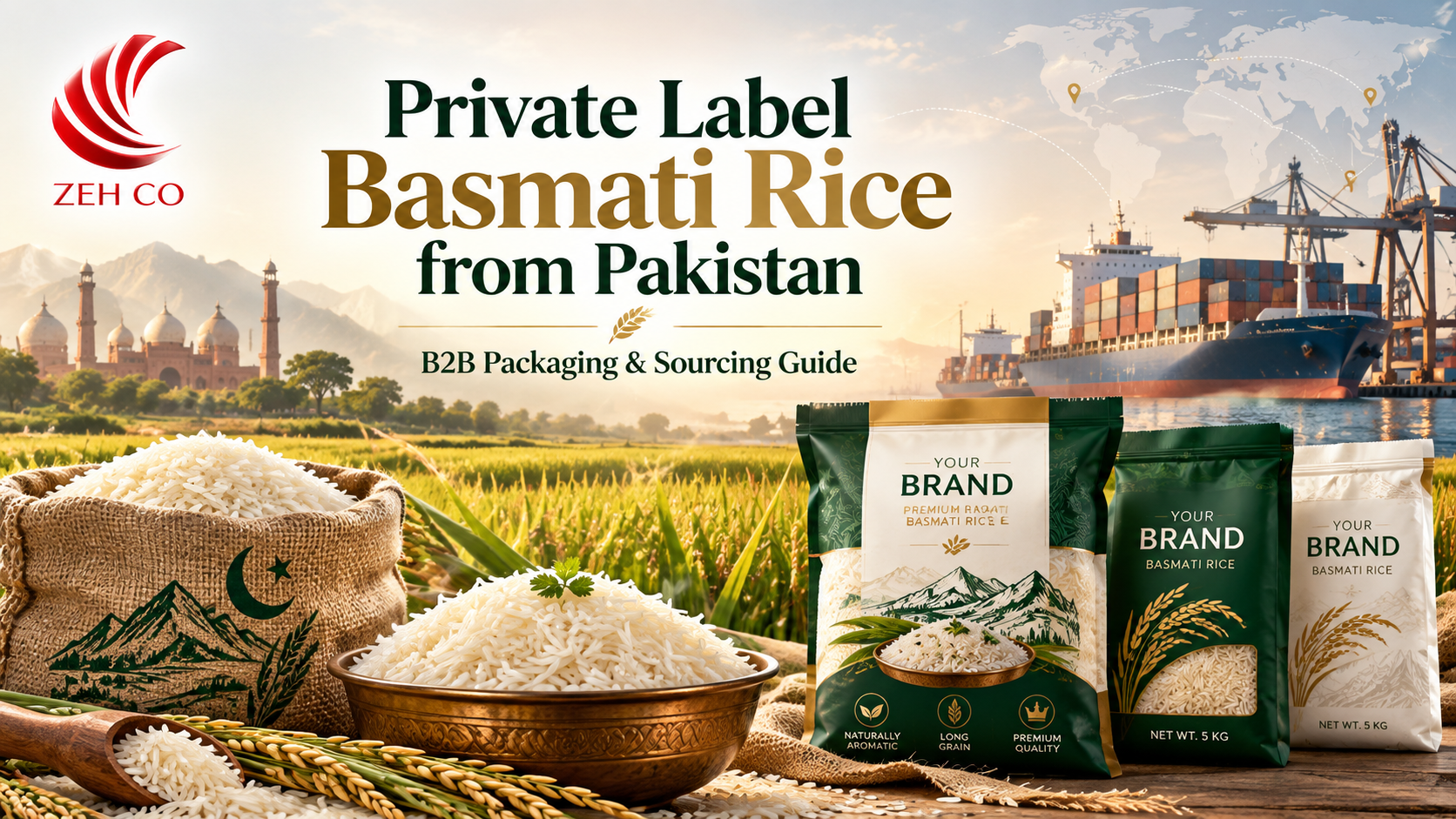
Private label Basmati rice from Pakistan gives international importers, supermarket suppliers, food distributors and retail brands an opportunity to source premium aromatic rice while selling it under their own brand identity. Instead of purchasing only generic bulk commodities, buyers can define rice variety, processing method, grain specifications, packaging size, artwork, labeling and carton configuration according to their target market. For successful procurement, however, private-label rice requires considerably more planning than simply comparing a price per metric ton.
Pakistan has an established Basmati rice production and export sector, while international buyers increasingly require suppliers capable of combining rice quality with professional retail packaging, traceability and consistent repeat-order specifications. ZEH Co works with international buyers seeking Pakistani agricultural products and can support B2B sourcing requirements with FOB Karachi, CIF and DDP shipping options according to destination and commercial requirements.
Why Source Private Label Basmati Rice from Pakistan?
Basmati rice is differentiated from ordinary long-grain rice by characteristics such as grain appearance, aroma, cooking performance and elongation. For importers building a retail or food-service brand, maintaining these characteristics consistently from one shipment to the next is essential because consumers associate the quality directly with the brand printed on the package.
Private labeling allows an importer to control how the product is positioned in its market. A buyer may develop an economical family pack for ethnic grocery stores, a premium pouch for supermarkets, a food-service bag for restaurants or a larger wholesale pack for distributors. The rice itself, packaging material, net weight, artwork, language and product declarations can therefore be planned around the intended sales channel.
Private Label Basmati Rice from Pakistan: Key Product Choices
Before requesting a quotation, buyers should determine exactly which rice specification they require. The term “Basmati rice” alone is usually insufficient for professional procurement because differences in variety and processing can materially affect appearance, cooking characteristics and price.
1121 Basmati Rice
1121 Basmati is widely used for premium retail, restaurant and catering markets where long grain appearance and elongation after cooking are important purchasing considerations. Depending on the intended market, buyers may request white, steam or parboiled/sella processing options.
Super Basmati Rice
Super Basmati is another important Pakistani Basmati option and is often selected by buyers who prioritize traditional aroma, taste and established consumer familiarity. Buyers should specify whether they require white, steam, brown or another processing format rather than assuming that every supplier's standard specification is identical.
Steam Basmati Rice
Steam processing can help buyers achieve a particular combination of grain appearance and cooking performance. It is commonly considered for retail packs, restaurants and food-service applications. Procurement teams should evaluate samples through their own cooking tests before approving commercial production.
Parboiled or Sella Basmati Rice
Sella rice undergoes parboiling before milling, producing a grain with different color, texture and cooking characteristics compared with traditional white rice. Golden and white sella products are commonly encountered in international trade. Markets serving restaurants, catering companies and South Asian or Middle Eastern cuisine may have specific preferences regarding sella rice.
Define the Rice Specification Before Negotiating Price
Professional buyers should issue a written specification sheet with their inquiry. Comparing quotations without matching specifications can be misleading because a lower price may reflect a different variety, processing method, broken percentage, moisture level or grading tolerance.
A B2B rice specification may address the following points:
- Rice variety: such as 1121 Basmati or Super Basmati.
- Processing: white, steam, parboiled/sella or brown rice where required.
- Broken percentage: maximum tolerance acceptable to the buyer.
- Moisture: agreed commercial specification suitable for storage and shipment.
- Foreign matter: buyer-defined cleanliness requirements.
- Damaged or discolored grains: acceptable tolerance according to contract specification.
- Crop or aging preference: where relevant to the buyer's cooking-performance requirements.
- Grain appearance: length, uniformity and overall visual standard.
- Cooking test: aroma, texture, elongation and separation according to intended market.
The final commercial specification should be agreed before production and preferably linked to an approved sample. This reduces disputes when the buyer inspects goods before shipment.
Retail Packaging Options for Private Label Rice
Packaging is one of the most important components of a private-label project because it protects the rice while communicating the buyer's brand to consumers. The packaging format should be selected according to retail positioning, transportation conditions, shelf presentation and destination-market requirements.
Common Retail Pack Sizes
Depending on the market and distribution channel, private-label rice can be packed in consumer and wholesale sizes such as 1 kg, 2 kg, 5 kg and 10 kg, while larger 20 kg, 25 kg or 50 kg formats may be suitable for food-service, wholesale or institutional customers. The appropriate size depends on local buying habits and logistics costs.
Packaging Material
Importers may choose laminated retail bags, printed polypropylene-based packaging or other food-appropriate packaging formats depending on their branding and technical requirements. Premium brands may prioritize strong shelf presentation, handles, resealable features or transparent windows, whereas high-volume wholesale buyers may prioritize durability and cost efficiency.
Buyers should evaluate packaging not only by appearance but also by seal integrity, resistance to handling, print quality and performance throughout container loading, ocean transit, warehousing and distribution.
What Information Should Be Printed on a Private Label Rice Bag?
Packaging artwork should never be finalized solely from a graphic-design perspective. Food labeling requirements vary by destination country, and the importer should confirm all mandatory information with its local regulatory or customs adviser before printing commercial quantities. Pakistan's Basmati specifications also recognize that export packaging and labeling must follow requirements applicable in the importing market.
Depending on the destination and sales format, packaging may need information such as:
- Brand and product name
- Rice variety or product description
- Net weight
- Country of origin
- Importer or distributor information
- Exporter or manufacturer information where required
- Batch or lot identification
- Packing or production date where applicable
- Best-before or shelf-life information according to applicable rules
- Storage instructions
- Nutrition information where required
- Barcode or retail identification
- Cooking instructions
- Required local-language declarations
The buyer should provide approved artwork in a production-ready format and confirm spelling, regulatory statements, barcodes, weights and contact information before printing begins. A digital proof or physical packaging sample can be approved before mass packaging.
Private Label Development Process for B2B Buyers
A structured development process reduces delays and prevents expensive packaging corrections. The first step is defining the rice itself. Once the variety and specification are agreed, the buyer can determine pack size, packaging material, branding and carton configuration.
A practical procurement sequence is:
- Step 1: Send the required rice variety, processing method and technical specification.
- Step 2: Confirm estimated quantity and preferred shipping term.
- Step 3: Select retail or wholesale pack sizes.
- Step 4: Submit brand logo, packaging design and mandatory label information.
- Step 5: Review packaging artwork and printing proof.
- Step 6: Approve product sample and cooking performance where required.
- Step 7: Confirm commercial order, packing configuration and shipment schedule.
- Step 8: Conduct agreed quality checks before container loading.
MOQ Considerations for Private Label Rice
Private-label orders generally require more planning than standard bulk shipments because customized printed packaging creates its own production requirements. Minimum quantities may therefore depend on the rice specification, bag size, printing method, number of artwork designs and packaging supplier requirements.
A buyer requesting one design in a large volume usually creates a simpler production run than a buyer dividing the same total quantity among many different brands, languages or bag sizes. Importers planning several SKUs should state the quantity required for each SKU instead of providing only a combined tonnage.
For a first order, buyers can also discuss whether packaging can be structured in a way that allows a practical market trial while remaining commercially workable for production.
Quality Control Before Shipment
Private labeling transfers the supplier's product into the buyer's brand, making pre-shipment quality control particularly important. The buyer should define inspection criteria before confirming the purchase rather than raising new standards after production.
Quality checks can include visual inspection, grain specification verification, packing weight checks, bag sealing, artwork verification, carton or outer packaging inspection and container condition before loading. When laboratory analysis or an independent inspection company is required, this should be agreed in the sales contract so responsibilities and costs are clear.
Retention samples can also be useful for repeat orders. Keeping approved reference samples allows the exporter and importer to compare future production against the originally accepted quality standard.
Container Loading and Export Packaging
Efficient container planning directly affects landed cost. Pack dimensions, bag weight, secondary packaging and pallet requirements influence how much saleable product can be shipped within a container.
Importers should tell the exporter whether they require loose-loaded bags, cartons, palletized cargo or another loading configuration. Pallets may simplify warehouse handling but also consume container space and add packaging weight, so the preferred configuration should be evaluated against the buyer's distribution system.
The container should be suitable for food cargo, dry and free from contamination or objectionable odors before loading. Packaging should be arranged to reduce movement and damage during international transportation.
FOB Karachi, CIF and DDP Buying Options
International buyers should compare quotations on the same Incoterm basis. A low ex-works or FOB price cannot be fairly compared with a quotation that already includes ocean freight or destination delivery.
FOB Karachi
Under an FOB Karachi arrangement, the buyer normally controls the main international freight after the contractual FOB delivery point. This can be suitable for importers with their own freight agreements or established logistics departments.
CIF Shipment
CIF quotations can be useful when the buyer wants the exporter to arrange ocean freight and insurance to the agreed destination port under the applicable contract terms. Buyers should specify the exact port because freight can differ substantially between destinations.
DDP Supply
DDP may be considered for destinations where an appropriate delivery structure can be arranged. Because taxes, import procedures, customs responsibilities and inland logistics vary by country, DDP feasibility and pricing should be evaluated individually for each market.
Information to Include in a Basmati Rice RFQ
A detailed request for quotation enables exporters to respond more accurately and saves time during negotiation. International buyers should ideally include:
- Required rice variety
- White, steam or sella processing
- Complete quality specification
- Required quantity in metric tons or containers
- Consumer pack size
- Number of packaging designs or SKUs
- Private-label artwork requirements
- Outer carton or master packing requirements
- Destination country and port
- Preferred Incoterm such as FOB Karachi, CIF or DDP
- Required certificates or testing
- Target shipment period
- Inspection requirements
An RFQ containing these details is more useful than simply asking, “What is your Basmati rice price?” Rice pricing depends on the exact specification, processing, packaging, quantity and shipment arrangement.
Reducing Risk on the First Private Label Order
New importers should separate product approval from commercial-scale packaging approval. First confirm that the rice meets the required cooking and visual standard. Then verify the printed packaging, net weight, artwork and labeling. Finally, agree inspection and shipping documentation before the cargo is dispatched.
Buyers should also avoid changing specifications after packaging materials have entered production. Even a small change to a barcode, nutrition panel, importer address or language can require packaging to be reprinted, increasing cost and delaying shipment.
Clear written purchase specifications, approved artwork, agreed tolerances and documented shipment terms create a stronger basis for long-term repeat business than relying on informal descriptions.
Why Consistency Matters for Retail Rice Brands
Importers building their own rice brand are not purchasing only one shipment; they are developing a product that consumers may expect to buy repeatedly. If grain appearance, aroma, cooking results or packaging quality changes significantly between shipments, retailers and consumers may lose confidence in the brand.
For this reason, serious private-label sourcing should focus on repeatability as well as initial price. Buyers should maintain product specifications, approved samples, artwork files, packaging dimensions and inspection criteria so subsequent orders can be reproduced as closely as commercially possible.
Source Private Label Basmati Rice from Pakistan with ZEH Co
For importers, distributors, supermarket suppliers and food-service buyers, private label Basmati rice from Pakistan can combine Pakistani rice sourcing with a customized retail identity. The strongest projects begin with a precise rice specification and then coordinate packaging, branding, labeling, quality control and logistics around the requirements of the destination market.
ZEH Co is a Pakistan-based B2B export company established in 2011 and serves international wholesale buyers across multiple markets. Buyers can contact ZEH Co with their required Basmati variety, processing method, quality specification, pack size, private-label design, quantity and destination port to request a commercial quotation. Shipping arrangements can be discussed on FOB Karachi, CIF or DDP terms depending on the destination and order requirements.
Providing a complete RFQ from the beginning enables a faster and more accurate sourcing process and helps both buyer and supplier establish a specification that can support consistent repeat orders.