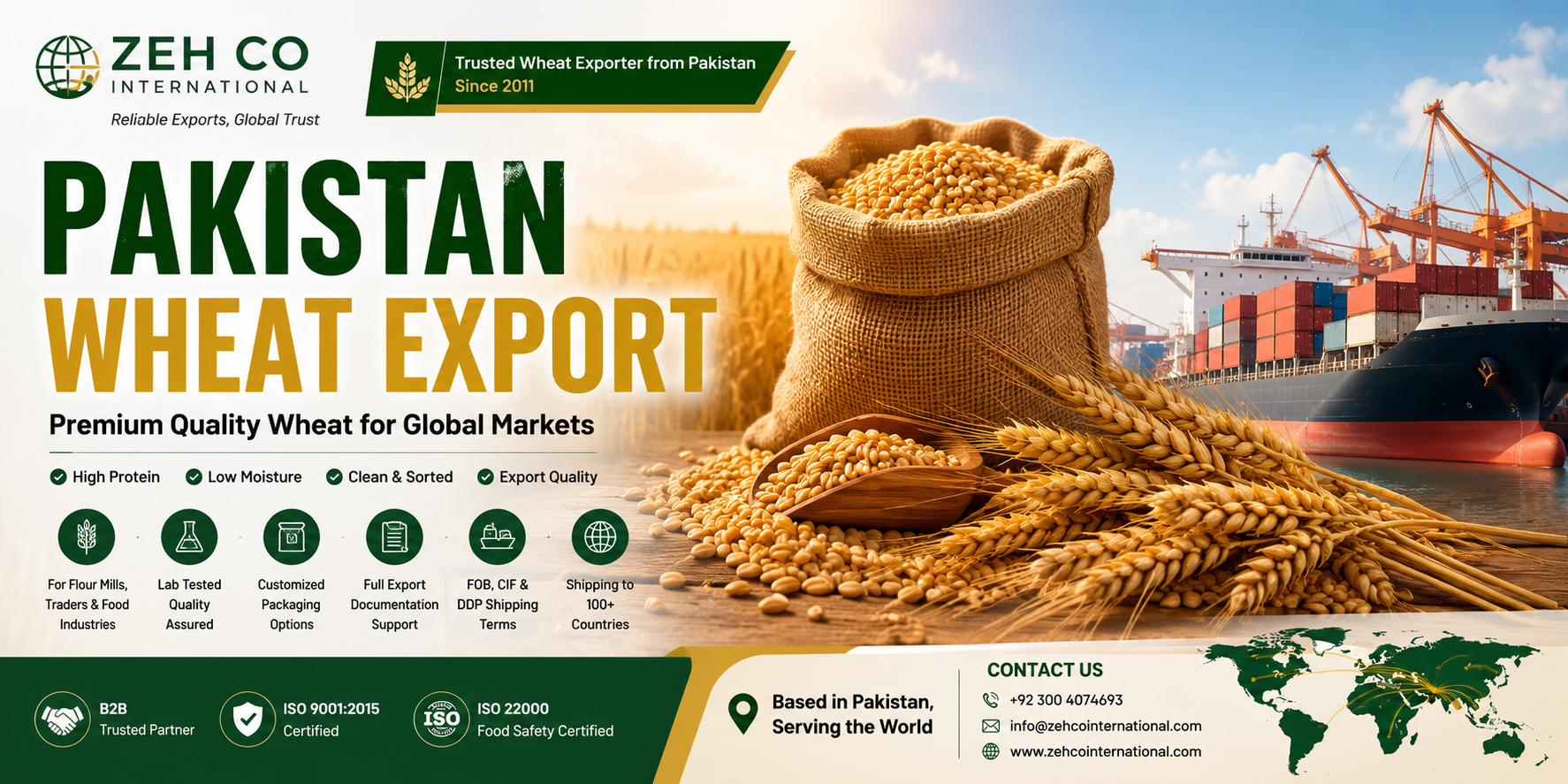
Pakistan wheat export opportunities can serve flour mills, grain traders, food manufacturers, distributors, and government procurement agencies seeking bulk agricultural commodities from South Asia. Pakistan has an established wheat-growing sector supported by farmers, grain markets, storage facilities, processors, laboratories, transport companies, and exporters. However, importing wheat successfully requires more than comparing prices per metric ton. Buyers must define the intended use, acceptable protein level, moisture limit, test weight, foreign matter, damaged kernels, packaging, inspection requirements, and destination-country regulations before confirming an order.
This guide explains the major commercial and technical factors international buyers should evaluate when sourcing wheat from Pakistan. It also outlines how ZEH Co can coordinate product selection, supplier verification, quality testing, packaging, documentation, and international shipment planning.
Why International Buyers Consider Pakistan Wheat Export Supply
Pakistan produces wheat primarily for flour milling, household consumption, food processing, and industrial grain applications. The country has a broad agricultural supply chain covering cultivation, harvesting, threshing, storage, cleaning, grading, transport, and processing. This infrastructure allows exporters to source wheat according to different buyer specifications, subject to crop availability and applicable export regulations.
Pakistan’s geographic location can provide logistical advantages for buyers in the Middle East, Central Asia, Africa, and parts of Asia. Export cargo can be moved through established road networks and seaports, with commercial arrangements available under terms such as FOB Karachi, CIF destination port, or selected delivered options where feasible.
For international buyers, the main value lies in obtaining wheat that matches a specific processing requirement. A flour mill producing bread flour may need different protein and gluten characteristics than a processor producing biscuits, noodles, flatbread, animal feed, or industrial starch. The exporter should therefore receive a complete technical specification before preparing a firm quotation.
Main Commercial Uses of Pakistani Wheat
Wheat can be sourced for several industrial and food-related applications. The required grade and quality parameters depend on the buyer’s processing method and final product.
- Flour milling: Wheat is processed into refined flour, whole-wheat flour, atta, semolina, and other milling products.
- Bread production: Bakeries and industrial bread manufacturers require wheat with suitable protein and gluten performance.
- Flatbread and chapati flour: Mills may prioritize dough handling, colour, softness, water absorption, and flour extraction.
- Biscuit and confectionery production: Buyers may prefer wheat with lower protein and softer gluten characteristics.
- Noodle and pasta production: Requirements may include specific protein, colour, hardness, and processing performance.
- Animal feed: Feed manufacturers may purchase lower-grade wheat or off-specification grain subject to safety and regulatory standards.
- Commodity trading: International grain traders purchase wheat for redistribution to mills, wholesalers, and regional buyers.
- Government procurement: Public-sector agencies may import wheat for strategic reserves, food-security programs, or subsidized distribution.
Buyers should clearly identify the intended application in their inquiry. This helps avoid purchasing wheat that meets a basic visual grade but performs poorly during milling, dough development, baking, or industrial processing.
Important Quality Specifications for Wheat Buyers
Protein Content
Protein content is one of the most important specifications for milling and baking wheat. It influences gluten development, dough strength, water absorption, loaf volume, texture, and processing performance. Higher protein is commonly associated with stronger flour applications, while lower-protein wheat may be suitable for biscuits, cakes, or selected confectionery products.
Buyers should state whether the protein percentage is required on an as-is basis or dry-matter basis. The testing method should also be agreed because laboratory procedures and moisture adjustments can affect the reported result.
Moisture Content
Moisture influences storage stability, cargo weight, milling behaviour, and the risk of mould or deterioration. Excessive moisture may result in heating, fungal growth, insect activity, odour, or reduced storage life. Buyers should establish a maximum acceptable moisture percentage and require testing before loading.
Storage and transport conditions are also important. Even wheat that meets the required moisture specification at the warehouse can absorb moisture if bags, containers, trucks, or storage areas are not properly protected.
Test Weight
Test weight, sometimes expressed as kilograms per hectolitre, provides an indication of grain density and overall kernel condition. Wheat with a higher test weight may deliver better milling yield, although test weight should not be evaluated in isolation.
Low test weight may be associated with shrivelled kernels, weather damage, immature grain, or poor crop development. Buyers should include a minimum test-weight requirement where milling yield and grain density are commercially important.
Foreign Matter and Impurities
Foreign matter may include stones, soil, straw, chaff, dust, weed seeds, broken stalks, or other non-wheat material. Excessive impurities increase cleaning costs, reduce usable yield, and may damage milling equipment.
The contract should define the maximum percentage of foreign matter and clarify whether the limit includes other grains, broken kernels, weed seeds, or only non-grain material. This prevents disputes caused by different interpretations of the specification.
Damaged and Broken Kernels
Damaged wheat can result from weather exposure, insects, heat, poor storage, disease, mechanical handling, or sprouting. Broken kernels can affect storage stability, cleaning efficiency, and flour quality.
International buyers should specify acceptable limits for damaged, broken, shrivelled, discoloured, or sprouted kernels. Where quality is critical, representative samples should be tested and approved before shipment.
Gluten Quality
Protein percentage alone does not fully explain baking performance. Wheat with a similar protein level can produce different dough strength, elasticity, extensibility, and water absorption. Flour mills and industrial bakeries may therefore request wet gluten, dry gluten, gluten index, sedimentation value, or other functional tests.
The required testing should be aligned with the buyer’s final product. Bread producers, noodle manufacturers, biscuit factories, and traditional flatbread mills may each require different gluten properties.
Falling Number
The falling number test is used to assess alpha-amylase activity and potential sprout damage. A very low result may indicate excessive enzyme activity, which can create sticky dough, weak bread structure, or processing difficulties. A very high result may also affect selected baking applications.
Buyers who require predictable milling and baking performance should include a suitable falling-number range in the specification rather than relying only on visual inspection.
Food Safety and Contaminant Controls
Wheat intended for food use must comply with the food-safety and contaminant requirements of the destination market. Depending on the importing country, testing may be required for pesticide residues, mycotoxins, heavy metals, insect infestation, microbiological contamination, or genetically modified material.
Mycotoxins are especially important because they can develop when grain is exposed to unsuitable growing, harvesting, or storage conditions. Buyers may request laboratory testing for aflatoxins, deoxynivalenol, ochratoxin A, or other regulated contaminants based on their national standards.
The buyer should provide the applicable maximum residue limits and testing requirements before shipment. Exporters cannot assume that standards are identical across the UAE, European Union, United Kingdom, China, Africa, or other markets.
Cleaning, Grading, and Processing Requirements
Wheat may be offered in different conditions, including field-cleaned, machine-cleaned, graded, fumigated, or processed according to a buyer-approved standard. The required level of cleaning influences the final price and usable yield.
A professional cleaning process may remove dust, stones, straw, light material, broken kernels, weed seeds, and selected foreign grains. Grading equipment can separate wheat according to size, density, and kernel condition.
Buyers should clarify whether they require:
- Unprocessed bulk wheat
- Machine-cleaned milling wheat
- Graded wheat with defined tolerances
- Fumigated wheat
- Bagged or bulk shipment
- Food-grade processing and handling
- Special cleaning for seed or industrial use
A quotation should clearly state the supplied condition so the buyer can compare equivalent offers. A cheaper uncleaned commodity may result in greater waste, additional processing expenses, and lower net yield.
Wheat Packaging Options for Export Shipments
Packaging depends on the quantity, destination, unloading facilities, storage system, and buyer preference. Wheat can be shipped in conventional bags, jumbo bags, or bulk cargo arrangements where infrastructure and shipment volume permit.
Standard Woven Bags
Polypropylene woven bags are commonly used for manageable handling and warehouse distribution. Typical bag weights may vary depending on the buyer’s market and labour practices. Bags should be strong enough to withstand filling, stacking, container movement, sea freight, and unloading.
Buyers may request plain bags, printed bags, inner liners, stitched closures, buyer branding, product details, country of origin, batch numbers, or handling instructions.
Jumbo Bags
Large flexible intermediate bulk containers may be suitable for industrial buyers with mechanical unloading systems. Jumbo bags can reduce manual handling, but the buyer must confirm lifting loops, bag capacity, liner requirements, discharge design, and warehouse compatibility.
Bulk Shipment
Large government, milling, or trading contracts may consider bulk vessel shipment. Bulk cargo requires suitable port facilities, loading arrangements, vessel inspection, fumigation planning, sampling, weight determination, and destination unloading infrastructure.
For containerized cargo, containers should be inspected for cleanliness, dryness, odour, holes, rust, chemical residue, and water leakage before loading. Moisture-control materials may be used where appropriate to reduce condensation risk during transit.
How Wheat Export Prices Are Determined
Wheat pricing is influenced by crop production, domestic demand, government policy, regional availability, grain quality, cleaning losses, packaging costs, transport, exchange rates, inspection, fumigation, port charges, and international freight rates.
To receive an accurate quotation, the buyer should provide:
- Required wheat grade or specification
- Protein and moisture limits
- Test weight requirement
- Foreign matter and damaged-kernel limits
- Required quantity
- Packaging type and bag weight
- Destination country and port
- Preferred Incoterm
- Inspection and laboratory requirements
- Payment terms
- Expected shipment period
Buyers should compare quotations on the same quality and delivery basis. A low-priced offer with higher moisture, more impurities, weaker packaging, or lower test weight may ultimately cost more after cleaning losses, milling waste, storage risk, and transport adjustments.
Inspection and Sampling Before Shipment
Representative sampling is necessary because wheat quality can vary between warehouses, lots, truckloads, and storage locations. A small hand sample supplied by a seller may not adequately represent hundreds or thousands of metric tons.
For larger orders, buyers may request third-party sampling from different parts of the stock, sealed counter-samples, laboratory analysis, weight verification, warehouse inspection, fumigation supervision, and container-loading checks.
A pre-shipment inspection may cover:
- Visual grain condition
- Protein content
- Moisture percentage
- Test weight
- Foreign matter
- Broken and damaged kernels
- Insect infestation
- Odour and discoloration
- Mycotoxin or residue testing
- Bag weight and packaging
- Container cleanliness
- Loading quantity
The inspection company, sampling method, laboratory, acceptance limits, and responsibility for inspection costs should be agreed before the sales contract is finalized.
Shipping Terms for Wheat Imports
FOB Karachi
Under FOB Karachi terms, the exporter arranges the goods, inland transport, export clearance, port handling, and loading onto the nominated vessel. The buyer normally controls the main freight, marine insurance, and destination arrangements.
CIF Destination Port
Under CIF terms, the exporter includes the product cost, marine insurance, and sea freight to the named destination port. Buyers should still verify destination handling charges, customs clearance, demurrage terms, container free time, and inland transport costs.
Delivered Arrangements
Delivered terms may be considered for selected markets where customs procedures, taxes, import licenses, and inland logistics can be managed reliably. Such arrangements require careful calculation because grain imports may be subject to quotas, duties, permits, inspections, and food-security controls.
The selected Incoterm should always include the named location or port and the applicable Incoterms version. This avoids confusion regarding transfer of risk, insurance, loading, customs, and additional charges.
Documents Required for Wheat Export
Documentation requirements depend on the buyer’s country, customs regulations, banking method, shipment type, and food-safety rules. A typical wheat export shipment may require:
- Commercial invoice
- Packing list
- Bill of lading
- Certificate of origin
- Phytosanitary certificate
- Fumigation certificate
- Weight certificate
- Quality certificate
- Laboratory analysis report
- Insurance certificate where applicable
- Inspection certificate
- Import permit references where required
The importer should confirm exact certificate wording and documentary requirements before shipment. Errors in product description, consignee name, tariff classification, quantity, weight, or certificate references can delay customs clearance and increase port costs.
Regulatory Factors International Buyers Must Check
Agricultural commodity exports can be affected by domestic supply conditions, government policy, crop forecasts, licensing rules, and temporary restrictions. Buyers should confirm that exports are permitted at the time of contracting and shipment.
The importing country may also require an import permit, phytosanitary treatment, specific fumigation methods, pest declarations, food-safety registration, or approved-origin documentation. These requirements should be verified with the buyer’s customs broker and relevant national authority.
Because regulations can change, long-term supply agreements should include provisions covering export restrictions, regulatory delays, force majeure, shipment extensions, and alternative performance arrangements.
Common Wheat Procurement Mistakes to Avoid
One major mistake is buying wheat based only on protein percentage. Milling performance also depends on gluten strength, moisture, kernel condition, test weight, enzyme activity, hardness, and impurities.
Another mistake is failing to specify the testing basis. Protein measured on an as-is basis may differ from protein reported on a dry-matter basis. Similarly, test results can vary depending on sampling and laboratory methods.
Buyers should also avoid accepting vague quality descriptions such as premium quality or export grade without measurable limits. Every essential parameter should be written into the contract.
Comparing FOB and CIF offers without adjusting for freight, insurance, inspection, packaging, and destination costs is another common error. Offers should be converted to a consistent landed-cost basis.
Finally, placing a large first order without representative sampling, supplier verification, or third-party inspection can expose the buyer to unnecessary quality and commercial risk. A trial shipment can help establish performance and trust before expanding volumes.
How ZEH Co Supports International Wheat Buyers
ZEH Co is a Pakistan-based B2B export company established in 2011. The company serves international importers, wholesalers, distributors, processors, procurement managers, and trading companies across multiple markets.
For wheat inquiries, ZEH Co begins by reviewing the buyer’s required application, technical specification, quantity, packaging, shipment schedule, destination, and commercial terms. The company can then coordinate supplier selection, sample preparation, laboratory testing, cleaning, grading, packaging, inspection, documentation, and logistics.
ZEH Co offers commercial arrangements including FOB Karachi, CIF destination port, and selected delivered solutions where operationally and legally feasible. The company’s wider experience in grains, fresh produce, salt, textiles, leather, safety products, and agricultural materials supports professional cross-border procurement and shipment management.
ZEH Co maintains ISO 9001:2015 and ISO 22000 certifications. Quality and food-safety procedures for wheat shipments are aligned with the buyer’s specification, contractual requirements, applicable regulations, and agreed inspection standards.
Conclusion: Building a Reliable Pakistan Wheat Export Partnership
A successful Pakistan wheat export transaction requires a detailed technical specification, representative sampling, reliable laboratory testing, suitable packaging, regulatory compliance, accurate documentation, and clearly defined shipping terms. International buyers should evaluate the total usable value of the grain rather than selecting an offer based only on the lowest price per metric ton.
Flour mills, grain traders, food processors, distributors, and institutional buyers can reduce procurement risks by clearly defining protein, moisture, test weight, impurities, damaged kernels, food-safety limits, and inspection procedures before placing an order. ZEH Co supports international buyers seeking professionally coordinated wheat sourcing from Pakistan with quality-focused procurement, flexible shipping options, export documentation assistance, and structured supply-chain management.