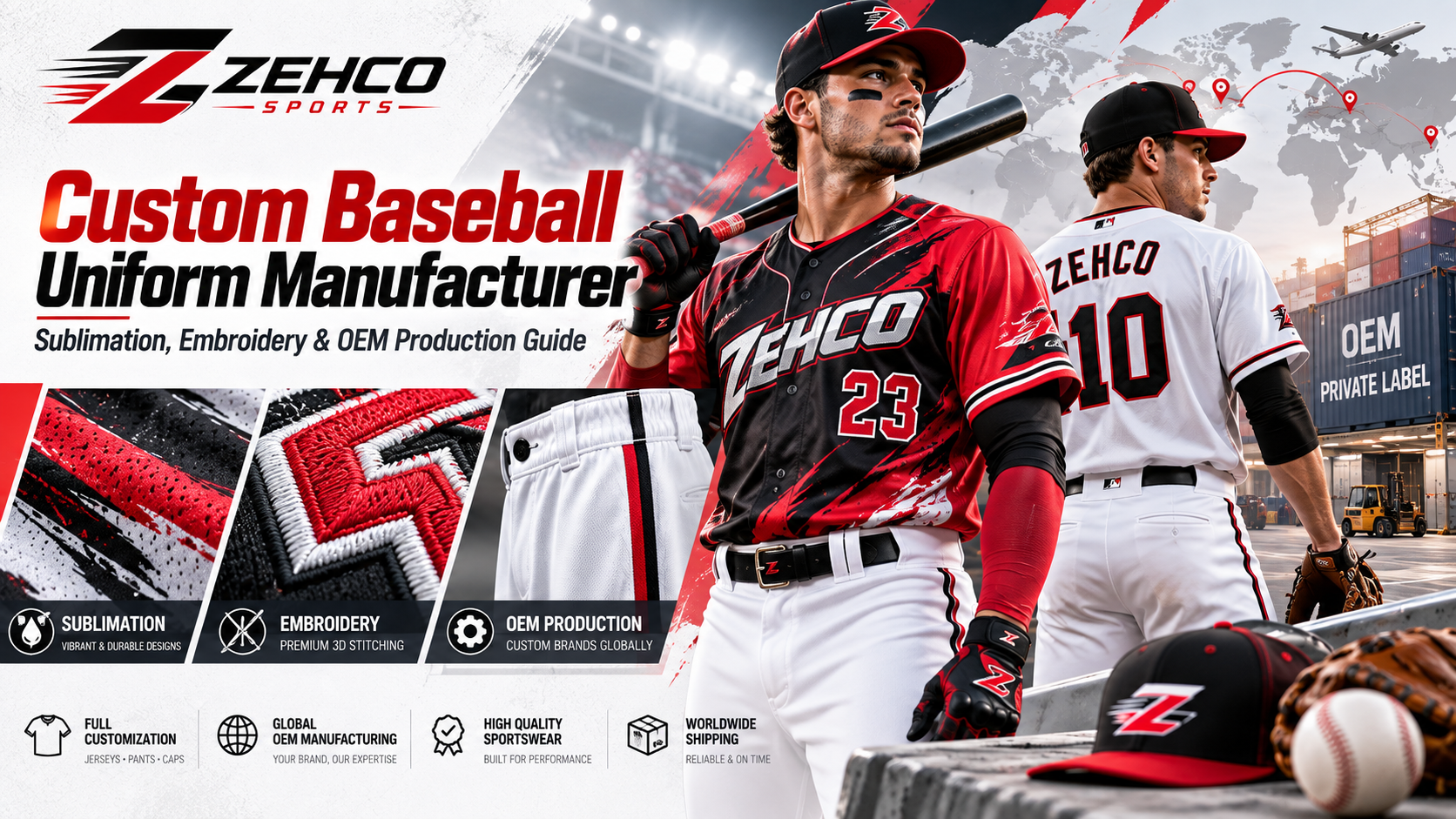
Choosing the right custom baseball uniform manufacturer involves much more than comparing a jersey price. International brands, sports clubs, distributors and teamwear companies must evaluate fabric construction, decoration techniques, sizing consistency, private labeling, sampling, quality control and repeat-order capability. A well-planned manufacturing specification helps buyers obtain baseball jerseys and pants that look professional, perform comfortably and remain consistent across future production runs. ZEHCO Sports, based in Sialkot, Pakistan, supports OEM, ODM and private-label team sportswear production for buyers seeking customized baseball apparel for their own brands, clubs or distribution networks.
What Should Buyers Expect From a Custom Baseball Uniform Manufacturer?
A professional baseball uniform production program should begin with technical requirements rather than artwork alone. Two jerseys can appear almost identical in a digital mockup while using completely different fabrics, stitching, printing methods and finishing standards. Buyers should therefore communicate the intended market, target quality level, uniform style, expected order quantity and decoration requirements before requesting final pricing.
For OEM and private-label projects, a manufacturer may produce complete baseball sets including button-front jerseys, pullover jerseys, baseball pants, training tops and related teamwear. The buyer can normally customize colors, patterns, team names, player numbers, sponsor logos, neck labels, size labels and packaging according to the project's requirements.
Provide a Clear Tech Pack or Reference Sample
The strongest production instructions come from a technical pack containing measurements, fabric specifications, color references, artwork placement, logo dimensions, stitching details and labeling requirements. If a technical pack is unavailable, a physical reference garment or detailed photographs can help establish the required construction. Buyers should avoid approving production solely from a front-and-back graphic because important specifications such as collar construction, sleeve shape, fabric weight and seam finishing may remain undefined.
Choosing the Right Fabric for Baseball Jerseys
Fabric selection affects comfort, appearance, durability, printing quality and total production cost. Polyester remains one of the most widely used materials for modern team uniforms because it provides good moisture management, shape retention and compatibility with sublimation printing.
Polyester Mesh Fabric
Polyester mesh can provide increased airflow and is suitable for teams playing in warm conditions or buyers seeking an athletic appearance. Different mesh structures create different levels of ventilation, transparency and stretch, so the fabric should be selected according to the intended quality level rather than simply specifying "mesh."
Interlock and Performance Polyester
Polyester interlock provides a smoother surface than open mesh and works well when buyers require sharp sublimated artwork. Depending on the construction, it can also provide a slightly heavier and more structured appearance. Performance polyester fabrics can be selected according to GSM, stretch, hand feel and intended use.
A buyer should specify fabric weight instead of requesting only "100% polyester." For example, a lightweight training jersey and a premium competition jersey may both be made from polyester but perform very differently because of their GSM, knitting structure and finishing.
Sublimation vs Embroidery for Custom Baseball Uniforms
Decoration is one of the most important decisions in baseball uniform manufacturing. Sublimation and embroidery each have advantages, but they should be used strategically rather than applying every decoration method to every design element.
Sublimation Printing
Sublimation is particularly suitable for complex backgrounds, gradients, topographic graphics, camouflage effects, mascots and multi-color illustrations. The design is transferred into compatible polyester fabric, allowing large artwork areas without creating the heavy surface associated with oversized embroidery.
Because sublimated graphics become part of the fabric surface rather than sitting as a thick layer on top, the method can maintain flexibility and is useful for detailed all-over uniform designs. It also allows brands to develop distinctive visual concepts without paying separately for every printed color in the way some traditional printing methods may require.
Embroidery and Tackle-Twill Applications
Embroidery can add a premium dimensional appearance to team names, logos, player numbers and selected badges. Tackle-twill or sewn appliqué lettering can also be used when a buyer wants a traditional baseball aesthetic.
However, heavy embroidery should be planned carefully. Large embroidered mascots or oversized filled artwork can add weight and stiffness to lightweight performance fabrics. For this reason, buyers may choose sublimation for complex background illustrations while reserving embroidery or appliqué for the main team name, numbers and smaller logos. This combination provides visual depth without unnecessarily increasing garment weight.
Baseball Jersey Construction Options
Baseball jerseys can be manufactured in several constructions, and each style creates a different appearance and production process. Buyers should decide the basic garment structure before finalizing artwork because elements such as buttons, plackets and piping affect logo positioning.
- Full button-front jerseys: Traditional baseball construction with a complete center-front button opening.
- Two-button jerseys: Athletic pullover construction with a shorter front opening.
- Pullover jerseys: Simplified performance style without a full front placket.
- Raglan sleeve jerseys: Useful for certain athletic designs and contrasting sleeve combinations.
- Set-in sleeve jerseys: A conventional shoulder construction suitable for many teamwear designs.
- Piped jerseys: Decorative piping can be applied around the placket, collar or sleeve depending on the design.
The buyer should also define hem shape, collar style, sleeve length, button color and whether names and numbers are printed, embroidered or applied as separate panels.
Baseball Pants and Complete Uniform Sets
Buyers sourcing complete baseball uniforms should treat pants as a separate technical product rather than assuming that every factory uses the same construction. Baseball pants may require stronger materials and reinforced areas because of sliding, repeated movement and contact with playing surfaces.
Important specifications may include waistband construction, belt loops, pockets, elastic sections, ankle style, piping, inseam measurements and reinforcement. Teams should also specify whether they require traditional full-length baseball pants or shorter styles designed to be worn with high socks.
For coordinated uniform sets, manufacturers should match fabric colors and trim shades across jerseys and pants as closely as possible. When different fabric structures are used, buyers should understand that the same color reference can appear slightly different depending on material texture and dye or printing process.
Custom Sizing for International Baseball Teams
Sizing inconsistencies can create expensive problems in international orders. A label such as Medium or Large does not guarantee the same finished garment measurements between different brands or countries. Buyers should therefore approve an actual measurement chart before production.
Important baseball jersey measurements can include chest width, body length, shoulder width, sleeve length, sleeve opening and bottom width. Baseball pants may require waist, hip, rise, thigh, inseam and bottom-opening measurements.
Brands developing their own private-label range can provide a proprietary size chart. Teams without an established chart can review a manufacturer's proposed measurements and request adjustments during sampling. Youth and adult ranges should be treated separately because simply scaling an adult pattern downward may not produce the correct proportions for children.
Private Label and OEM Branding Options
International buyers frequently require more than a customized team logo. A true private-label program can include the buyer's branding throughout the garment and packaging.
- Custom woven or printed neck labels
- Size labels
- Care and composition labels
- Brand patches
- Custom player names and numbers
- Team and sponsor logos
- Hangtags
- Individual polybag packaging
- Barcode or SKU stickers where required
Brand owners should submit label artwork and mandatory care information before bulk production. Requirements for fiber composition, country-of-origin marking and consumer labeling may vary by destination market, so importers should confirm applicable requirements for the countries where the uniforms will be sold.
Sampling Before Bulk Baseball Uniform Production
Sampling is one of the most valuable stages of an OEM project. A physical sample allows the buyer to evaluate fit, fabric feel, artwork scale, embroidery density, stitching and overall presentation before committing to a larger order.
What Should Be Checked on a Sample?
Buyers should compare the sample against the approved technical specification rather than judging only whether it "looks good." Review chest and body measurements, fabric type and weight, collar shape, placket alignment, button placement, logo size, spelling, number positioning, thread quality, color accuracy and seam construction.
If changes are required, they should be documented clearly. Revised measurements or artwork should be marked numerically instead of using vague instructions such as "make the logo slightly bigger." Precise feedback reduces misunderstanding and makes repeat production easier.
MOQ and Bulk Order Planning
Minimum order quantity depends on the design, fabric, decoration method, number of colorways and level of customization. Buyers should separate total order quantity from quantity per design because manufacturing efficiency can change when a single order contains many different styles.
For example, 500 units of one consistent jersey design can be easier to manage than 500 units divided into ten completely different designs. Multiple fabrics, custom trims and extensive embroidery can also affect production planning.
When requesting a quotation, provide expected quantity ranges such as 50, 100, 300, 500 or 1,000 units per design. This allows the manufacturer to calculate production efficiencies and provide appropriate pricing for different purchasing volumes.
Quality Control for Baseball Uniform Orders
Quality control should follow the approved sample and specification. Inspection points should include material, measurements, artwork, stitching, labeling and packing.
- Verify fabric type and approved weight range.
- Check major garment measurements against tolerances.
- Inspect sublimation for unwanted marks, misalignment or obvious color inconsistencies.
- Review embroidered logos for clean edges and correct placement.
- Check buttons, plackets, collars and hems for consistent construction.
- Confirm player names, numbers and spelling where uniforms are individually customized.
- Verify size labels, care labels and private-label branding.
- Confirm ordered quantities and size ratios before packing.
For repeat orders, keeping approved artwork files, patterns and specifications is particularly important. Buyers should use consistent product references or style numbers so that future production can be matched to the correct version.
Packaging and Export Requirements for International Buyers
Packaging should be agreed before bulk completion. Standard teamwear may be individually packed in polybags and then placed into export cartons, while branded retail programs may require custom bags, barcode labels, SKU identification or hangtags.
Importers should also determine their preferred shipping arrangement when requesting commercial quotations. Depending on the transaction, pricing may be discussed under terms such as FOB or other agreed Incoterms. Freight cost should normally be calculated after the approximate packed weight, carton dimensions, destination and shipping method are known.
Courier shipment can be practical for samples and smaller urgent quantities, while larger commercial orders may require air cargo, sea freight or another logistics arrangement. Buyers should avoid assuming that the lowest garment price creates the lowest landed cost because packaging volume, shipment size and destination charges can significantly affect the final economics of an order.
How to Request an Accurate Baseball Uniform Quotation
A detailed RFQ helps a manufacturer provide a more accurate price and reduces unnecessary back-and-forth communication. International buyers should provide as much of the following information as possible:
- Jersey and pants style
- Estimated quantity per design
- Adult or youth sizing requirements
- Preferred fabric and GSM
- Sublimation artwork
- Embroidery or tackle-twill requirements
- Team names, numbers and sponsor logos
- Private-label requirements
- Packaging requirements
- Sample quantity
- Target destination country
- Preferred shipping or Incoterm requirement
If specifications are still being developed, buyers can begin with reference images and explain their target market and desired quality level. The specification can then be refined before sampling.
Why Work With ZEHCO Sports for OEM Baseball Uniform Production?
ZEHCO Sports is a custom sportswear and racing gear manufacturer based in Sialkot, Pakistan, supporting export-oriented OEM, ODM and private-label production. For baseball and other team sportswear projects, production can be developed around buyer-supplied designs, branding requirements, sizing specifications and order quantities.
The objective of a reliable manufacturing relationship should be repeatability rather than a successful first shipment only. Brands and distributors need a production process that can preserve approved patterns, artwork positions, labeling requirements and quality specifications for future orders. Clear communication during development and accurate documentation make that process significantly more manageable.
Conclusion: Selecting a Custom Baseball Uniform Manufacturer
Selecting a custom baseball uniform manufacturer should involve a structured review of materials, garment construction, decoration techniques, sizing, private-label requirements, sampling and quality control. Sublimation is highly effective for complex full-color graphics, while embroidery and sewn applications can add premium detail when used strategically for lettering, numbers and logos.
For international apparel brands, distributors, baseball clubs and sourcing companies, the best results come from creating a clear specification before bulk production begins. ZEHCO Sports can support custom baseball jerseys, pants and coordinated teamwear projects with OEM, ODM and private-label manufacturing from Sialkot, Pakistan. Buyers preparing a new collection or team order should provide artwork, estimated quantities, size requirements and target specifications so the project can be evaluated for sampling and production.