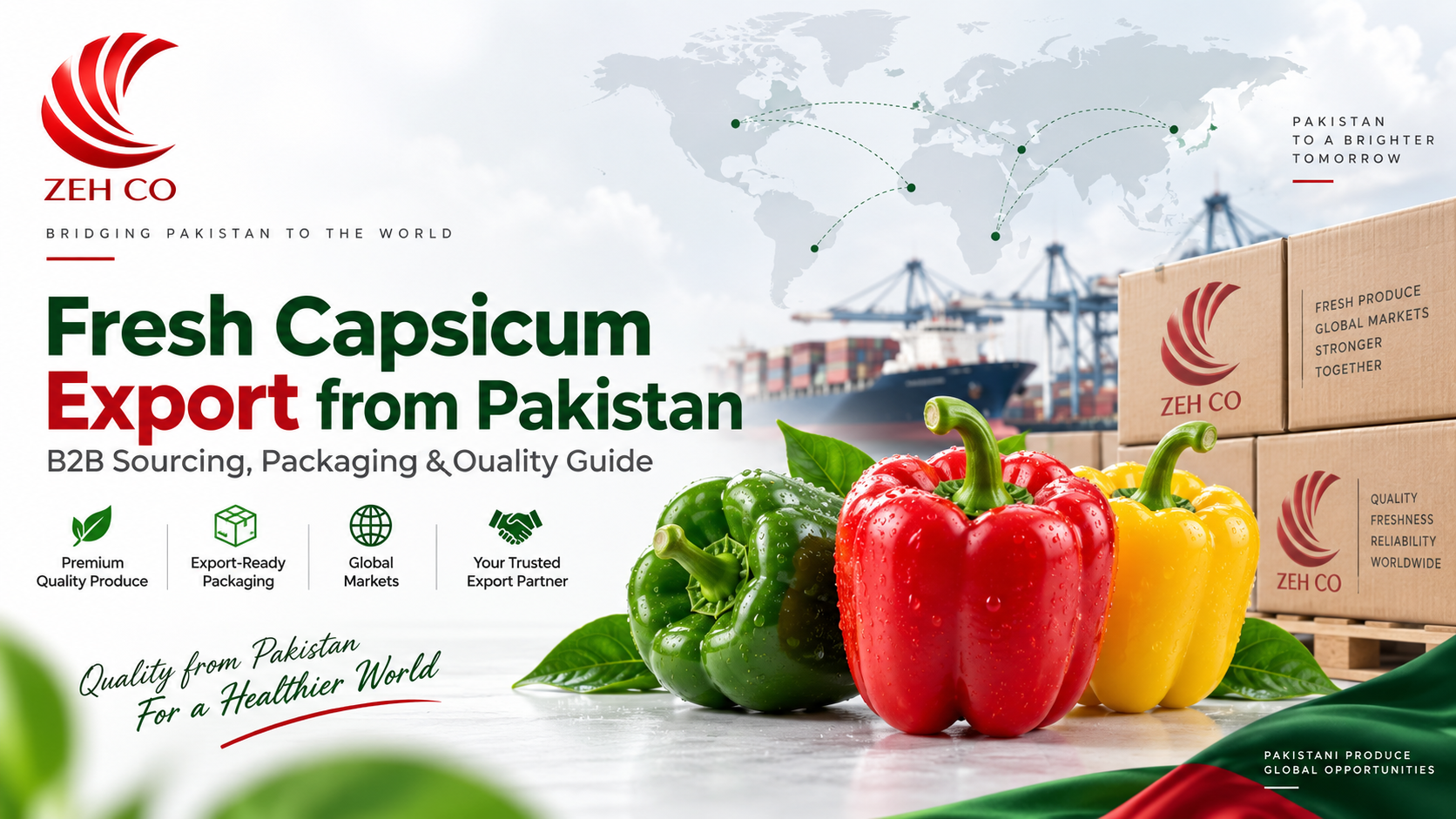
International importers looking for dependable vegetable sourcing opportunities are increasingly evaluating fresh capsicum export from Pakistan for wholesale, retail, foodservice and distribution requirements. Capsicum, commonly known as bell pepper or sweet pepper, is a highly specification-sensitive fresh product, which means successful international procurement depends on more than simply finding the lowest farm-gate price. Size uniformity, firmness, color, packaging strength, temperature management, transit time and destination-market requirements all influence the commercial performance of each shipment.
ZEH Co supports international B2B buyers sourcing fresh agricultural products from Pakistan with export coordination, commercial packing requirements and shipping options including FOB Karachi, CIF and DDP where operationally available. For capsicum buyers, a clearly defined specification before procurement is particularly important because different wholesale markets, supermarkets, processors and foodservice distributors can require substantially different grades.
Why Consider Fresh Capsicum Export from Pakistan?
Pakistan has a substantial agricultural supply base and produces a broad range of fresh vegetables for domestic and commercial markets. Capsicum can form part of an importer's diversified Pakistan sourcing program alongside onions, potatoes, green chilli, okra, bottle gourd and other vegetables.
For international buyers, sourcing from Pakistan may be commercially relevant when the required combination of product availability, specification, freight conditions and landed cost matches the destination market. Buyers should evaluate each program shipment by shipment rather than assuming that one specification or shipping method will work for every country.
A professional capsicum procurement program should therefore consider:
- Required color, size and maturity.
- Expected shelf life at destination.
- Carton or crate configuration.
- Net weight per package.
- Temperature and ventilation requirements.
- Transit duration and shipment method.
- Import permits and phytosanitary documentation.
- Maximum defect tolerances agreed between buyer and supplier.
Capsicum Types and Buyer Specifications
International capsicum buyers may request green, red, yellow or other commercially available bell pepper types depending on their market. Availability and volume can vary according to crop conditions, production area and sourcing period, so buyers purchasing colored capsicum should confirm the required volume and color composition before finalizing a contract.
Green Capsicum
Green capsicum is commonly used by restaurants, vegetable wholesalers, food processors and retail chains. Importers generally look for firm fruit with a fresh appearance, consistent shape, strong walls and good resistance to handling during transportation.
Colored Capsicum
Red and yellow capsicum can be attractive for premium retail and foodservice markets, but color uniformity and maturity become especially important. The buyer should define whether the shipment requires a single color, mixed colors or a particular percentage of each color.
Size Requirements
Capsicum is often traded according to count, diameter, weight range or a buyer-specific grade. Instead of using vague terms such as small, medium or large, importers should provide measurable specifications whenever possible. A written size range reduces disputes and helps packing teams maintain greater consistency.
Quality Parameters International Capsicum Buyers Should Define
Fresh vegetable quality can deteriorate quickly if procurement specifications are unclear. A professional purchase order should identify the characteristics that are commercially important to the buyer.
Typical capsicum quality requirements may include:
- Firmness: Fruit should be sufficiently firm for the intended transit and distribution cycle.
- Shape: Buyers may specify uniform blocky shapes or accept naturally variable shapes depending on market positioning.
- Surface appearance: Buyers generally prefer clean produce with an attractive appearance and without excessive scarring.
- Color: Green or colored capsicum should meet the agreed maturity and color specification.
- Damage tolerance: Limits should be agreed for cuts, bruising, cracks, sun damage and other defects.
- Decay: Commercial shipments should be inspected to reduce the inclusion of fruit showing visible deterioration.
- Uniformity: Consistency within each carton helps importers supply supermarkets and organized wholesale customers more efficiently.
Importers should communicate whether their business supplies premium retail, open wholesale markets, processors or institutional buyers. A specification suitable for one channel may be unnecessarily expensive or commercially unsuitable for another.
Grading and Sorting Before Export
Sorting is one of the most important stages in preparing capsicum for international trade. Produce should be separated according to the agreed quality parameters before packing. Consistent grading helps minimize rejection disputes and makes destination-market distribution easier.
A practical sorting process can include removal of damaged or unsuitable pieces followed by separation according to size, color and overall appearance. Buyers purchasing multiple grades should request separate labeling so that each category can be identified immediately after arrival.
For repeat orders, maintaining an approved reference specification is valuable. Buyers can use photographs, sample cartons, size ranges and defect tolerances as benchmarks for subsequent shipments.
Capsicum Packaging for International Shipments
Packaging must protect fresh capsicum while allowing appropriate ventilation and efficient handling. The ideal packing format depends on transportation method, customer requirements and destination-market practices.
Corrugated Cartons
Export-quality corrugated cartons are commonly considered where buyers need organized palletization, branding and a professional retail or wholesale presentation. Carton strength must be appropriate for stacking and the expected humidity conditions during transport.
Plastic Crates
Reusable or commercial plastic crates may be suitable for certain regional supply chains, particularly where the importer has an established crate-handling system. Buyers should consider the return, disposal or ownership arrangement before choosing this format.
Customized Packaging
Private-label buyers may require printed cartons, stickers, barcodes, importer information or destination-specific labeling. These requirements should be finalized before packing materials are produced because custom packaging can affect order preparation time and cost.
The buyer should clearly specify the required net weight rather than relying only on gross carton weight. This is particularly important when calculating purchase cost, freight allocation and resale margins.
Cold-Chain Management for Fresh Capsicum
Temperature management is a major commercial issue in fresh vegetable exports. Poor post-harvest handling can reduce saleable shelf life even when the product appears acceptable at the time of dispatch.
Fresh capsicum should be handled under conditions appropriate for the product and planned transit route. Importers should discuss cooling, storage, container conditions and expected transportation duration with their supplier and logistics provider before loading.
Maintaining the correct environment is not simply a matter of selecting a low temperature. Fresh produce can also be affected by inappropriate temperatures, condensation, poor airflow and prolonged loading delays. Container ventilation and cargo arrangement therefore need to support the intended transport conditions.
For longer routes, buyers may also consider temperature-recording devices so the shipment history can be reviewed after arrival. This can be useful when investigating quality deterioration or improving future shipments.
Air Freight vs Sea Freight for Capsicum
The most appropriate transport method depends on destination, order size, product condition, freight cost and required delivery speed.
Air Freight
Air freight can be suitable for smaller quantities, urgent orders and markets where fast delivery justifies the higher logistics cost. Importers should calculate the total landed cost per kilogram because freight can represent a significant proportion of the final price.
Sea Freight
Reefer sea freight may be commercially attractive for larger-volume programs where transit time and product tolerance make sea transport practical. Before placing a container-scale order, the buyer should assess expected transit duration, port handling, customs clearance and remaining shelf life after arrival.
A trial shipment is often useful when a buyer is developing a new route. Commercial performance should be evaluated based on the condition at destination rather than only the quality observed at origin.
Documents for Capsicum Imports from Pakistan
Documentation requirements vary by destination country and the applicable plant-health and food-import regulations. Buyers should confirm their country's requirements before shipment instead of assuming the same documents apply in every market.
Depending on the transaction and destination, documents may include:
- Commercial invoice.
- Packing list.
- Bill of lading or air waybill.
- Certificate of origin where required.
- Phytosanitary documentation where applicable.
- Additional inspection or food-safety documentation required by the destination market.
The importer remains responsible for understanding its local import requirements, but coordination between exporter, buyer, customs agent and freight forwarder can reduce avoidable clearance delays.
How Importers Should Request a Capsicum Quotation
Sending a detailed inquiry allows exporters to prepare a more meaningful quotation. Requests that simply ask for the price of one container of capsicum may require several follow-up questions before an accurate commercial offer can be prepared.
A useful RFQ should include:
- Destination country and port or airport.
- Required capsicum color.
- Preferred size or count specification.
- Grade and acceptable defect tolerance.
- Net weight per carton or crate.
- Total required quantity.
- Preferred transport method.
- Required delivery period.
- Packaging and private-label requirements.
- Requested Incoterm such as FOB, CIF or another agreed term.
Providing these details helps suppliers compare the correct product, packaging and logistics options rather than quoting a generic price that may not match the buyer's actual requirement.
FOB, CIF and DDP Options for International Buyers
ZEH Co can work with different shipment structures depending on the product, route and commercial agreement. Under an FOB Karachi arrangement, buyers can manage their international freight through their preferred logistics network. This may suit established importers with negotiated carrier rates.
Under a CIF arrangement, the quotation can incorporate ocean freight and insurance to the agreed destination port according to the applicable terms. This allows buyers to compare the delivered-to-port procurement cost more easily.
DDP may be considered for suitable destinations and transactions where the logistics and customs structure can be arranged. Because import regulations and local charges differ considerably among countries, DDP feasibility should be confirmed individually.
Why Trial Orders Matter for New Capsicum Buyers
A trial shipment allows both buyer and supplier to validate the commercial specification under real transport conditions. Importers can evaluate arrival quality, packaging performance, shelf life, market acceptance and the effectiveness of the cold chain before committing to a larger program.
After the trial, both parties should review measurable outcomes. If particular sizes sold faster, certain packaging performed better or destination handling caused avoidable losses, the next shipment specification can be adjusted accordingly.
This process is especially important for fresh produce because a successful long-term supply program depends on repeatable arrival quality rather than a single attractive sample.
Choosing a Pakistan Capsicum Export Supplier
International buyers should evaluate suppliers on their ability to execute an agreed specification consistently. Price remains important, but the cheapest quotation can become expensive if grading is inconsistent, packaging fails or cargo arrives with excessive deterioration.
Key supplier evaluation points include:
- Ability to source according to measurable specifications.
- Clear communication before packing.
- Export-appropriate packaging coordination.
- Understanding of fresh produce logistics.
- Accurate commercial documentation.
- Ability to provide shipment updates.
- Support for repeat wholesale requirements.
- Flexibility regarding FOB, CIF and other agreed shipping structures.
Importers planning recurring purchases should also discuss forecast volumes in advance. Better visibility can help coordinate sourcing, packing materials and logistics capacity.
ZEH Co as a B2B Fresh Vegetable Export Partner
ZEH Co is a Pakistan-based B2B export company established in 2011, serving international customers across a broad portfolio of agricultural and manufactured products. The company works with importers, wholesalers, distributors and procurement organizations seeking Pakistani products for international markets.
For fresh capsicum inquiries, buyers can submit their destination, quantity, grade, color, size, packaging and shipping requirements for commercial review. Where necessary, specifications can be clarified before pricing so the quotation reflects the buyer's actual requirement instead of a generic market offer.
International procurement works best when quality expectations are established before the order is packed. Clear documentation, measurable specifications and realistic logistics planning help both exporter and importer build a more dependable supply relationship.
Conclusion: Building a Reliable Fresh Capsicum Supply Program
Successful fresh capsicum export from Pakistan requires coordinated sourcing, grading, packaging, temperature management and transportation rather than price comparison alone. International importers should define exact product specifications, destination requirements and expected delivery conditions before confirming an order.
For wholesale buyers, distributors, foodservice suppliers and importers considering Pakistan as a vegetable sourcing origin, ZEH Co can support capsicum procurement based on buyer-defined requirements and appropriate shipping arrangements. A well-planned trial order can provide the practical data needed to refine specifications and develop a scalable B2B sourcing program for future shipments.