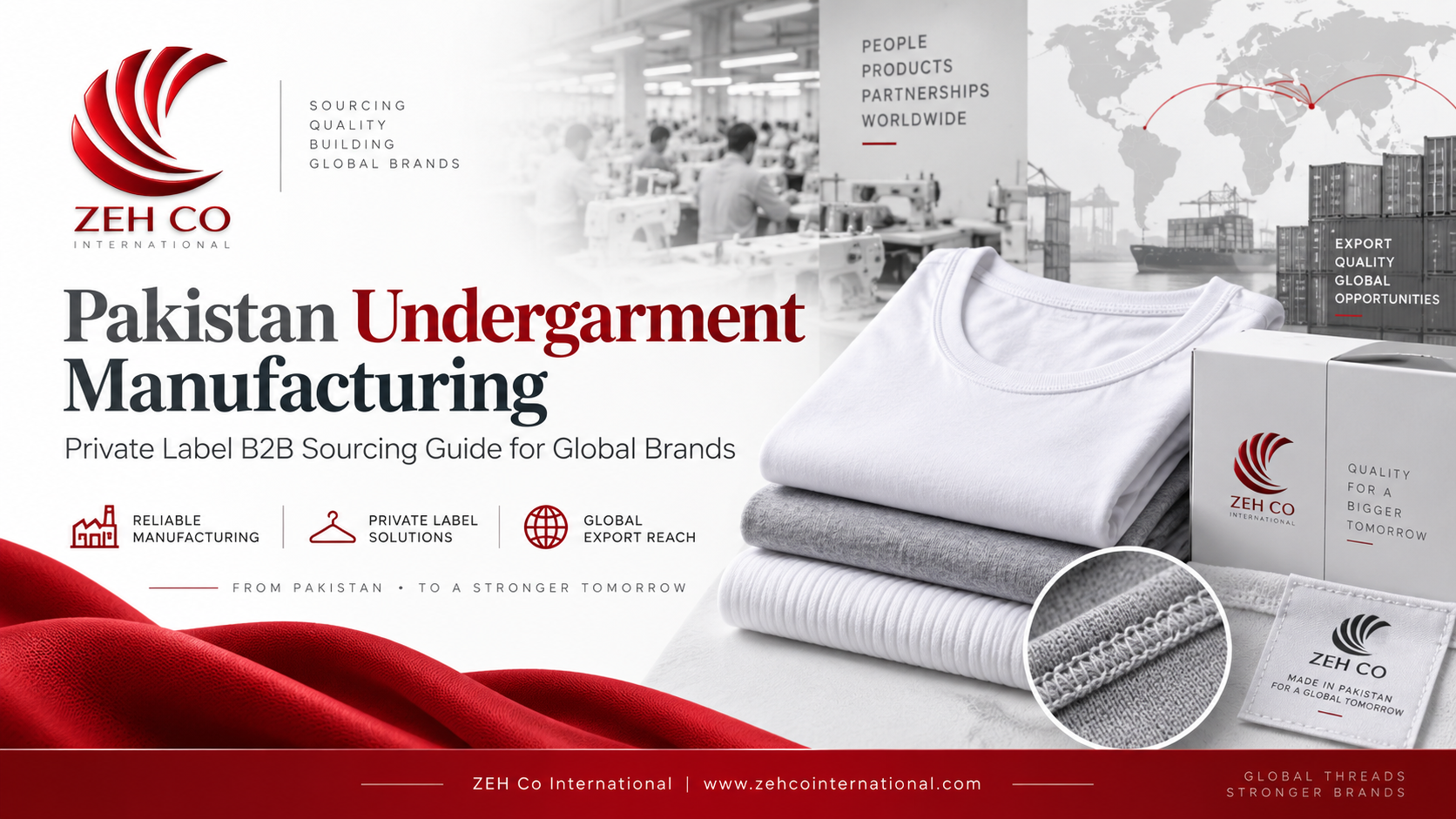
Choosing the right Pakistan undergarment manufacturer can give international apparel brands, wholesalers and importers access to flexible product development, competitive manufacturing and private label production under one sourcing arrangement. Pakistan has a strong textile and garment manufacturing base supported by cotton availability, knitting, dyeing, cutting, stitching, embroidery, printing and export-oriented production capabilities. For buyers sourcing underwear, briefs, boxers, undershirts and related garments, the most important factors are not price alone but fabric consistency, accurate sizing, stitching quality, comfort, labeling and reliable repeat production.
ZEH Co works with international B2B buyers seeking Pakistani textile and apparel products for wholesale, private label and customized requirements. This guide explains what buyers should evaluate before placing undergarment orders and how a structured sourcing process can reduce production risks.
Why Source from a Pakistan Undergarment Manufacturer?
Pakistan's textile industry covers several stages of apparel production, allowing buyers to source garments with different fabric compositions, weights, finishes and branding requirements. For underwear and undergarments, this manufacturing ecosystem is particularly useful because buyers often need close coordination between fabric selection, elastic development, garment construction, size grading, labels and packaging.
International buyers may source from Pakistan for private label collections, wholesale distribution, retail chains, promotional programs, online apparel brands and institutional requirements. Depending on the product and order specifications, manufacturers can develop basic value-oriented garments as well as more refined products using premium cotton, stretch fabrics and customized components.
Another advantage for B2B buyers is the ability to consolidate different apparel products through one sourcing channel. A buyer developing men's underwear, T-shirts, trousers, hoodies or other textile products may be able to coordinate multiple categories within the same broader supply chain.
Types of Undergarments Available for B2B Production
Product specifications vary considerably between markets. A successful sourcing program should therefore begin with a clearly defined product range rather than a generic request for “underwear.” Common categories include:
- Men's briefs: classic briefs, low-rise briefs and stretch cotton styles.
- Boxer shorts: woven loose-fit boxers and knitted casual styles.
- Boxer briefs: fitted garments combining stretch, comfort and support.
- Trunks: shorter-leg fitted underwear for fashion and retail brands.
- Undershirts: sleeveless vests, tank tops and basic innerwear tops.
- Women's basic undergarments: selected private label cotton and stretch styles according to buyer specifications.
- Thermal innerwear: warmer base-layer products intended for colder climates.
- Custom retail sets: coordinated multipacks developed for supermarkets, online brands and apparel retailers.
Buyers should provide reference samples, technical packs, measurement charts or detailed drawings whenever possible. This improves quotation accuracy and reduces misunderstandings during sampling.
Fabric Selection for Private Label Underwear
Fabric has a direct impact on comfort, durability, fit, appearance and final cost. Selecting a fabric simply by composition is insufficient because two fabrics described as “95% cotton and 5% elastane” can still perform very differently depending on yarn quality, knitting structure, weight and finishing.
100% Cotton
Cotton remains widely used for basic underwear because of its softness, breathability and familiarity to consumers. It is suitable for briefs, boxers, undershirts and everyday innerwear. Buyers should define fabric weight, knitting structure and desired shrinkage performance before approving production.
Cotton and Elastane Blends
Stretch cotton fabrics are commonly used for boxer briefs, trunks and fitted underwear. Elastane improves recovery and allows the garment to follow body movement more closely. Buyers should evaluate stretch recovery during sampling because excessive deformation after repeated use can negatively affect customer satisfaction.
Polyester and Performance Blends
Synthetic and blended fabrics can be considered for sports-oriented underwear, moisture-management garments and certain value-focused programs. The appropriate composition depends on the end-use market, climate, retail positioning and required performance.
Fabric Weight and Hand Feel
Fabric GSM should be agreed before bulk manufacturing. A lighter fabric can create a cooler and more economical garment, while a heavier fabric may provide better coverage and a more substantial hand feel. Buyers should approve actual fabric swatches rather than relying only on written descriptions.
Private Label and OEM Customization Options
Private label buyers normally require much more than an unbranded finished garment. The complete product presentation may include customized components that establish the buyer's retail identity.
Typical customization options can include:
- Buyer-specific garment designs and measurements
- Custom fabric composition and GSM
- Customized waistband elastic
- Woven brand labels
- Printed or heat-transfer size labels
- Care and composition labels
- Logo printing or embroidery where suitable
- Custom colors and color combinations
- Individual polybags
- Printed retail boxes
- Multipack packaging
- Barcode and SKU labels
- Carton markings according to importer requirements
A professional sourcing process should define these details before final pricing because packaging and branded accessories can significantly affect both cost and production lead time.
Importance of Correct Sizing and Measurement Specifications
Underwear is highly sensitive to fit. Even small measurement differences can create comfort problems, excessive tightness or poor garment appearance. International buyers should therefore provide a detailed size chart covering all critical measurements.
Depending on the style, measurements may include waistband width, front rise, back rise, leg opening, inseam, side seam and garment length. Manufacturers may also create graded specifications from an approved base size.
Buyers serving multiple geographic markets should not assume that one size system automatically fits every market. A Medium size intended for one country may differ from a Medium used by another retailer. The buyer's approved measurement specification should always control production.
Waistband Elastic: A Critical Component
The waistband is one of the most visible and functional parts of men's underwear. Poor-quality elastic can lose recovery, twist after washing or feel uncomfortable against the skin.
Private label brands may choose plain elastic, jacquard elastic or customized waistbands containing their logo or brand name. Buyers should evaluate elasticity, recovery, width, softness and colorfastness during development.
When customized elastic is required, it should be approved before bulk production because color, logo proportions and elastic tension can influence the overall appearance of the finished garment.
Sampling Before Bulk Production
A sample is one of the most important risk-control tools in apparel sourcing. Buyers should avoid moving directly from a photograph or preliminary quotation into bulk production.
Development Sample
The first sample allows the buyer and manufacturer to evaluate the overall design, construction method and approximate fit.
Fit Sample
A fit sample is used to verify measurements and determine whether adjustments are necessary before final approval.
Pre-Production Sample
A pre-production sample should reflect the intended bulk product as closely as possible, including approved fabric, elastic, labels, colors and workmanship.
For complex private label orders, buyers may also request packaging samples or complete retail-ready samples before confirming mass production.
Quality Control for Wholesale Undergarment Orders
Quality control should cover raw materials, production and final packing rather than relying only on inspection after garments have been completed.
Important checkpoints include:
- Fabric composition and approved construction
- Fabric weight and shade consistency
- Measurement tolerance
- Stitch density and seam quality
- Elastic attachment
- Waistband strength and recovery
- Label positioning
- Printing or branding quality
- Loose threads and workmanship defects
- Garment cleanliness
- Size assortment accuracy
- Packaging and carton quantities
Buyers should communicate inspection standards before manufacturing begins. For larger orders, inspection criteria can also be incorporated into the purchase order or product specification sheet.
Testing Requirements for International Markets
Testing requirements depend on the destination country, product composition, retail channel and buyer's internal compliance rules. Importers should determine applicable requirements before production rather than waiting until goods are ready for shipment.
Depending on the order, buyers may request testing related to fabric composition, dimensional stability, colorfastness, restricted substances, seam performance or other textile parameters. Large retailers and branded apparel companies may also maintain their own supplier compliance standards.
The importer remains responsible for confirming regulations applicable in the destination market. Requirements for the EU, UK, USA, Middle East and other destinations can differ, particularly regarding labeling and chemical compliance.
Packaging Options for Wholesale and Retail Buyers
Packaging should be designed around the buyer's distribution model. A bulk wholesaler may require simple individual packing, while a supermarket or e-commerce brand may need retail-ready boxes containing barcodes, size indicators, product information and branding.
Common options include individual polybags, paper bands, cardboard boxes, multipacks and master export cartons. Buyers should provide barcode files, packaging artwork and labeling instructions early enough to avoid delaying production.
For private label programs, consistent packaging is particularly important because customers evaluate the brand through both the garment and its presentation.
MOQ and Order Planning
Minimum order quantities depend on garment design, fabric availability, custom colors, specialized elastic, packaging requirements and the number of sizes included in the order.
A basic style produced using commonly available materials may allow more flexible order quantities than a completely customized product requiring specially knitted fabric, custom-dyed colors and branded elastic.
Buyers can improve purchasing efficiency by limiting unnecessary color variations during initial orders and distributing quantity strategically across core sizes. Once demand is established, future orders can be expanded into additional colors and designs.
Information Buyers Should Include in an RFQ
A detailed request for quotation allows suppliers to calculate pricing more accurately and reduces repeated communication. Importers should ideally provide:
- Product type and reference images
- Target fabric composition
- Required GSM or fabric weight
- Size range
- Measurement chart
- Estimated quantity per size and color
- Branding requirements
- Waistband specifications
- Label requirements
- Packaging format
- Destination country
- Preferred shipping term
- Required delivery schedule
If buyers do not yet have a technical specification, they can begin with a physical reference sample or a detailed product concept and develop specifications during sampling.
FOB Karachi, CIF and DDP Shipping Options
International buyers should select shipping terms based on their logistics capabilities and destination requirements. ZEH Co can work with commercial arrangements including FOB Karachi, CIF and DDP, depending on the buyer's order and destination.
Under FOB arrangements, the buyer normally manages the main international freight after the agreed Pakistani port stage. CIF arrangements can include cost, insurance and freight to the agreed destination port, while DDP arrangements involve a broader delivered solution subject to destination feasibility, import requirements and agreed commercial terms.
The correct Incoterm should always be clearly stated in the quotation and purchase documents so both parties understand responsibility for transportation, insurance, customs and related expenses.
Why Buyers Should Compare Total Value Instead of Unit Price
The lowest quoted underwear price is not necessarily the lowest overall purchasing cost. Buyers should consider fabric consistency, rejected goods, sizing problems, packaging errors, delayed delivery and customer returns when evaluating a supplier.
A slightly lower unit price can become expensive if the garments lose shape after washing or if retail packaging does not meet the buyer's specifications. Professional procurement teams therefore compare samples, materials, workmanship, service responsiveness, compliance capability and production reliability alongside price.
Working with ZEH Co for Private Label Undergarment Sourcing
ZEH Co International is a Pakistan-based B2B exporter established in 2011, serving international wholesale and procurement requirements across multiple markets. The company supports buyers looking for textiles, clothing and related manufactured products with export documentation and international shipping coordination.
ZEH Co can work with buyers on private label and wholesale requirements based on product specifications, target quantities, packaging requirements and destination. The company operates with ISO 9001:2015 and ISO 22000 certifications and supports international trade arrangements including FOB Karachi, CIF and DDP.
For serious sourcing inquiries, buyers should provide specifications, target quantities, required sizes, destination and branding requirements so that product feasibility and commercial terms can be evaluated efficiently.
Conclusion: Choosing the Right Pakistan Undergarment Manufacturer
Selecting a reliable Pakistan undergarment manufacturer requires more than comparing quotations. Successful B2B sourcing depends on fabric approval, accurate measurement specifications, waistband quality, consistent stitching, controlled sampling, appropriate labeling, retail packaging and clear quality expectations.
International importers and private label brands can reduce sourcing risks by developing specifications before bulk production and approving representative samples before manufacturing begins. Pakistan's established textile and garment production capabilities make it a practical sourcing destination for underwear and innerwear programs ranging from basic wholesale garments to customized private label collections.
Buyers seeking customized undergarments, wholesale apparel or private label production from Pakistan can contact ZEH Co with their product specifications, quantities and destination requirements to discuss sampling, quotation, production and export arrangements.