Finding a reliable Pakistan cap manufacturer can give international brands, promotional-product distributors, sports suppliers and wholesale buyers access to flexible product development, customized branding and export-oriented production. Caps may appear simple, but professional manufacturing requires careful control of fabric, panel construction, embroidery, sizing, closures, peak shape, labeling and finishing. Buyers who define these specifications correctly before production are far more likely to receive a consistent product that fits their market and brand positioning.
Pakistan has an established textile and apparel manufacturing base capable of supporting customized products for international markets. For B2B buyers, the main advantage is not simply obtaining a low unit price. The real sourcing objective should be to develop a cap specification that can be repeated consistently across samples, bulk production and future reorders.
Why Source from a Pakistan Cap Manufacturer?
International buyers normally evaluate cap suppliers according to price, manufacturing capability, customization options, communication, quality control and export experience. A professional Pakistan cap manufacturer can work with buyers that require private-label collections, corporate merchandise, sportswear accessories, promotional caps and customized headwear for retail distribution.
Pakistan's wider textile supply chain also provides access to commonly used cotton fabrics, polyester materials, blended textiles, embroidery services, woven labels, printing facilities and garment finishing processes. This makes it possible to coordinate several elements of a private-label cap through one sourcing arrangement rather than purchasing every component independently.
For importers, however, supplier selection should always be based on demonstrated manufacturing capability. Buyers should request samples, specifications, material confirmation and branding details before approving a commercial order.
Types of Caps Available for OEM and Private Label Production
The correct cap style depends on the buyer's target customer, selling price, branding strategy and intended use. A wholesale importer supplying sports retailers will often require a different construction from a company purchasing promotional merchandise.
Baseball Caps
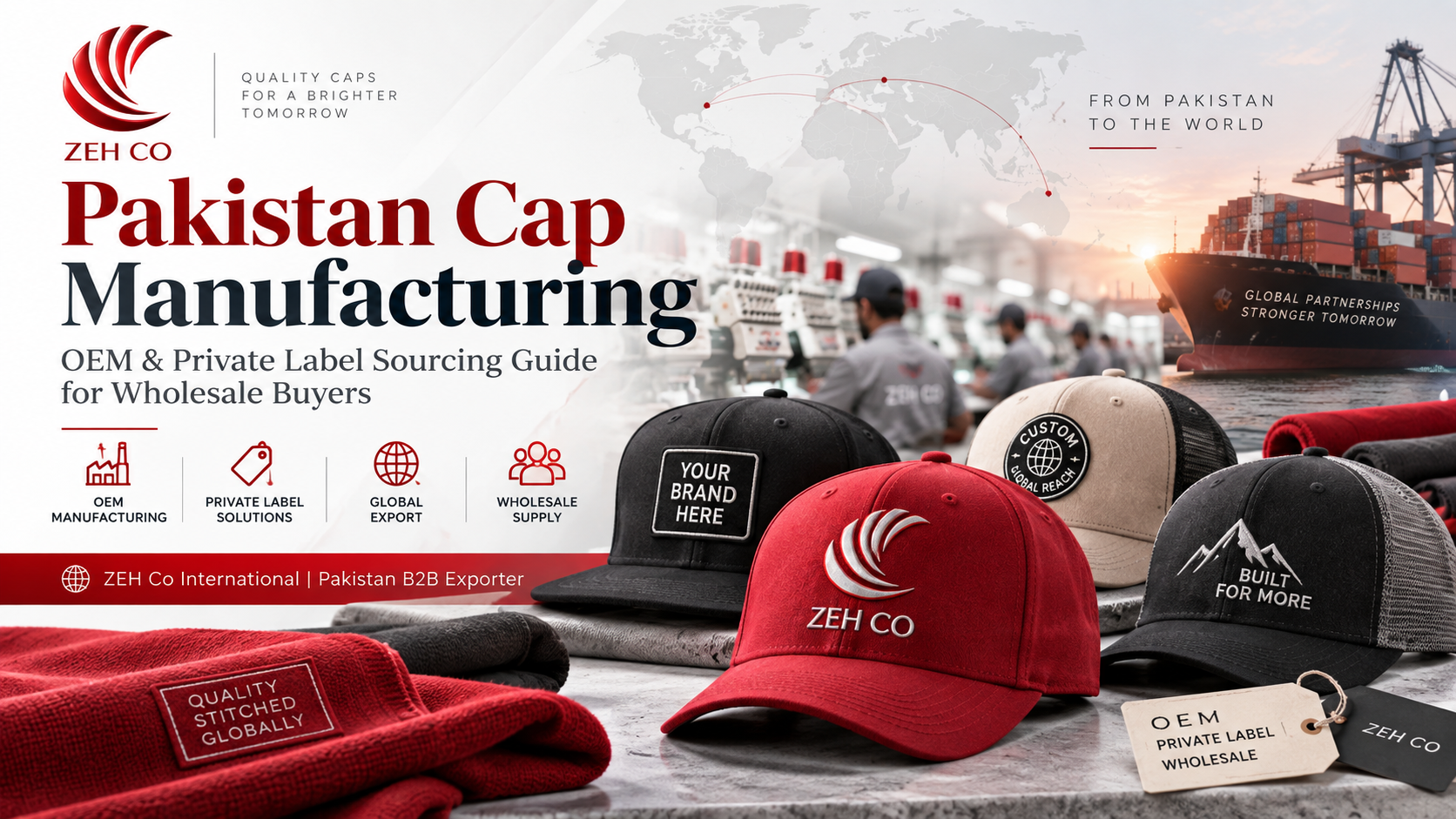
Baseball caps remain one of the most versatile options for retail brands, corporate promotions, sports organizations and merchandise businesses. Buyers can customize the crown structure, panel count, visor shape, ventilation eyelets, closure system, fabric and logo application.
Snapback Caps
Snapbacks are commonly selected by streetwear brands, sports merchandise companies and youth-focused fashion labels. Their adjustable rear closure can reduce the number of size variations required for wholesale inventory. Buyers should specify crown height, visor profile, closure color and branding placement during development.
Trucker Caps
Trucker caps normally combine front fabric panels with mesh sections that improve ventilation. They are popular for outdoor, automotive, workwear, promotional and casual markets. Importers should pay particular attention to mesh quality, crown shape and stitching around the transition between fabric and mesh panels.
Unstructured and Casual Caps
Unstructured caps provide a softer appearance and are often used by lifestyle, fashion and minimalist private-label brands. Fabric washing, embroidery density and fit become especially important because the finished appearance depends heavily on how the material falls around the crown.
Choosing the Right Fabric for Custom Caps
Fabric selection affects comfort, durability, appearance, printing compatibility and production cost. Importers should avoid placing an order using only descriptions such as “premium cotton” or “high-quality polyester.” A more useful specification defines the actual fabric composition, weight, finish and required color.
- Cotton: Suitable for casual, fashion and promotional caps where a natural hand feel is preferred.
- Polyester: Often selected for sports, performance, promotional and outdoor applications because of its durability and versatility.
- Cotton-polyester blends: Can provide a balance between comfort, structure and durability.
- Mesh: Commonly used for trucker caps and products where improved airflow is required.
- Specialty fabrics: Buyers can discuss performance, brushed, washed or other finishes when developing a differentiated collection.
Color consistency should also be confirmed before bulk production. When a brand requires a specific corporate or retail color, the buyer should provide an approved color reference rather than relying only on names such as navy blue, royal blue or dark green.
Private Label and Custom Branding Options
Brand presentation is one of the most important areas of OEM cap manufacturing. A generic cap becomes a private-label product through the combination of logo application, labels, packaging, color selection and customized construction.
Embroidery
Embroidery is widely used for front logos, side branding and small rear graphics. Buyers should review embroidery samples carefully because the final appearance depends on stitch density, thread selection, artwork complexity and the fabric underneath the embroidery.
Very fine text or extremely detailed artwork may require simplification to achieve a clean result. Sending a vector logo file helps the manufacturing team prepare more accurate artwork for production.
Woven and Embroidered Patches
Patches can create a strong visual identity for fashion, outdoor, motorsport and workwear collections. They may be positioned on the front panel, side or another agreed location. The buyer should approve the patch dimensions, border, colors and attachment method before production.
Printed Branding
Depending on the cap material and design, printed logos or graphics may also be considered. The suitability of a printing method should be confirmed through sampling because different fabrics respond differently to ink, heat and pressure.
Private Labels and Packaging
Wholesale buyers can also develop a more complete branded product through woven labels, care labels, size information, hang tags, stickers and customized packaging. Importers selling through retail stores or e-commerce channels should communicate labeling and packaging requirements before the quotation stage, as these components affect final cost and production planning.
Cap Construction Details Importers Should Specify
One of the most common sourcing mistakes is concentrating on the logo while ignoring cap construction. Two caps with similar photographs can feel very different when worn because of changes in crown dimensions, visor construction, panel shape and internal finishing.
A detailed purchase specification should address the following points:
- Cap style and intended market
- Number and shape of panels
- Structured or unstructured crown
- Fabric composition and color
- Visor shape and stiffness
- Curved or flat peak requirement
- Closure type
- Ventilation eyelets
- Sweatband material
- Logo size and position
- Embroidery or patch requirements
- Internal labels and care information
- Finished dimensions and fit
- Individual and master-carton packaging
A physical reference sample can be extremely useful when the buyer wants to reproduce a particular fit or construction. The supplier can compare measurements, materials and structural details against the reference before preparing a development sample.
Importance of Pre-Production Sampling
Sampling is an essential stage for private-label cap orders. It allows both buyer and manufacturer to identify differences before those differences are repeated across hundreds or thousands of pieces.
During sample review, importers should check the cap from both a technical and commercial perspective. A product may be correctly manufactured but still fail to match the intended retail positioning.
Important sample inspection points include:
- Overall crown shape and fit
- Front-panel symmetry
- Peak shape and alignment
- Fabric color and texture
- Embroidery placement and dimensions
- Logo thread colors
- Closure operation
- Sweatband finishing
- Inside seam quality
- Labels and branding
- Packaging presentation
Buyers should provide consolidated feedback rather than approving changes through scattered messages. A final approved sample, specification sheet or clearly recorded set of changes creates a much stronger production reference.
Quality Control for Wholesale Cap Orders
Quality control should focus on measurable and repeatable characteristics. Importers should establish acceptable standards before production instead of attempting to define quality after goods have already been manufactured.
Fabric and Color Inspection
Materials should be checked against the approved sample or specification for appearance, composition, consistency and visible defects. Color variation can be particularly noticeable when multiple panels form one cap.
Stitching and Construction
Inspectors should look for irregular stitching, skipped stitches, loose threads, asymmetrical panels, distorted crowns and poorly aligned peaks. Because a cap is highly visible when worn, relatively small alignment problems can negatively affect its retail appearance.
Logo and Embroidery Inspection
Brand logos must be positioned consistently. Buyers should define logo dimensions and placement rather than relying on visual judgment alone. Embroidery should also be checked for loose threads, incorrect colors, distortion and inconsistent density.
Closure and Functional Checks
Adjustable straps, buckles, snap closures and other components should operate correctly. Functional checks are particularly important for caps intended for repeated daily use.
How Wholesale Buyers Should Request a Cap Quotation
A detailed request for quotation helps manufacturers calculate prices more accurately and reduces unnecessary communication. Instead of sending only a photograph and asking for the “best price,” buyers should provide enough technical information to define the product.
A professional RFQ should ideally include:
- Required cap style
- Estimated order quantity
- Number of colors
- Fabric preference
- Logo artwork
- Branding technique
- Label requirements
- Packaging instructions
- Target destination
- Preferred shipping term
- Required delivery schedule
The final price can change according to materials, quantity, embroidery complexity, accessories, packaging and shipping requirements. For this reason, comparing suppliers solely on an initial unit price can produce misleading results if the quotations are based on different specifications.
MOQ and Bulk Order Planning
Minimum order quantity for custom caps depends on the construction, fabric, number of colors, branding process and packaging requirements. Highly customized products may require different production quantities than standard cap designs with simple embroidery.
Wholesale buyers should also consider how their order quantity will be divided between colors and designs. An order containing one design in two colors is generally easier to manage than the same total quantity divided across numerous colors, embroidery patterns and packaging variations.
Brands testing a new market should discuss sample development and practical production quantities with the supplier before creating a large collection. Once a model has been tested commercially, repeat orders can use the approved specifications as a reference.
International Packaging and Shipping
Caps must be packed carefully because excessive compression can damage the crown or visor during international transportation. The packing method should therefore consider both freight efficiency and product presentation.
Buyers should confirm pieces per carton, individual packaging requirements, carton markings and any special protection needed for the cap structure. Retail-ready packaging can also be incorporated when agreed during product development.
ZEH Co supports international B2B transactions using shipping arrangements including FOB Karachi, CIF and DDP, depending on the destination and agreed commercial terms. Importers should determine which Incoterm is most suitable by considering freight responsibility, customs clearance capability, landed-cost planning and destination requirements.
Documents International Cap Importers May Require
Documentation requirements differ between countries, customers and shipping methods. Importers should confirm applicable customs and labeling regulations in their destination market before production.
Commercial shipments commonly require documentation such as a commercial invoice, packing list and transportation documents. Additional certificates or declarations may be needed depending on the buyer, destination, material composition or applicable trade regulations.
Providing the manufacturer with documentation requirements early is important because certain information may need to appear on labels, cartons or commercial documents before the shipment leaves Pakistan.
Common Mistakes When Importing Custom Caps
Many sourcing problems can be prevented through better specifications and approval procedures. International buyers should avoid several common mistakes:
- Ordering from photographs alone: Images cannot fully communicate dimensions, fabric weight or internal construction.
- Approving branding without dimensions: Exact logo measurements reduce placement inconsistency.
- Ignoring fit: Crown height and circumference significantly affect customer satisfaction.
- Changing specifications after approval: Late changes can affect production cost and schedules.
- Comparing quotations with different specifications: A lower price may simply represent a different material or construction.
- Leaving packaging decisions until shipment: Packaging influences both product protection and freight planning.
- Skipping sample approval: Sampling provides the clearest opportunity to correct problems before bulk manufacturing.
Who Can Source Custom Caps from Pakistan?
Custom cap manufacturing can serve a wide range of international B2B customers. These include clothing brands, streetwear labels, sports clubs, promotional merchandise distributors, corporate gift suppliers, uniform companies, outdoor brands, automotive businesses, wholesalers and e-commerce retailers.
The ideal production setup will vary between these buyers. A fashion label may prioritize premium materials and distinctive embroidery, while a promotional distributor may focus on repeatability, competitive bulk pricing and fast identification of multiple corporate logos. Communicating the intended sales channel helps the manufacturer recommend a more appropriate product specification.
Working with ZEH Co for Custom Cap Sourcing
ZEH Co is a Pakistan-based B2B exporter established in 2011 and works with international buyers across multiple product sectors, including textiles, clothing and related manufactured products. The company supports buyers requiring product sourcing, customization, export coordination and international shipment planning.
ZEH Co holds ISO 9001:2015 and ISO 22000 certifications and serves international markets including the UAE, China, Germany, Italy, the United Kingdom, the United States, Russia, South Korea, Vietnam and Turkey.
For cap inquiries, buyers can provide product photographs, technical specifications, artwork, estimated quantities, packaging requirements and destination details. This information allows the sourcing and production requirements to be reviewed before a commercial quotation is prepared.
Conclusion: Choosing the Right Pakistan Cap Manufacturer
Selecting the right Pakistan cap manufacturer requires more than comparing unit prices. International importers should evaluate fabric, construction, sizing, embroidery, branding, sampling procedures, quality control, packaging and export coordination as part of one complete sourcing process.
A clearly defined specification protects both the buyer and manufacturer by establishing exactly what must be produced. For private-label brands and wholesale distributors, investing additional attention during product development can improve consistency, simplify future reorders and reduce avoidable production disputes.
International buyers seeking custom baseball caps, snapbacks, trucker caps or other private-label headwear can contact ZEH Co with their artwork, target quantity, specifications and destination market to discuss OEM manufacturing and export options from Pakistan.