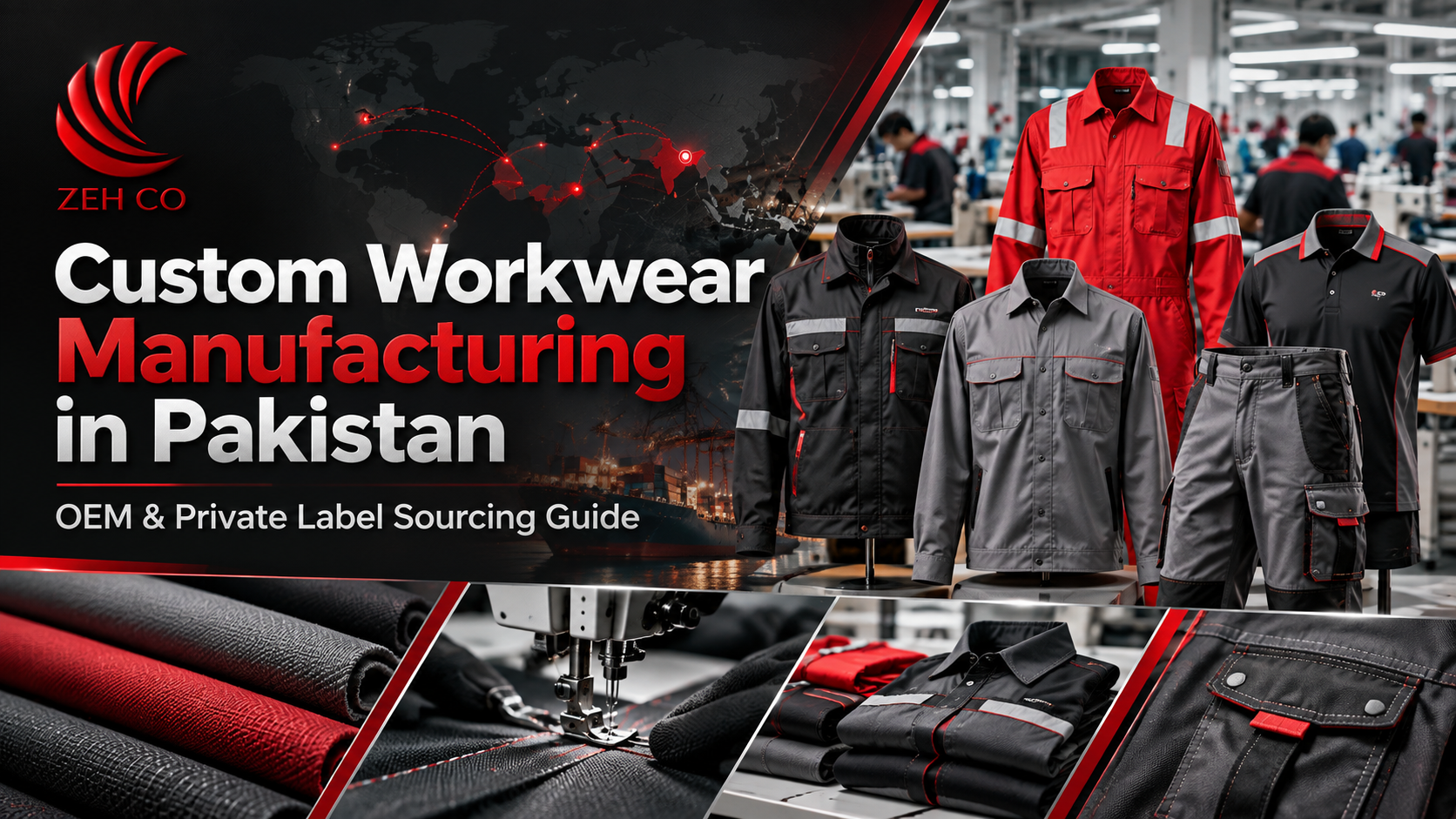
Custom workwear manufacturing in Pakistan is increasingly relevant for international distributors, uniform suppliers, industrial buyers, construction companies and private-label brands looking for competitively manufactured garments with customized fabrics, colors, logos and specifications. Unlike standard fashion apparel, professional workwear must balance durability, comfort, appearance, safety-related requirements and repeat-order consistency. For B2B buyers, selecting the right manufacturing partner therefore requires a detailed evaluation of materials, garment construction, branding methods, sizing, quality control and export packaging.
Pakistan has a well-established textile and garment manufacturing base that supports the production of customized apparel for international markets. ZEH Co works with wholesale buyers, importers and procurement professionals sourcing textile and clothing products from Pakistan, with export arrangements available under FOB Karachi, CIF and DDP depending on destination and commercial requirements.
Why Source Custom Workwear Manufacturing in Pakistan?
Workwear is a broad category covering garments used by employees in construction, logistics, warehousing, manufacturing, maintenance, automotive workshops, hospitality, security, utilities and many other industries. Buyers in these sectors often require products designed specifically around their workforce rather than generic ready-made garments.
Pakistan can support OEM and private-label workwear programs where buyers provide their own designs, color combinations, logos, labels, size specifications and packaging requirements. This makes the country relevant not only for companies purchasing uniforms for direct use but also for wholesalers and brands developing workwear collections for resale.
For international buyers, cost is important, but the lowest unit price should not be the only purchasing criterion. Garment performance, stitching quality, fabric weight, color consistency, sizing accuracy and production repeatability can have a much larger impact on long-term profitability.
Types of Custom Workwear Buyers Can Source
Workwear programs can be developed around the specific needs of an industry, brand or customer segment. The exact product range depends on the buyer's design and technical requirements.
- Industrial work shirts
- Work trousers and cargo trousers
- Work jackets
- Coveralls and boiler suits
- Warehouse and logistics uniforms
- Maintenance uniforms
- Mechanic and automotive workwear
- Construction work garments
- Corporate staff uniforms
- Hospitality and service uniforms
- Customized workwear sets
- Private-label work clothing
International buyers should specify whether they need individual garments or coordinated uniform sets. Matching shirts, trousers and jackets within one program can require careful management of color, trims and branding so that all components present a consistent appearance.
Choosing Fabrics for Custom Workwear
Fabric selection is one of the most important decisions in a workwear project. The correct material depends on the working environment, expected garment life, climate, washing conditions and target price.
Cotton Fabrics
Cotton can provide comfort and breathability, making it suitable for workwear where wearer comfort is a priority. Buyers should specify fabric composition, construction and weight rather than requesting simply “cotton workwear.”
A heavier fabric may provide greater substance and durability, while lighter material may be more suitable for warm climates or indoor work environments. The final specification should reflect the actual intended use.
Polyester-Cotton Blends
Polyester-cotton blends are commonly considered for uniforms and work garments because they can combine practical durability with wearer comfort. Different blend ratios can produce different results in terms of feel, strength, drying behavior and overall garment appearance.
Importers should therefore confirm the required fiber composition and fabric weight before sampling. Changing these specifications after sample approval can alter both pricing and performance.
Polyester-Based Materials
Polyester materials may be suitable for certain uniform applications where easy care, dimensional stability or specific appearance characteristics are required. Again, buyers should define the garment's final use before selecting material purely on price.
Fabric Weight and GSM Matter in Workwear Production
GSM, or grams per square meter, is an important part of textile specifications because it provides an indication of fabric weight. Two garments that look similar in photographs may perform very differently if one uses significantly lighter material.
Buyers should include GSM requirements in their RFQ whenever possible. A target range may also be agreed where minor production tolerance is commercially acceptable.
For demanding work environments, buyers may prefer heavier fabrics, while lightweight uniforms may be more appropriate for hot climates, indoor operations or promotional staff. There is no single GSM that is ideal for every workwear application.
Garment Construction and Reinforcement
Workwear construction should be designed around how the garment will actually be used. Employees working in warehouses, workshops or construction environments may repeatedly bend, lift, stretch and carry equipment, placing more stress on garments than ordinary casual clothing.
Reinforced Stitching
High-stress areas may require reinforced stitching depending on the garment design. Pocket openings, belt loops, side seams and other pressure points should be considered during product development.
The buyer's technical package should indicate where additional reinforcement is required rather than relying on assumptions during production.
Pockets and Utility Features
Functional workwear frequently includes multiple pockets for tools, phones, identification cards, notebooks and other workplace items. Pocket design should be based on practical use.
Buyers may specify cargo pockets, chest pockets, pen compartments, concealed pockets, zipper pockets or tool-related features. Placement and dimensions should be confirmed during sampling.
Zippers, Buttons and Trims
Trims can affect both garment appearance and long-term performance. Buyers should identify preferred zipper styles, buttons, snaps, hook-and-loop closures, drawcords, elastic sections and other accessories in the specification sheet.
Using an approved trim standard is particularly important for repeat orders because apparently small changes in components can create noticeable differences between production batches.
OEM Workwear Manufacturing for International Buyers
OEM production is suitable for buyers that already have established workwear designs and want manufacturing according to their own specification. The buyer may provide technical drawings, measurement charts, fabric information, logo placement and packaging instructions.
The manufacturer's role is then to develop samples, confirm material availability, calculate production requirements and manufacture the approved design at scale.
For professional OEM sourcing, buyers should avoid relying solely on reference photographs. A photograph can communicate general style but rarely provides enough information about fabric weight, measurements, internal construction or finishing.
Private Label Workwear Manufacturing
Private-label production enables distributors, wholesalers and clothing brands to sell workwear under their own brand identity. Branding can extend beyond simply adding a logo to the chest.
Depending on the project, customization can include:
- Custom woven labels
- Printed care labels
- Brand neck labels
- Size labels
- Hangtags
- Custom embroidery
- Screen printing
- Heat-transfer logos
- Custom packaging
- Branded cartons
All branding materials should be approved before mass production. Buyers should provide high-quality logo files and specify exact logo dimensions and placement.
Embroidery for Professional Workwear Branding
Embroidery is often selected for corporate uniforms and professional workwear because it can create a durable and premium appearance. Company names, department names, employee roles and logos can potentially be embroidered depending on the garment design.
However, embroidery cost depends on factors such as design complexity, stitch count, logo dimensions and number of embroidery locations. Buyers should therefore provide artwork when requesting a quotation.
A simple small chest logo and a large multi-color back logo should not be expected to have the same branding cost.
Printing Options for Custom Uniforms
Printing may be preferable when artwork is large, detailed or needs a different visual appearance from embroidery. The appropriate technique depends on fabric composition, quantity, artwork and required durability.
Buyers should discuss whether the logo or graphics need screen printing, heat-transfer application or another suitable method. Testing during sampling helps determine whether the selected decoration works properly with the chosen fabric.
Sizing and Measurement Specifications
Sizing is one of the most common sources of problems in international apparel procurement. A size labeled “Large” can differ substantially between brands and countries. International buyers should therefore provide an actual measurement chart rather than relying only on generic size names.
The specification can include measurements such as chest width, garment length, sleeve length, shoulder width, waist, hip, inseam and other relevant dimensions.
Buyers should also define acceptable production tolerances because textile garments cannot always be manufactured to zero measurement variation.
Developing Samples Before Bulk Production
Sampling is essential for customized workwear. It allows the buyer to evaluate the design before committing to a larger manufacturing run.
A workwear sample should be reviewed for:
- Fabric composition and feel
- Fabric weight
- Color
- Garment measurements
- Stitching quality
- Pocket positioning
- Zipper and trim selection
- Logo size and placement
- Labeling
- Overall fit and appearance
Buyers should consolidate their comments after reviewing the sample and provide clear revision instructions. Multiple unstructured changes can slow product development and increase sampling costs.
Quality Control for Bulk Workwear Orders
Quality control should compare bulk production against the approved sample and written specifications. Inspection standards should focus on measurable requirements rather than subjective expectations introduced after production.
Fabric Inspection
Fabric should be checked against the approved composition, weight, color and general quality expectations. Consistency becomes particularly important when garments are part of a company-wide uniform program.
Measurement Checks
Measurements can be checked against the buyer-approved size chart within agreed tolerances. Buyers ordering several sizes should ensure that grading between sizes has been properly defined.
Stitching and Finishing
Quality checks should review seam construction, loose threads, skipped stitches, pocket attachment, closures and overall garment finishing.
Branding Verification
Logo placement, colors, labels and other branded elements should match approved artwork. This is especially important for private-label distributors because branding errors can make otherwise usable garments commercially unacceptable.
Packaging for Wholesale and Private Label Workwear
Packaging requirements depend on how the garments will be distributed after import. Some buyers require individual polybags, while others may prefer bulk packing.
Private-label programs may also require size stickers, barcodes, branded bags, SKU labels or other retail-ready elements.
Buyers should communicate packaging requirements before the final quotation because specialized packaging materials can affect production cost.
MOQ and Bulk Order Planning
Minimum order quantities can vary according to fabric availability, number of colors, design complexity, branding requirements and size breakdown. A highly customized project using specially developed fabric may require a different production quantity from a relatively standard garment.
Importers should provide the estimated quantity by style, color and size when requesting pricing. For example, ordering 1,000 garments in one color can have very different production economics from dividing the same quantity across ten colors.
How to Request a Custom Workwear Quotation
A detailed RFQ allows the supplier to calculate pricing more accurately. International buyers should ideally provide:
- Garment type
- Reference image or technical drawing
- Fabric composition
- Required GSM
- Color requirements
- Measurement chart
- Size breakdown
- Order quantity
- Embroidery or printing artwork
- Label requirements
- Packaging specifications
- Destination country
- Required shipping term
Sending these details together can significantly reduce quotation delays and help buyers compare offers on equivalent specifications.
FOB Karachi, CIF and DDP Supply Options
ZEH Co can work with international customers using different trade terms depending on the shipment and destination.
FOB Karachi
FOB Karachi can be suitable for experienced importers that manage their own international freight arrangements or work with nominated freight forwarders.
CIF
CIF can be considered for buyers who prefer the exporter to arrange main international freight and specified insurance to the agreed destination port.
DDP
DDP may be evaluated where the buyer needs a delivered solution and the customs and logistics structure makes it commercially practical. DDP quotations should always be assessed individually because duties, taxes and delivery costs differ between countries.
Building a Repeat Workwear Supply Program
For distributors and companies ordering uniforms regularly, repeatability is often more valuable than obtaining the absolute lowest price on one shipment. Once a successful product has been developed, buyers should maintain clear records of approved fabrics, measurements, colors, trims, logos and packaging.
This specification becomes the reference for future production and helps reduce variation between repeat orders.
Forecasting future requirements can also help with procurement planning. Buyers who know they will need several production cycles each year should discuss anticipated quantities and delivery windows early.
Conclusion: Custom Workwear Manufacturing in Pakistan
Custom workwear manufacturing in Pakistan provides international importers, uniform distributors and private-label brands with opportunities to develop work garments around their own specifications. Successful sourcing depends on clearly defining fabric composition, GSM, construction, measurements, branding, packaging and quality-control requirements before bulk production begins.
ZEH Co supports international B2B buyers sourcing textile and clothing products from Pakistan and can discuss OEM and private-label workwear projects based on the buyer's design, volume, branding requirements and destination. Buyers seeking an accurate quotation should provide their technical specifications, target quantity and required shipping term so the project can be evaluated on a clear commercial basis.