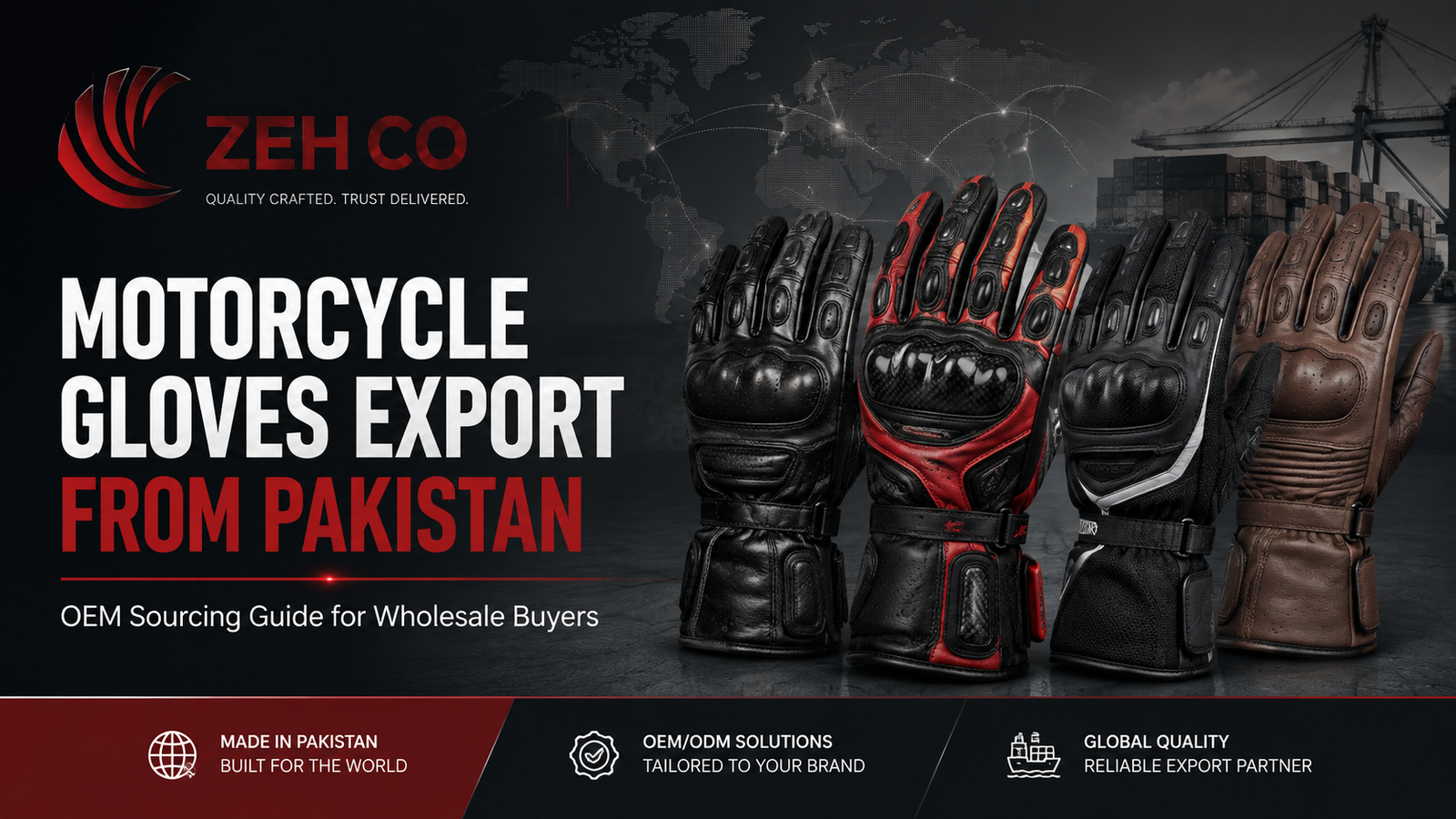
Motorcycle gloves export from Pakistan offers international wholesalers, riding-gear brands, distributors and private-label companies access to a well-established manufacturing ecosystem combining leatherwork, textile stitching, protective components and customized branding. For B2B buyers, however, successful sourcing requires more than choosing a glove design from a catalog. Materials, protection level, sizing, stitching construction, seasonal use, testing requirements, packaging and inspection standards should all be defined before bulk production. ZEH Co supports international buyers seeking structured sourcing and export solutions from Pakistan for customized motorcycle gloves and related sports and protective products.
Why Source Motorcycle Gloves from Pakistan?
Pakistan has extensive experience in leather processing, garment manufacturing, sportswear production and stitched goods. These capabilities are particularly relevant to motorcycle gloves because a single glove may combine genuine leather, synthetic textiles, mesh panels, molded protection, foam padding, hook-and-loop closures, reinforced palms and decorative branding. Buyers can therefore source products ranging from simple road-riding gloves to more technically detailed touring, racing and winter styles.
Another advantage for importers is customization flexibility. Instead of purchasing only generic finished stock, wholesale buyers can develop products around their own target market. Specifications can be adjusted according to climate, retail price range, riding category, customer demographics and brand positioning. This allows a distributor serving hot-weather riders in the Middle East to source a different construction from a European retailer requiring insulated winter gloves or a racing brand requiring stronger protection and more complex panel construction.
Motorcycle Gloves Export from Pakistan: Key Product Categories
Leather Motorcycle Gloves
Leather remains a widely requested material for motorcycle gloves because of its appearance, abrasion resistance and suitability for premium riding products. Depending on the required specification, buyers may consider cowhide, goatskin or other suitable leather types. The choice should be based on required thickness, softness, flexibility, surface finish, durability and target retail positioning rather than price alone.
Importers should specify whether leather is required throughout the glove or only in selected areas such as the palm, fingers or reinforcement zones. They should also define acceptable color variation, surface characteristics and thickness tolerances before approving samples. These details help reduce inconsistencies between the approved prototype and bulk production.
Textile and Mesh Riding Gloves
Textile motorcycle gloves are commonly developed for warmer climates, urban riding and buyers seeking lightweight products. Polyester fabrics, breathable mesh sections, synthetic palm materials and flexible reinforcement components can be combined to create gloves with better airflow than fully enclosed leather designs.
For hot-weather markets such as the UAE and other Gulf countries, ventilation can become an important purchasing factor. Buyers should therefore examine airflow zones, fabric durability and palm grip instead of selecting a glove simply because it appears lightweight. Mesh material placed in high-wear areas without appropriate reinforcement may reduce product life.
Winter and Touring Motorcycle Gloves
Cold-weather motorcycle gloves require a different specification. Buyers may request thermal lining, wind-resistant outer materials, longer cuffs, water-resistant construction and improved closure systems. Because additional layers can reduce finger movement, sample evaluation should include grip comfort and control operation while wearing the glove.
Importers should distinguish between water-resistant and waterproof requirements when preparing product specifications. If a particular waterproof performance level is commercially important, the requirement should be measurable and supported by appropriate material selection and testing instead of relying on marketing terminology alone.
Racing and Performance Gloves
Performance-oriented gloves can include molded knuckle protection, reinforced palms, additional finger protection, wrist retention systems and extended cuffs. Construction becomes more complex because protective components must be positioned correctly without unnecessarily restricting hand movement.
For these products, buyers should approve detailed pre-production samples and evaluate fit while the hand is positioned as it would be on motorcycle controls. A glove that feels comfortable with an open hand can behave differently when gripping a handlebar, so ergonomic testing should form part of sample approval.
Materials International Buyers Should Specify
A professional purchase specification should identify the main outer material, palm material, lining, reinforcement materials, protective components, closure system and any required padding. Descriptions such as “premium motorcycle glove” are too subjective for bulk procurement. Precise material specifications give both buyer and supplier measurable criteria for production and inspection.
For leather models, buyers should define leather type, required finish and intended performance. For synthetic models, fabric composition and construction should be documented. Reinforcement zones should also be identified because the palm, thumb contact area and other high-friction sections may require different materials from low-stress areas.
Buyers developing multiple price points can use a structured product architecture. For example, an entry-level collection may use synthetic materials and simplified protection, while a premium series can incorporate higher-grade leather, more sophisticated protective components and detailed finishing. Maintaining clear specifications between product tiers prevents unnecessary cost increases while preserving meaningful differences between collections.
Protection Features to Evaluate Before Ordering
Motorcycle glove appearance should never be the only purchasing criterion. Depending on the product category, buyers may evaluate knuckle protection, palm reinforcement, wrist retention, finger coverage, abrasion-resistant panels and protective padding. Each component should remain correctly positioned when the hand moves and should not create excessive pressure points.
Importers selling protective motorcycle gloves in regulated markets should also determine which product safety, labeling, testing or conformity requirements apply in the destination country. Where standards such as EN 13594 or other motorcycle protective-equipment requirements are relevant to the intended market, compliance expectations should be established before mass production. Buyers should verify current legal and certification requirements with the appropriate testing or conformity-assessment organization for their destination market.
Private Label and OEM Motorcycle Gloves
OEM motorcycle gloves allow brands to control more than the logo. Buyers can develop custom color combinations, panel layouts, cuff designs, material combinations, protection placement, closure styles and packaging. This is especially useful for importers building a coordinated riding-gear collection where gloves need to match jackets, racing suits or other accessories.
Branding options can include embroidered logos, printed graphics, rubber or molded logo patches, woven labels, heat-transfer graphics and branded packaging depending on the glove construction. Buyers should identify logo dimensions and placement during sampling because changing branding after production begins can affect panel dimensions and manufacturing processes.
Private-label buyers should provide vector artwork whenever possible. Color references should also be clearly communicated using recognized color standards or approved physical samples. Relying only on colors displayed on a computer or mobile screen can produce unexpected differences in finished materials.
Motorcycle Glove Sizing for International Markets
Sizing is one of the most important areas in glove sourcing because customers immediately notice incorrect fit. Simply marking products S, M, L and XL without an agreed measurement chart can create inconsistent expectations between supplier and importer.
Buyers should define measurement points such as hand circumference, hand length, finger length and cuff opening where relevant. If the gloves will be sold in Europe, North America, the Middle East or Asia, sizing should be reviewed against the intended customer base. The same nominal size may not satisfy every market.
A complete size set should ideally be evaluated before large-volume production, particularly when the buyer is developing a proprietary fit. Checking only one sample size may fail to reveal grading problems that become visible in smaller or larger sizes.
Quality Control Before Shipment
For wholesale motorcycle glove orders, quality control should begin during product development rather than only after production is completed. The approved sample should serve as the reference for materials, construction, measurements, branding and workmanship.
Production inspections can evaluate stitching consistency, loose threads, seam alignment, protection placement, logo position, color matching, closure strength, left-and-right glove pairing and size measurements. Leather products may also require inspection for excessive shade differences, avoidable surface defects or inconsistent panel selection depending on the agreed quality grade.
Functional inspection is equally important. Closures should operate correctly, fingers should flex comfortably, internal seams should not create unacceptable pressure points, and reinforcement pieces should remain correctly positioned. Packaging quantities and carton markings should also be checked against the purchase order before dispatch.
Packaging Options for Wholesale Motorcycle Gloves
Packaging should be planned according to the buyer's distribution model. A bulk distributor may prefer economical individual polybags and export cartons, while a retail brand may require printed boxes, hang cards, barcode labels, size stickers, care instructions and customized inserts.
Buyers should provide barcode data, SKU structure and carton-marking requirements before packing begins. Each carton can be organized by model, size and color to simplify receiving operations at the destination warehouse. Accurate packing lists are especially important for mixed-size shipments containing several glove designs.
Retail packaging should also be evaluated for shipping efficiency. Oversized boxes increase dimensional volume and can raise logistics costs without improving the product. Packaging development should therefore balance retail presentation, product protection and carton utilization.
MOQ and Sample Development
Minimum order quantity depends on factors including material availability, number of colors, size breakdown, custom components, logo application and packaging requirements. A simple existing design with minor branding modifications will normally be easier to develop than a fully customized glove requiring unique molds, specialized protection or multiple custom materials.
International buyers can reduce development problems by beginning with a clear technical brief. Useful information includes product reference images, target use, required materials, expected protection features, size range, colors, branding details, packaging requirements, destination market and estimated order quantity.
Samples should be treated as technical approval tools rather than merely sales samples. Feedback should identify exact changes such as increasing finger length, relocating a logo, changing cuff width or replacing a material. Clear revision instructions shorten development cycles and improve production accuracy.
Commercial Terms and International Shipping
ZEH Co works with international buyers using commercial arrangements that may include FOB Karachi, CIF and DDP depending on destination, shipment characteristics and agreed order conditions. Selecting the correct Incoterm is important because it determines which party manages different transport stages, costs and responsibilities.
FOB Karachi can suit experienced importers or distributors managing their own freight arrangements. CIF may be useful when the buyer wants the exporter to arrange ocean freight and insurance to the agreed destination port. DDP may be considered for buyers seeking a broader logistics solution where commercially and operationally available.
Motorcycle gloves are relatively compact compared with many other manufactured products, allowing buyers to consider both air freight and sea freight depending on order size and urgency. Samples and small commercial quantities may move by air or courier, while higher-volume wholesale orders can achieve better freight economics through consolidated or sea shipments.
Documents Buyers Should Confirm Before Shipment
Required documentation depends on the destination country and transaction, but commercial shipments commonly involve a commercial invoice, packing list and transport documentation. Certificates of origin, inspection reports, product test reports or other documents may also be requested according to buyer requirements or destination-market regulations.
Importers should confirm documentation requirements before production is completed. Waiting until cargo is ready to ship can create unnecessary delays if a particular certificate, label statement or compliance document requires advance preparation.
How to Request a Motorcycle Gloves Quotation from ZEH Co
A detailed quotation request helps suppliers calculate pricing more accurately. International buyers should provide the motorcycle glove category, material preference, estimated quantity, size ratio, number of colors, branding method, packaging type, destination country and preferred shipping term.
If the buyer has an existing product, technical drawing or reference sample, it can be used to clarify construction requirements. Buyers developing a new collection should explain the target market and intended retail positioning so appropriate material and construction options can be evaluated.
ZEH Co is a Pakistan-based B2B exporter established in 2011, serving wholesale buyers and international procurement requirements across multiple product categories. The company supports export transactions for customers in markets including the UAE, China, Germany, Italy, the UK, USA, Russia, South Korea, Vietnam and Turkey, with shipping arrangements available under FOB Karachi, CIF and DDP terms according to the transaction.
Conclusion
Successful motorcycle gloves export from Pakistan depends on translating a buyer's commercial idea into a detailed and measurable product specification. Materials, protection, sizing, stitching, branding, packaging, quality control and destination-market requirements should all be agreed before bulk production begins. International wholesalers and private-label brands that establish clear specifications during sampling are better positioned to achieve consistent quality, predictable costs and smoother repeat orders. Buyers seeking customized motorcycle gloves, OEM branding and international shipment support can contact ZEH Co through https://zehcointernational.com/ to discuss product specifications, quantities, packaging and delivery requirements.