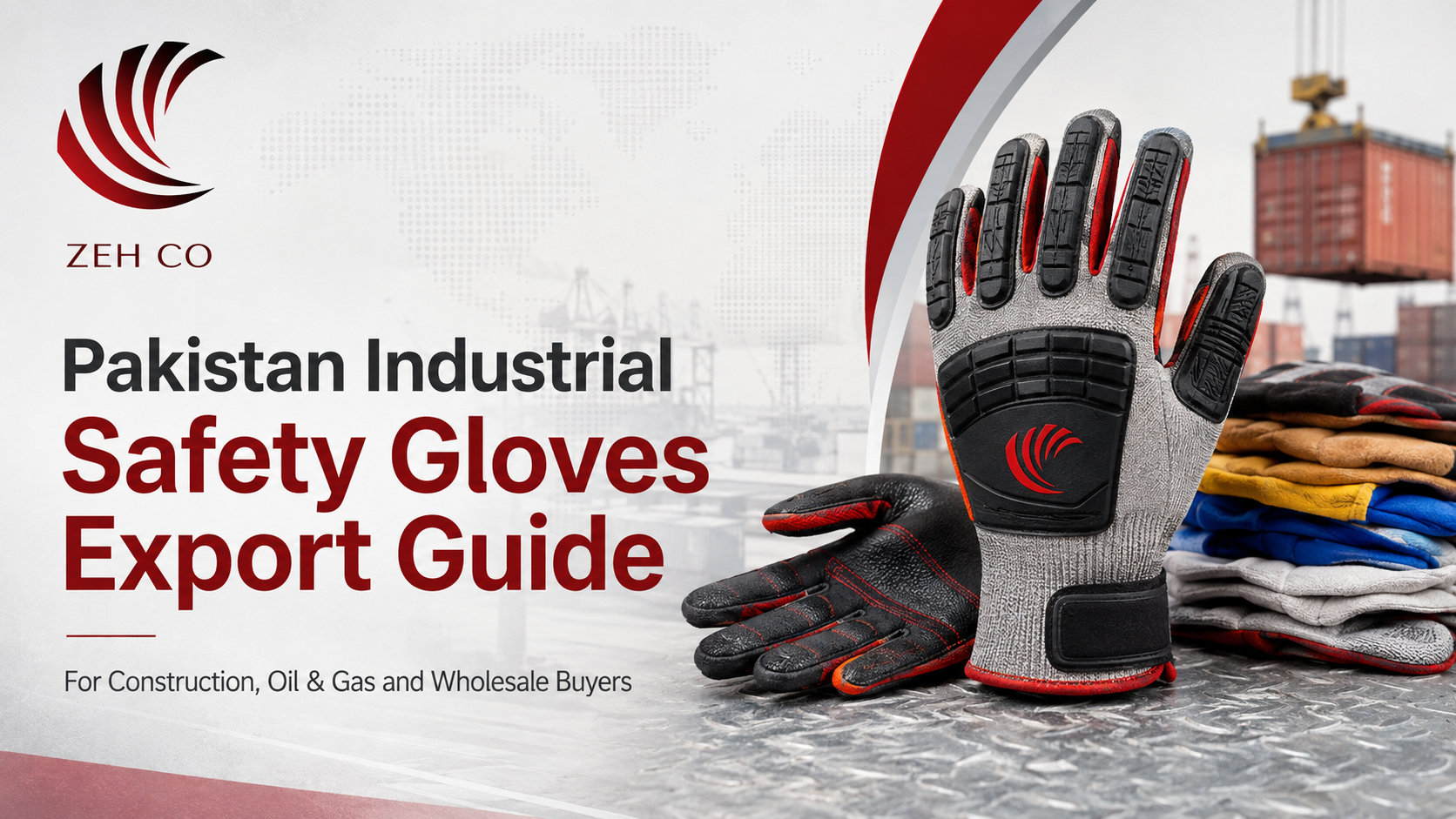
Pakistan industrial safety gloves are an increasingly relevant sourcing category for international PPE importers, construction suppliers, industrial distributors, oil and gas contractors and private-label workwear brands. Pakistan combines an established textile and leather manufacturing base with export-oriented production capabilities, making it suitable for buyers looking for leather work gloves, fabric gloves, coated gloves and other hand-protection products. For serious B2B procurement, however, buyers should evaluate far more than price. Glove material, construction, intended hazard, sizing, testing requirements, labeling, packaging and consistency between production batches can directly influence product performance and commercial acceptance.
Why Buyers Source Pakistan Industrial Safety Gloves
Pakistan has long-standing manufacturing capabilities in leather, textiles, stitching and sports-related protective products. These capabilities can also support the production of industrial work gloves for international wholesalers and private-label buyers. Manufacturers can combine locally available leather and textile materials with cutting, stitching, reinforcement, lining, printing and packaging processes required for commercial glove production.
For importers, Pakistan can be particularly useful when sourcing multiple glove categories from one manufacturing market. A distributor may require general-purpose leather gloves, reinforced work gloves, winter industrial gloves and customized branded products for different customer segments. Consolidating sourcing can simplify communication, quality control and packaging development.
The most successful procurement programs begin with a clearly defined application. A glove designed for warehouse handling is not automatically suitable for welding, heavy construction or chemical exposure. Buyers should therefore identify the hazard and intended work environment before selecting a glove design.
Main Types of Pakistan Industrial Safety Gloves
Leather Work Gloves
Leather remains widely used in industrial hand protection because it offers durability, abrasion resistance and practical protection for many mechanical tasks. Depending on design and leather selection, work gloves may be used in construction, logistics, material handling, fabrication, agriculture and general maintenance.
Common construction options can include full-leather gloves, leather palm gloves and reinforced designs. Buyers should specify the type of leather, thickness expectations, reinforcement areas and whether lining is required. These details directly affect durability, comfort and price.
Fabric and General-Purpose Gloves
Fabric gloves can be suitable for light handling, packaging, warehouse operations and general-purpose work where high mechanical protection is not required. Cotton or blended fabrics may be selected according to comfort, breathability and cost objectives.
For higher-volume industrial users, consistency in fabric weight, stitching and sizing can be more commercially important than decorative appearance. Buyers should therefore include measurable specifications in their purchase documents.
Coated Work Gloves
Coated gloves are commonly used where buyers need improved grip, abrasion performance or handling efficiency. Various coating technologies exist in the global PPE industry, and the appropriate option depends on application and required certification.
Importers sourcing coated gloves should confirm coating material, coating coverage, liner construction, grip pattern, size range and any required test results. Claims such as “oil resistant” or “cut resistant” should not be used without appropriate technical evidence supporting the intended market claim.
Winter Industrial Gloves
Cold-weather work environments may require insulated gloves that combine hand protection with thermal comfort. Buyers serving construction, transport, warehouse or outdoor industries in colder climates may request fleece, thermal or other suitable linings.
Insulation can reduce dexterity if the design becomes too bulky, so product development should balance warmth with handling requirements. Buyers should test representative samples before confirming large private-label orders.
Choosing Gloves According to Industrial Application
The end-use application should determine glove construction. General-purpose gloves should not be marketed as specialized protective equipment unless their performance has been tested for the relevant hazards.
- Construction: Buyers often prioritize abrasion resistance, grip, reinforcement and durability.
- Warehousing and logistics: Dexterity, comfort and grip can be especially important for repetitive handling.
- Metal fabrication: Buyers may require thicker materials, reinforced construction and protection appropriate to the task.
- Oil and gas operations: Products may require stricter performance specifications and documented compliance depending on the intended application.
- Agriculture: Durability, comfort and economical replacement cost are often key procurement factors.
- General maintenance: Flexible multi-purpose designs may be preferred for mixed tasks.
International buyers should avoid purchasing solely from photographs. Two gloves with nearly identical appearance can differ significantly in leather thickness, seam construction, liner quality, reinforcement and overall performance.
Material Selection for Industrial Safety Gloves
Material is one of the most important elements affecting glove performance and price. For leather work gloves, buyers may encounter cowhide, goatskin or other leather categories, each offering different characteristics.
Cowhide
Cowhide is frequently selected for industrial work gloves because of its durability and suitability for demanding general-purpose applications. Depending on finishing and thickness, it can provide a useful combination of strength and abrasion resistance.
Goatskin
Goatskin can provide flexibility and a softer hand feel while maintaining useful durability. It may be preferred where workers need better dexterity than is typically associated with heavier leather constructions.
Textile Components
Industrial gloves may incorporate cotton, polyester, knitted materials, elastic cuffs, hook-and-loop closures or reinforcement fabrics. Buyers should specify material composition whenever it affects regulatory labeling, product claims or customer requirements.
Consistency is important for repeat orders. A manufacturer should not substitute materials without buyer approval when the change could affect performance, appearance or compliance.
Safety Standards and Compliance Considerations
Industrial glove requirements vary by country and application. Buyers importing PPE into regulated markets should determine which standards, conformity procedures and labeling rules apply before placing a production order.
For example, certain markets may require testing related to mechanical risks, abrasion, cut resistance, tear resistance, puncture resistance, thermal hazards or other performance characteristics. The exact requirements depend on the product category and intended claim.
Importers should request valid documentation relevant to the specific glove model rather than relying on general statements such as “CE quality” or “international standard.” Certifications, declarations and test reports should correspond to the actual product being purchased where required.
Regulatory compliance remains the responsibility of the parties according to the destination market, so buyers should verify current requirements with qualified testing laboratories, certification bodies and local regulatory specialists before commercialization.
OEM and Private-Label Manufacturing Options
Private-label sourcing is important for wholesalers, industrial distributors and PPE brands seeking products under their own trademarks. Pakistan industrial safety gloves can be developed with customized branding, packaging and product details according to order size and manufacturing capability.
Common customization options may include:
- Printed or embossed buyer logos
- Custom cuff labels
- Brand-specific color combinations
- Private-label hangtags
- Individual polybag packaging
- Printed retail boxes
- Master carton customization
- Barcode and SKU labeling
- Customized size markings
Buyers should provide accurate vector logo files, packaging artwork, Pantone references where necessary and labeling content before mass production. A pre-production sample or approved reference sample should normally be established when branding and construction details are important.
Importance of Glove Sizing and Fit
Size inconsistency can create complaints even when material quality is acceptable. Industrial gloves should be developed around a defined sizing system and checked for repeatability between production batches.
Buyers should specify required sizes, such as small through extra-large or another defined range, and should confirm whether dimensions are based on their own specifications or the manufacturer's standard pattern. For private-label programs, an approved size chart can be retained as part of the product specification.
Fit affects more than comfort. Gloves that are excessively loose may reduce handling control, while gloves that are too tight can reduce comfort during long work periods. Buyers serving professional users should therefore test actual samples across representative hand sizes.
Stitching and Construction Quality
Industrial gloves are exposed to repeated movement and mechanical stress, making stitching quality a key production factor. Inspection should consider seam consistency, skipped stitches, loose threads, reinforcement at stress points and alignment of components.
For leather gloves, variation in natural material also requires careful cutting and selection. Defective or weak leather areas should not be used in high-stress sections simply to reduce manufacturing cost.
Reinforcement may be added to palms, fingertips, thumbs or other areas depending on the intended application. Buyers should confirm exactly where reinforcement is required rather than assuming that all “heavy-duty” gloves use the same construction.
Quality Control Before Industrial Glove Shipment
Quality inspection should be based on agreed specifications. For large wholesale orders, random sampling can help verify workmanship, size consistency, material appearance, branding accuracy and packaging before shipment.
A practical inspection process may evaluate:
- Correct glove model and size
- Pair matching
- Material consistency
- Stitching and seam quality
- Reinforcement placement
- Logo accuracy
- Labels and care instructions
- Packaging quantity
- Carton markings
- Visible manufacturing defects
Where safety performance claims are involved, visual inspection alone is not sufficient. Relevant laboratory testing should be completed according to the standards applicable to the product and destination market.
Packaging for Wholesale and Industrial Distribution
Packaging requirements differ depending on whether gloves are supplied to industrial distributors, retailers, contractors or institutional procurement programs. Bulk customers may prioritize efficient carton packing, while retail buyers may need individual packaging and display-ready presentation.
Importers should specify the number of pairs per inner pack, pairs per master carton, carton dimensions, gross weight limits and any barcode requirements. Optimized carton dimensions can also improve container utilization and reduce freight cost per pair.
Private-label buyers should approve packaging samples before mass printing because errors in barcodes, compliance markings or product descriptions can create costly problems after shipment.
How to Prepare an Industrial Safety Gloves RFQ
A detailed request for quotation allows suppliers to offer a more accurate price and reduces the risk of receiving quotations for products that only look similar. Buyers should include technical and commercial details from the beginning.
- Glove type and intended application
- Material specification
- Required leather or fabric thickness where applicable
- Size range and quantity per size
- Required reinforcement
- Lining requirements
- Color requirements
- Applicable safety standards or testing requirements
- Logo and private-label requirements
- Packaging configuration
- Total quantity
- Destination country and port
- Preferred shipping term
- Required delivery schedule
The more detailed the specification, the easier it becomes to compare competing quotations on an equal basis. A low price may simply reflect thinner material, less reinforcement, simplified packaging or the absence of required testing.
Evaluating a Pakistan Industrial Safety Gloves Supplier
International buyers should assess a supplier's ability to maintain product specifications across repeated production runs. Reliable B2B procurement requires production discipline as well as competitive pricing.
- Manufacturing capability: Confirm whether the supplier can handle cutting, stitching, reinforcement, finishing and packaging consistently.
- Material control: Materials should match approved specifications and should not be substituted without authorization.
- Sample development: The supplier should be willing to develop and revise samples before bulk production.
- Quality control: Inspection procedures should cover both workmanship and buyer-specific requirements.
- Compliance awareness: The supplier should understand that PPE claims require applicable testing and documentation.
- Export documentation: Commercial invoice, packing list, shipping documents and other required paperwork should be prepared accurately.
- Communication: Clear communication is essential when orders include multiple sizes, designs and branding elements.
FOB, CIF and DDP Procurement Options
International buyers can negotiate different shipping arrangements depending on their import infrastructure. FOB Karachi may be useful for buyers who prefer to manage international freight through their own forwarders. CIF can allow the exporter to arrange freight and insurance to an agreed destination port. DDP may be considered for selected destinations where import procedures, duties and delivery can be managed under an agreed commercial structure.
Importers should compare offers using the same Incoterm. A factory-level or FOB price should not be directly compared with a delivered quotation without accounting for freight, insurance, customs clearance, duties and inland transportation.
ZEH Co for Industrial Safety Glove Sourcing from Pakistan
ZEH Co is a Pakistan-based B2B exporter established in 2011, working with international importers, wholesale buyers and procurement organizations. The company's wider product portfolio includes gloves, textiles, leather products, fresh agricultural products, grains and Himalayan salt.
For industrial glove inquiries, ZEH Co can discuss buyer requirements including glove construction, materials, size assortment, private labeling, packaging and shipping terms. Orders can be developed according to commercial specifications for distributors, wholesalers, contractors and private-label brands.
ZEH Co offers international trade arrangements including FOB Karachi, CIF and DDP, subject to destination and commercial feasibility. The company also holds ISO 9001:2015 and ISO 22000 certifications. International buyers can submit sourcing requirements through https://zehcointernational.com/.
Conclusion: Building a Reliable Pakistan Industrial Safety Gloves Supply Program
Sourcing Pakistan industrial safety gloves successfully requires a combination of product specification, manufacturing control, appropriate testing, packaging accuracy and reliable export coordination. Buyers should begin by identifying the actual industrial application and then define the materials, construction, sizes, performance requirements and branding needed for that market.
For wholesalers, PPE distributors and private-label businesses, Pakistan offers access to established leather and textile manufacturing capabilities that can support customized industrial glove programs. ZEH Co works with international B2B buyers seeking structured sourcing from Pakistan and can prepare glove procurement proposals based on quantity, specifications, destination and required shipping terms. Buyers can contact ZEH Co through https://zehcointernational.com/ for industrial safety glove sourcing inquiries.