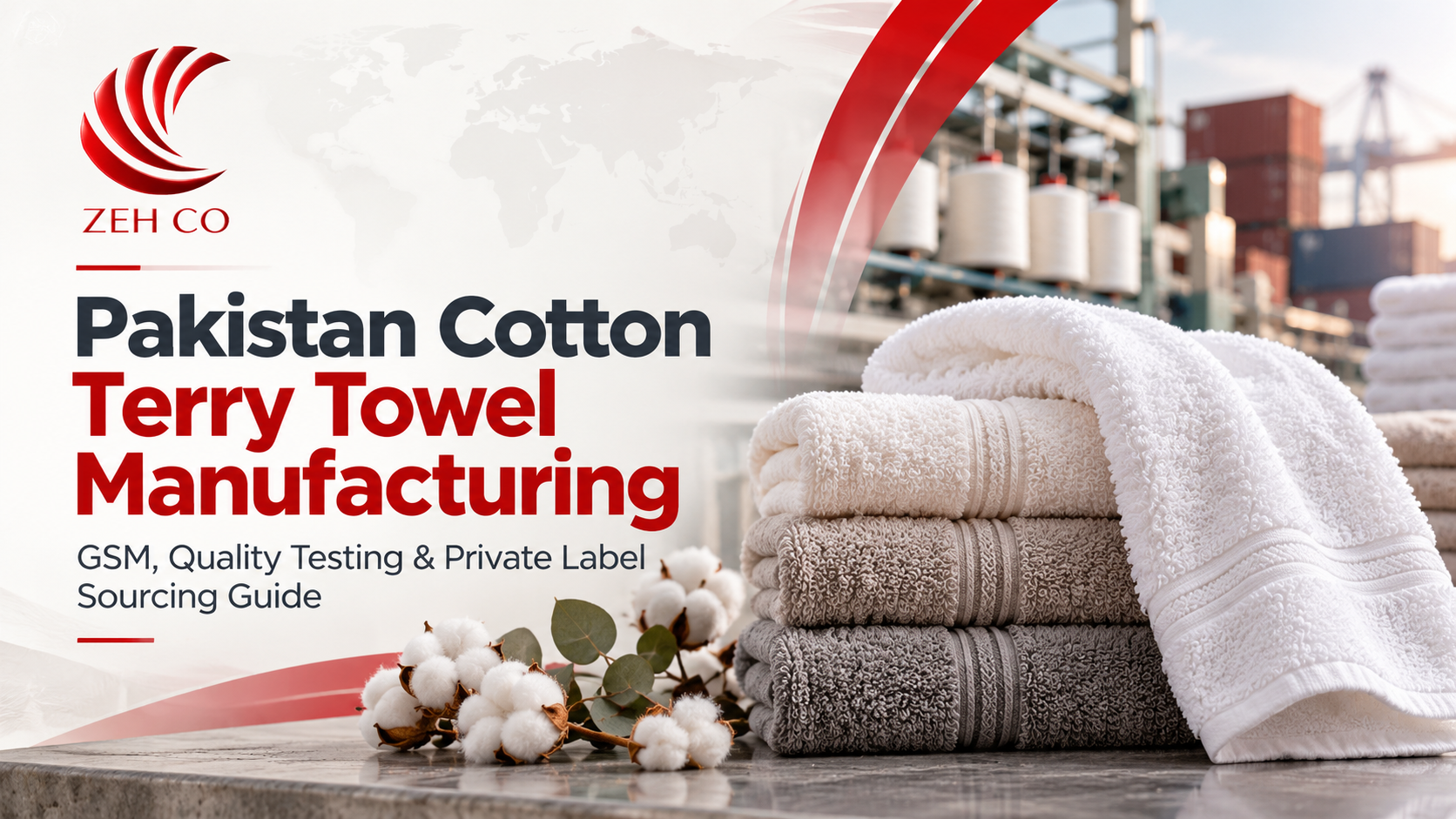
Pakistan Cotton Terry Towel Manufacturing: A B2B Procurement Opportunity
Pakistan cotton terry towel manufacturing offers international importers an opportunity to develop wholesale bath linen, hotel towel collections, spa products and private label home textile ranges. However, selecting the right supplier requires more than comparing quotations. Buyers must evaluate fabric weight, yarn construction, absorbency, dimensional stability, finishing quality and packaging before placing commercial orders.
For distributors, hospitality purchasing departments and retail brands, consistency between approved samples and bulk shipments is especially important. An attractive towel can still perform poorly if its pile construction, dyeing or finishing is unsuitable for the intended washing conditions.
ZEH Co, a Pakistan-based wholesale export company established in 2011, supports international buyers with textile sourcing enquiries, product specifications, procurement coordination and export documentation. This guide explains how importers can prepare technically accurate towel purchase orders and reduce sourcing risks.
Understanding Cotton Terry Towel Construction
Terry towels are generally produced with an additional looped pile structure designed to absorb moisture. Their performance depends on multiple variables, including fibre composition, yarn quality, loop length, weaving density, finishing and laundering behaviour.
Ring-Spun Cotton and Combed Cotton
Ring-spun cotton yarn is commonly considered for towel manufacturing because it can offer a balance between durability and softness. Combed cotton undergoes additional fibre preparation to remove shorter fibres and impurities, potentially producing a smoother yarn. Buyers should not assume that a combed cotton label alone guarantees better performance; actual testing and finished-product inspection remain necessary.
Open-End Yarn and Cost-Focused Construction
Open-end spun yarn may be evaluated for price-sensitive institutional or promotional towel programmes. The resulting quality depends on yarn count, fibre characteristics and fabric design. When comparing ring-spun and open-end options, buyers should request equivalent finished towel specifications rather than relying solely on yarn descriptions.
Pile Height and Fabric Density
Terry pile loops influence the towel's texture, surface area and drying behaviour. Longer pile loops can create a fuller feel but may also increase vulnerability to snagging where the construction is unsuitable. Shorter, tightly controlled loops may be attractive for some commercial laundry applications.
Importers should request information about pile construction and evaluate samples for loose loops, uneven surface texture and excessive lint formation after laundering.
Choosing the Right GSM for Wholesale Cotton Towels
GSM stands for grams per square metre and describes a textile's mass relative to its area. It is a useful purchasing parameter, but GSM alone does not measure absorbency, softness or overall quality.
As an initial sourcing framework, buyers may compare the following indicative towel weight categories:
- 300–400 GSM: Lightweight towels suited to selected promotional, travel and cost-sensitive applications.
- 400–500 GSM: Medium-weight towels for general retail, household and selected hospitality requirements.
- 500–600 GSM: Fuller towels often considered for premium household, hotel and spa collections.
- 600–700 GSM: Heavyweight towels aimed at buyers prioritising a substantial, plush feel.
- Above 700 GSM: Specialist luxury constructions where increased weight must be balanced against washing and drying costs.
These categories are commercial reference ranges rather than universal quality classifications. A well-manufactured 450 GSM towel may outperform a poorly finished 650 GSM towel in absorbency, durability or wash stability.
How to Calculate Approximate Towel Weight
A useful purchasing formula is: towel weight in grams equals finished length in metres multiplied by finished width in metres multiplied by GSM.
For example, a 70 × 140 cm bath towel with a nominal fabric weight of 500 GSM has an approximate calculated weight of 490 grams. Actual finished weight may differ because of hems, borders, production tolerances and construction details.
When negotiating freight, buyers should request verified finished net weights and carton gross weights rather than calculating logistics costs from GSM alone.
Quality Testing Requirements for International Importers
Quality inspection is a critical stage of international towel sourcing. A reliable specification should identify the test methods, acceptance limits, sampling procedures and responsibility for third-party inspection.
Absorbency Performance
Absorbency determines how effectively a towel takes up water during use. Buyers may request water absorption or immersion testing appropriate to the product. Testing should be performed on representative finished samples, with consideration given to the effects of washing and finishing treatments.
Some finishing agents can temporarily affect water absorption. Therefore, buyers should evaluate both the initial performance and the condition of towels after washing where relevant.
Colour Fastness to Washing
Colour fastness indicates how well a dyed towel resists colour change and staining during laundering. ISO 105-C06 provides test methods for assessing textile colour fastness under specified washing conditions.
Importers should agree on acceptable performance ratings before production. Dark-coloured hotel towels, for example, may require particular attention where repeated commercial washing is expected.
Dimensional Stability and Shrinkage
Towels may change dimensions after laundering due to fabric relaxation and other construction-related factors. Buyers can specify washing procedures based on EN ISO 6330 and dimensional change assessment methods such as ISO 5077, selecting conditions relevant to the expected product use.
A tolerance should be clearly documented. It is not sufficient for a supplier to describe a towel as pre-shrunk without establishing how shrinkage performance is measured.
Stitching, Loop Security and Physical Inspection
Commercial inspections should include hem stitching, side seams, loose yarns, pile uniformity, stains, holes, incorrect dimensions and visual shade variation.
For institutional contracts, buyers may also consider suitable tensile strength and pile-loop extraction tests. These can help assess construction durability, particularly where towels will undergo frequent laundering.
Private Label Cotton Towel Manufacturing for International Brands
Private label towel programmes allow wholesalers and retailers to develop coordinated product collections without establishing their own manufacturing facilities.
Common customisation requirements include:
- Custom bath towel, hand towel, face towel and bath sheet dimensions.
- Brand-specific cotton composition and GSM requirements.
- Colour matching against approved references.
- Embroidered logos and decorative woven borders.
- Custom woven brand labels and care labels.
- Retail belly bands, paper wraps and branded carton packaging.
- Coordinated towel sets for retail and hospitality distribution.
Embroidery and Brand Decoration
Embroidered branding can be useful for hotels, resorts, spas and promotional collections. However, logo size, stitch density and placement should be approved through physical sampling because heavy embroidery can change the feel and flexibility of the towel.
For hotel programmes, small, consistently positioned logos may offer a practical balance between brand presentation and daily operational use.
Retail Packaging Requirements
Retail packaging should be designed around product presentation, transport protection, required labelling and the destination market's packaging rules. Buyers should confirm barcode formats, product descriptions, fibre-content declarations, country-of-origin marking and care instructions before production.
For e-commerce distribution, packages should also be evaluated for dimensional weight, storage efficiency and the risk of moisture exposure during transportation.
Hotel and Hospitality Towel Procurement
Hotel towel purchasing differs from conventional consumer retail sourcing because the products may undergo frequent washing, industrial drying and repeated handling.
Procurement departments should focus on lifetime value rather than the lowest unit price. Relevant factors include laundering durability, drying time, replacement frequency, appearance retention and compatibility with commercial laundry processes.
Recommended Questions for Hospitality Buyers
- What fibre composition and yarn construction are used?
- Is the towel suitable for the intended washing temperature and chemicals?
- What dimensional change is expected under the agreed test procedure?
- Can the factory maintain consistent shades and specifications across repeat orders?
- Are replacement quantities available with matching dimensions and finishes?
- What inspection records and product test reports can be supplied?
Buyers serving multiple properties should standardise their towel specifications wherever possible. This can simplify purchasing, reduce inconsistent stock and support repeat replenishment.
Preparing a Professional Towel RFQ for Pakistani Suppliers
An RFQ, or request for quotation, should contain enough technical detail to support comparable quotations from different manufacturers. Incomplete requests often lead to mismatched prices, because suppliers may assume different cotton grades, towel weights, finishing processes or packaging arrangements.
A complete wholesale towel RFQ should specify:
- Product category and intended application.
- Fibre composition and preferred yarn construction.
- Finished dimensions and GSM.
- Colour references and decoration requirements.
- Expected quantity per design, colour and size.
- Required product tests and acceptable tolerances.
- Labelling, folding and packaging instructions.
- Destination country, delivery port and preferred Incoterm.
- Target delivery schedule and sample approval process.
Buyers should also request a clear quotation breakdown for product manufacturing, decoration, packaging, testing and transportation. Any tooling, embroidery setup or development charges should be identified separately.
Sampling and Pre-Shipment Quality Control
Sampling should take place before a bulk order is authorised. A practical process begins with an initial development sample followed by an approved reference sample that documents the required construction, dimensions, weight, colour, finishing and packaging.
The approved reference should remain available for comparison during production and final inspection.
Pre-Production Approval
Before bulk manufacturing, buyers should confirm whether the final production materials and processes match the approved sample. Special attention is required when manufacturers substitute yarn, alter dyeing procedures or change the finishing process.
Final Inspection
A final inspection may evaluate randomly selected cartons against the agreed specification. Buyers should determine the sampling approach and acceptance criteria before manufacturing starts, including which defects constitute critical, major or minor nonconformities.
Third-party inspection may be appropriate for new supplier relationships, high-value orders or contracts involving strict retail requirements.
Export Packaging, Shipping Terms and Documentation
Packaging is especially important for textile shipments because moisture, contamination and compression can affect the condition and presentation of finished towels.
Export cartons should be suitable for the intended transport route and handling requirements. Buyers should agree on carton dimensions, packing quantities, net and gross weights, inner packaging and shipping marks before dispatch.
FOB Karachi, CIF and DDP Options
ZEH Co works with international export enquiries involving FOB Karachi, CIF and DDP shipping arrangements, subject to the product, destination and agreed commercial terms.
- FOB Karachi: The seller delivers the goods on board the nominated vessel at Karachi, with subsequent responsibilities allocated according to the agreed Incoterms rule.
- CIF: The seller arranges and pays for the agreed sea freight and required insurance to the named destination port, while risk transfers according to the CIF rule.
- DDP: The seller assumes extensive destination delivery and import-clearance obligations, so legal and operational feasibility must be confirmed before quotation.
Each quotation should identify the named place or port and the applicable Incoterms version. Import duties, taxes and local compliance obligations should not be left ambiguous.
Typical Export Documents
Depending on the shipment and destination, required documents may include a commercial invoice, packing list, bill of lading or airway bill, certificate of origin and any applicable inspection or testing certificates.
Importers should verify destination-specific labelling, textile compliance and customs requirements before placing orders. Documentary requirements can vary by country, fibre composition, product category and sales channel.
Common Mistakes in Wholesale Towel Sourcing
One frequent mistake is selecting a supplier based only on the quoted price per towel. Price comparisons become unreliable when dimensions, GSM, cotton construction or packaging specifications differ.
Another mistake is approving attractive showroom samples without verifying performance after repeated washing. A towel may feel soft initially but fail to retain its intended shape, shade or surface appearance.
Buyers should also avoid assuming that every manufacturer has the same minimum order quantity or lead time. Production quantities depend on fabric availability, custom colours, decoration, packaging and factory scheduling.
Finally, shipping and customs costs should be evaluated before confirming the landed cost. A low factory price does not necessarily result in a competitive delivered price if carton utilisation or freight arrangements are inefficient.
Why Work with ZEH Co for Textile Sourcing from Pakistan?
ZEH Co, also known as Zawar-E-Hussain Company, is a Pakistan-based export business established in 2011, serving international wholesale and commercial buyers. The company reports export activity across more than 100 countries and holds ISO 9001:2015 and ISO 22000 certifications.
For cotton terry towel enquiries, buyers can approach ZEH Co with their required specifications, estimated quantities, quality expectations and delivery requirements to discuss available sourcing and export arrangements.
The company's broader export experience supports coordination of commercial documentation and international shipment enquiries. Product availability, testing, private label arrangements, minimum order quantities and production schedules should be confirmed for each specific towel project.
Conclusion: Building a Reliable Cotton Towel Supply Chain
Pakistan cotton terry towel manufacturing can provide international wholesale buyers with opportunities to source household bath linen, hospitality towels and private label textile collections. Successful procurement depends on clearly documented specifications, representative samples, appropriate performance testing and transparent commercial terms.
Importers should assess GSM alongside absorbency, cotton construction, laundering performance, stitching and packaging rather than treating fabric weight as the only measure of quality.
If your business is planning a wholesale cotton towel order, contact ZEH Co to discuss your sourcing requirements, target specifications and preferred shipping arrangements.
Company: ZEH Co International
Website: https://zehcointernational.com/
Email: info@zehcointernational.com
WhatsApp: +92 304 5595026