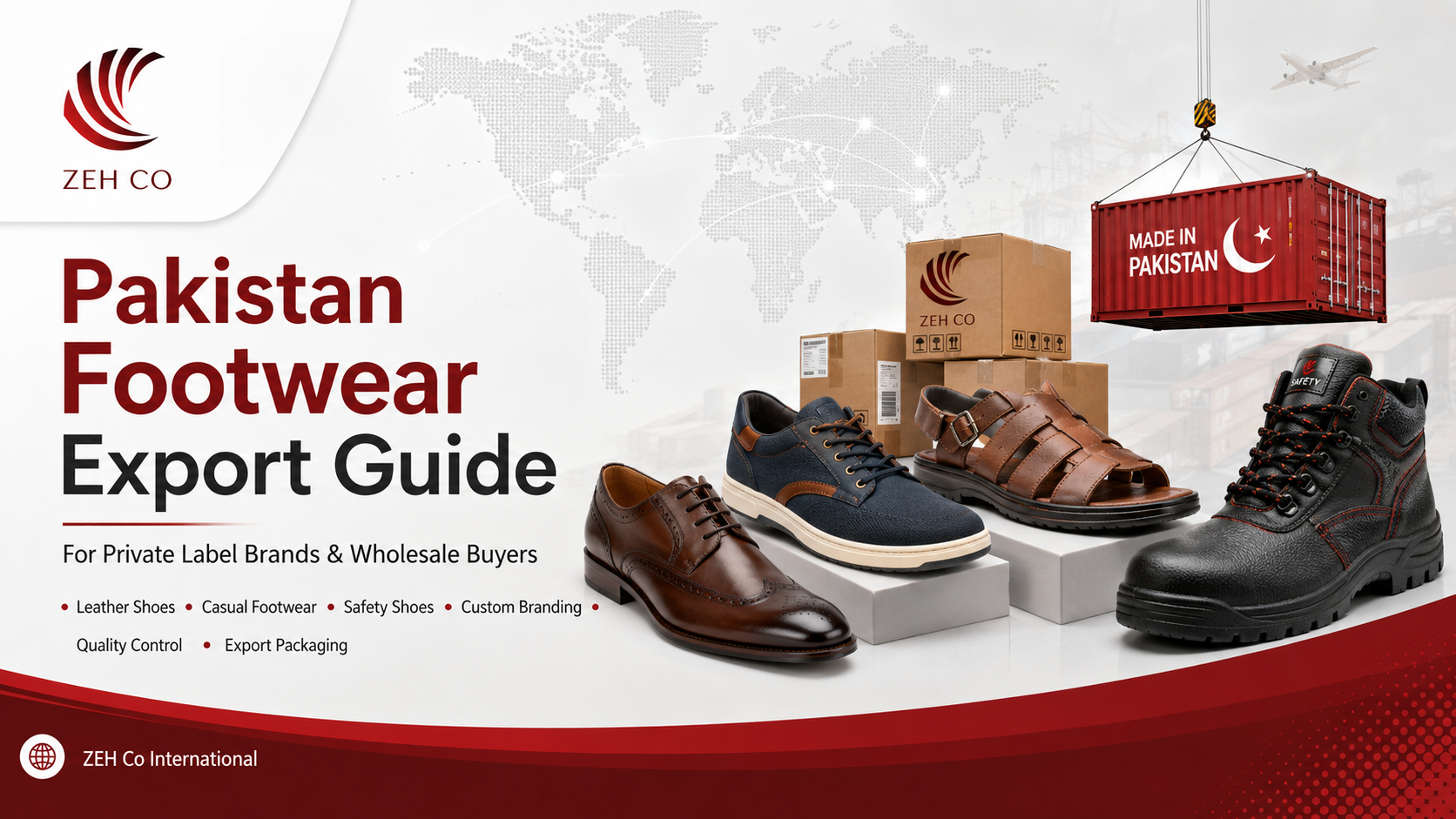
Pakistan footwear export offers international brands, wholesalers, distributors, retailers, and sourcing companies access to leather shoes, safety footwear, sandals, casual shoes, traditional footwear, and private-label manufacturing. Pakistan’s leather-processing and footwear-production sectors allow buyers to source both commercial collections and customized products. Successful procurement, however, requires clear specifications for materials, sizing, construction, comfort, testing, branding, packaging, and delivery schedules. This guide explains how B2B buyers can evaluate Pakistani footwear suppliers and manage an export order from product development to final shipment.
Why International Buyers Source Footwear from Pakistan
Pakistan has an established leather industry supported by tanneries, footwear manufacturers, stitching units, sole producers, packaging suppliers, and skilled labour. This manufacturing base enables exporters to produce footwear for fashion, work, institutional, promotional, and traditional markets.
The country is particularly relevant for buyers seeking leather footwear because manufacturers can source cow, buffalo, goat, and sheep leather through domestic supply chains. Synthetic leather, textile uppers, rubber, EVA, polyurethane, thermoplastic rubber, and other footwear materials can also be incorporated according to the buyer’s product category and target price.
Pakistan can be suitable for private-label buyers that need greater flexibility than large mass-production sourcing markets may offer. Depending on the manufacturer and product complexity, buyers may develop custom designs, packaging, logos, colours, materials, size ranges, and sole constructions for their own brands.
Pakistan Footwear Export Categories for B2B Buyers
Before requesting a quotation, buyers should identify the intended footwear category, target customer, retail price, and expected order volume. Each product category requires different machinery, materials, moulds, testing procedures, and production expertise.
Leather Formal Shoes
Leather formal footwear includes Oxford shoes, Derby shoes, loafers, monk straps, office shoes, and dress boots. Buyers should define the leather type, finish, lining, insole, outsole, heel, stitching method, and desired level of flexibility. Formal footwear quality is strongly influenced by pattern accuracy, leather selection, edge finishing, polishing, and size consistency.
Casual Shoes and Sneakers
Casual footwear may use leather, suede, canvas, mesh, synthetic materials, or combinations of several materials. Important specifications include upper construction, padding, lining, footbed, sole material, bonding strength, lace quality, ventilation, and expected weight. Buyers should also clarify whether the design is intended for fashion use, daily walking, school, travel, or light sports activity.
Safety and Industrial Footwear
Safety shoes and work boots are supplied to construction companies, factories, logistics businesses, engineering firms, oil and gas contractors, and institutional buyers. Depending on the workplace, footwear may require toe protection, puncture-resistant midsoles, slip-resistant outsoles, electrical resistance, heat resistance, oil resistance, antistatic properties, or water-resistant construction.
Safety claims should be supported by applicable testing and certification. Buyers must identify the required destination-market standard before product development because different countries and industries may apply different technical requirements.
Sandals and Slippers
Men’s, women’s, and children’s sandals can be manufactured in leather, synthetic materials, textiles, rubber, or EVA. Buyers should specify the strap material, buckle quality, footbed construction, sole hardness, flexibility, colourfastness, and size range. For warm-climate markets, comfort, breathability, and outsole durability are often the main purchasing considerations.
Traditional Pakistani Footwear
Traditional products such as Peshawari chappals and khussas can serve ethnic retailers, cultural fashion brands, gift stores, and online sellers. These products may include hand stitching, embroidery, decorative patterns, leather soles, rubber soles, and customized colours. Because handcrafted production can create natural variation, buyers should agree on acceptable tolerances before placing a bulk order.
Children’s Footwear
Children’s shoes require particular attention to comfort, flexibility, fit, material safety, fastening strength, and the absence of sharp components. Buyers should provide accurate size charts and confirm destination-market requirements for restricted substances, small parts, labelling, and product safety.
Choosing the Right Materials
Material selection affects cost, durability, appearance, comfort, product positioning, and regulatory compliance. Buyers should not rely only on descriptions such as genuine leather or premium synthetic because these terms may cover a wide range of qualities.
Upper Materials
Footwear uppers may be produced from full-grain leather, corrected-grain leather, split leather, suede, nubuck, synthetic leather, canvas, knitted fabric, mesh, or blended materials. The purchase specification should identify thickness, colour, finish, physical appearance, and performance expectations.
Leather buyers should consider colour consistency, grain defects, flex resistance, tear strength, finish adhesion, and colour transfer. Textile and synthetic uppers may require testing for abrasion resistance, colourfastness, delamination, and dimensional stability.
Lining and Insole Materials
Lining materials influence moisture management, comfort, odour control, and durability. Options include leather, textile, mesh, nonwoven materials, and synthetic linings. Insoles may use leather board, foam, EVA, memory foam, or moulded components depending on the intended price and comfort level.
Outsole Materials
Common outsole materials include rubber, EVA, polyurethane, thermoplastic rubber, PVC, and leather. Rubber may offer strong abrasion and slip performance, while EVA is lightweight and commonly used in casual products. Polyurethane can provide cushioning and durability, but the correct formulation and storage conditions are important for long-term performance.
The sole should be selected according to climate, ground surface, product use, expected lifespan, and target price. Sole hardness, flex resistance, abrasion performance, bonding strength, and slip resistance may need to be tested.
Footwear Construction Methods
The construction method determines how the upper, insole, and outsole are joined. It affects cost, durability, flexibility, appearance, water resistance, and repairability.
- Cemented construction: The upper is bonded to the sole using adhesive. It is widely used for formal, casual, and fashion footwear.
- Direct injection: Sole material is injected directly onto the prepared upper. This method is commonly used for work and safety footwear.
- Stitched construction: The sole and upper may be connected through visible or concealed stitching for added durability or traditional appearance.
- Vulcanized construction: Rubber components are bonded through heat and pressure, commonly for canvas and casual footwear.
- Handmade construction: Traditional footwear may involve manual cutting, stitching, shaping, and finishing.
Buyers should ask the factory which construction methods are performed internally and which processes are outsourced. Outsourcing is not necessarily a quality problem, but it requires effective supplier control and inspection.
Private Label Footwear Development
Private-label manufacturing allows buyers to sell footwear under their own brand. The development process usually begins with a technical pack, reference sample, drawing, photograph, or existing design concept. A complete technical pack reduces errors and helps the supplier calculate a more accurate price.
The buyer should provide product measurements, materials, colours, logo placements, size range, outsole requirements, packaging instructions, and target performance. Any branded metal components, buckles, labels, insoles, outsoles, tissue paper, boxes, or hangtags should also be specified.
Prototype and Sample Approval
A prototype allows the buyer to evaluate the shape, fit, materials, colour, workmanship, branding, and comfort before mass production. Several sample stages may be needed for a new design, especially when custom lasts, moulds, soles, or metal accessories are required.
The final approved sample should become the reference standard for production. Buyers should retain one approved sample and ensure that the manufacturer keeps an identical signed reference at the factory.
Custom Lasts and Sole Moulds
A shoe last determines the internal shape, toe profile, heel position, width, volume, and fit. Buyers developing a distinctive footwear line may require custom lasts. New outsoles may also require mould development, which adds tooling cost and development time.
The contract should clarify mould ownership, exclusivity, maintenance responsibility, permitted use, and what happens to the mould after the commercial relationship ends.
Footwear Sizing and Fit Management
Sizing is one of the most common sources of customer complaints in footwear. A size number alone is insufficient because European, UK, US, and regional sizing systems do not always produce identical internal measurements.
Buyers should provide a size chart showing foot length, last length, internal shoe length, ball girth, width, and any required fitting notes. The factory should grade the approved base size carefully across the entire range. Size-set samples should be reviewed before mass production.
Products intended for wider or narrower customer groups should use appropriate lasts rather than relying only on size adjustments. Buyers should also consider whether socks, safety toe caps, thick linings, or removable insoles will affect the final fit.
Quality Control for Export Footwear
Footwear inspection should begin with incoming materials and continue through cutting, stitching, lasting, sole attachment, finishing, packaging, and container loading. Detecting defects early is less expensive than sorting finished goods after production.
Key Quality Checks
- Leather, textile, and synthetic material consistency
- Correct component colours and thicknesses
- Accurate cutting and matching of left and right shoes
- Stitching density, alignment, and thread security
- Adhesive application and sole-bonding strength
- Toe shape, heel alignment, and pair symmetry
- Logo positioning and branding quality
- Insole attachment and internal cleanliness
- Metal accessory strength and corrosion resistance
- Finished size, fit, weight, and appearance
- Correct pair packing and carton assortment
Final inspection should verify workmanship, dimensions, quantity, size ratio, packaging, carton markings, barcode accuracy, and approved product specifications. Buyers may appoint an independent inspection company or approve the exporter’s inspection system depending on order value and supplier history.
Footwear Testing and Compliance
Testing requirements depend on the footwear category and destination market. Fashion footwear may require checks for restricted chemicals, colourfastness, flexing, abrasion, sole adhesion, and component durability. Safety footwear may require extensive testing against the applicable protective-footwear standard.
Potential laboratory tests include:
- Upper and sole flex resistance
- Sole abrasion resistance
- Upper-to-sole bond strength
- Slip resistance
- Colourfastness to rubbing and perspiration
- Tear and tensile strength
- Water resistance or water penetration
- Restricted substances and chemical compliance
- Toe-cap impact and compression resistance
- Puncture resistance for protective midsoles
The importer is responsible for identifying the legal and customer-specific requirements in the destination market. Testing should be completed on representative production materials and, where necessary, on finished production footwear.
Minimum Order Quantities and Price Factors
Footwear minimum order quantities depend on the design, size range, number of colours, availability of materials, custom mould requirements, packaging, and factory production system. Orders divided across many designs and colours may be more difficult to manufacture than a larger order concentrated in one style.
Major footwear price factors include:
- Upper, lining, insole, and outsole materials
- Construction method and labour requirements
- Custom last, sole mould, or metal-component tooling
- Number of colours and sizes
- Testing and certification requirements
- Logo application and private-label accessories
- Individual box and export-carton specifications
- Inspection, inland transport, and shipping terms
Buyers should compare quotations based on the same bill of materials and technical specification. A lower-priced quotation may use thinner leather, lower-density foam, a different sole compound, cheaper lining, or simplified construction.
Packaging and Export Cartons
Footwear is commonly packed as one pair per box, followed by several boxes in a master export carton. Packaging should protect the shoes from deformation, rubbing, moisture, dust, and handling damage.
Buyers should specify shoe-box dimensions, paper quality, printing, tissue paper, inserts, silica gel, labels, barcodes, care instructions, and carton assortment. Master cartons should display the style number, colour, size ratio, quantity, net weight, gross weight, carton dimensions, destination, and buyer reference.
Carton strength should be selected according to stacking height, transit duration, climate, and handling conditions. Container loading should maximize space without crushing lower cartons or damaging retail packaging.
Shipping Terms and Export Documentation
ZEH Co can support footwear orders under FOB Karachi, CIF, and DDP terms, subject to destination feasibility and the agreed transaction structure. FOB allows buyers to manage their own international freight, while CIF includes freight and insurance to the named destination port. DDP may provide a broader delivered solution where customs clearance, duties, and local delivery can be arranged.
Common export documents may include a commercial invoice, packing list, bill of lading, certificate of origin, insurance certificate, inspection report, and testing documents. Buyers using letters of credit should provide documentary requirements before production to prevent discrepancies.
Importers should verify tariff classifications, duties, product labelling, country-of-origin marking, chemical restrictions, packaging regulations, and safety standards with their customs broker or regulatory adviser.
How to Evaluate a Pakistani Footwear Supplier
A reliable footwear supplier should demonstrate experience in the buyer’s required category. A factory specializing in traditional leather sandals may not have the machinery or testing systems required for safety boots or athletic footwear.
- Review factory capabilities and production equipment.
- Confirm experience with the required footwear category.
- Request material specifications and construction details.
- Evaluate development samples and size-set samples.
- Ask how materials and subcontractors are controlled.
- Define inspection, testing, and claim procedures.
- Verify production capacity and realistic lead times.
- Confirm export packaging and documentation capability.
- Begin with a controlled trial order when practical.
Information to Include in a Footwear Enquiry
A complete request for quotation allows the exporter to assess production feasibility and prepare an accurate commercial offer. Buyers should include:
- Footwear category and intended use
- Reference images, samples, or technical drawings
- Upper, lining, insole, and outsole materials
- Construction method and performance requirements
- Target order quantity per style and colour
- Required size range and size ratio
- Logo, label, packaging, and barcode requirements
- Testing and destination compliance requirements
- Target price range, if available
- Destination port and preferred Incoterm
- Required sample and shipment dates
How ZEH Co Supports International Footwear Buyers
ZEH Co is a Pakistan-based B2B export company established in 2011. We support importers, distributors, private-label brands, retailers, procurement companies, and institutional buyers with supplier coordination, product development, specification review, quality inspection, export packaging, documentation, and international shipping.
Our quality-management approach is supported by ISO 9001:2015 and ISO 22000 certifications. For footwear enquiries, buyers can provide product references, material preferences, size ranges, branding requirements, order quantities, destination details, and required compliance standards. This information helps our sourcing team identify an appropriate manufacturing partner and prepare a relevant quotation.
Conclusion
Pakistan footwear export provides international buyers with opportunities to source leather shoes, casual footwear, safety products, sandals, traditional designs, and private-label collections. Successful orders depend on accurate technical specifications, approved samples, controlled sizing, suitable materials, production inspections, compliance testing, protective packaging, and realistic delivery planning. By working with ZEH Co, importers can coordinate product development, quality control, documentation, and flexible shipping terms through one Pakistan-based B2B export partner.