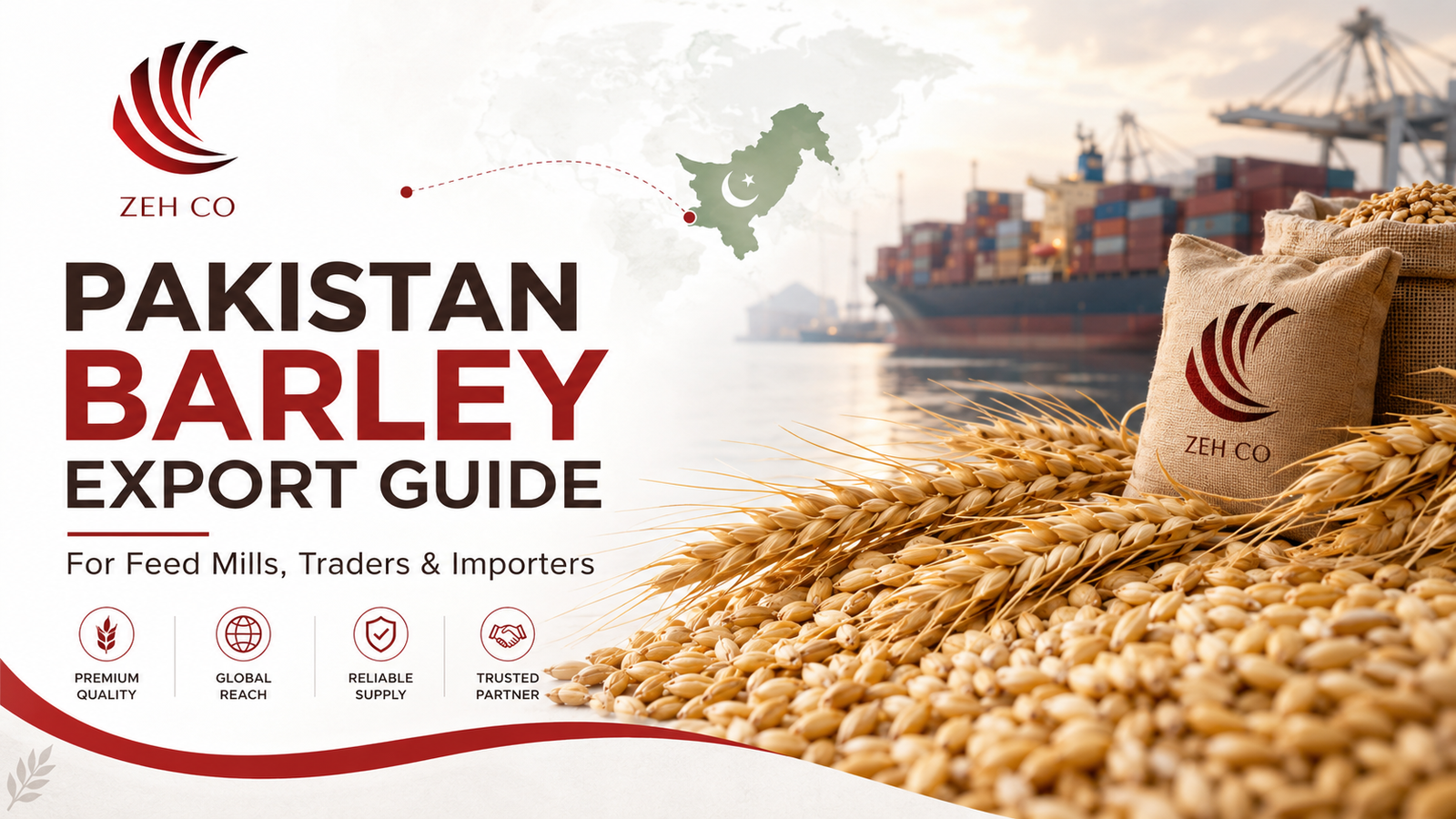
Pakistan barley export offers international feed mills, grain traders, food processors, and agricultural distributors an additional sourcing option from South Asia. Barley is a versatile cereal used in animal feed, food products, grain blends, and selected industrial applications. However, successful importing depends on clear specifications, representative sampling, suitable cleaning, moisture control, correct packaging, and complete export documentation. This guide explains how B2B buyers can evaluate Pakistani barley, reduce quality risks, and structure commercial orders with reliable suppliers such as ZEH Co.
Why Pakistan Barley Export Deserves Buyer Attention
International grain buyers usually compare suppliers based on landed cost, consistency, shipment flexibility, and the ability to satisfy destination-market requirements. Pakistan can support buyers seeking bulk agricultural commodities through established port access at Karachi, experienced commodity traders, agricultural production capacity, and flexible commercial arrangements.
The best sourcing results are achieved when buyers provide detailed technical requirements rather than requesting a broad product such as “feed barley.” Barley quality can differ according to the crop, storage method, cleaning level, moisture condition, grain variety, and intended application.
A professional sourcing process should therefore begin with a written specification sheet. Buyers should define the required grade, maximum moisture, foreign matter tolerance, broken-kernel allowance, test weight, grain size, crop year, treatment requirements, packaging format, and shipment quantity before requesting a firm quotation.
Common B2B Uses of Pakistani Barley
Animal Feed and Feed Milling
Feed-grade barley is commonly purchased as an energy grain for livestock and poultry feed formulations. Feed mills should evaluate moisture, protein, fiber, test weight, damaged kernels, foreign material, mold risk, and applicable mycotoxin limits.
The purchase contract should also state whether the grain must be delivered whole, machine-cleaned, screened, crushed, or processed in another form. Buyers should communicate the animal category and feed-manufacturing requirements because specifications for cattle feed may differ from those used in poultry or specialized livestock formulations.
Food Processing and Grain Blends
Food processors may use barley in flour blends, porridge, soups, cereal mixtures, bakery products, health-food formulations, and traditional grain products. Food-grade orders normally require tighter controls for purity, appearance, odor, pesticide residues, infestation, and microbiological condition.
Buyers should request details about cleaning, grading, polishing, storage, and packaging. They should also confirm whether the supplier can provide the required laboratory analysis and destination-specific certificates before approving a commercial shipment.
Malting and Specialized Industrial Use
Barley intended for malting requires much stricter parameters than ordinary feed-grade or food-grade barley. Germination capacity, varietal purity, protein range, kernel uniformity, storage age, dormancy, and moisture can all affect malting performance.
Importers should never assume that general-purpose barley is suitable for brewing or malt production. Malt-grade orders should be based on approved laboratory results and, where possible, a small production trial using a representative sample from the intended supply lot.
Essential Barley Specifications for Import Contracts
A detailed specification protects both the buyer and the exporter. It also allows inspection companies, laboratories, warehouse teams, and logistics providers to evaluate the shipment against measurable standards.
Depending on the final application and destination-country regulations, an international buyer may include the following parameters in the purchase contract:
- Moisture: Establish a maximum percentage suitable for safe transportation and storage in the destination climate.
- Foreign matter: Define the acceptable percentage of dust, stones, stems, husk, soil, and other non-grain materials.
- Other grains and admixture: State the permitted quantity of wheat, oats, seeds, or other cereal grains.
- Damaged kernels: Set limits for heat-damaged, mold-affected, sprouted, discolored, or insect-damaged grain.
- Broken kernels: Specify the maximum percentage, particularly when appearance, processing efficiency, or production yield is important.
- Test weight: Agree on a minimum test weight and clearly identify the measurement method.
- Protein and fiber: Include target values when required for feed formulation, food processing, or malting.
- Mycotoxins: Define maximum acceptable levels for aflatoxins and other regulated contaminants.
- Pesticide residues: Require compliance with the maximum residue limits of the destination market.
- Live infestation: Require the shipment to be free from live insects at the agreed inspection and loading point.
The specification should identify an internationally recognized testing method wherever possible. This reduces the risk of disputes caused by laboratories using different procedures. The contract should also state whether final quality will be determined at the loading port, destination port, or through an independent inspection report.
Cleaning, Screening, and Barley Grading
Unprocessed grain may contain dust, lightweight material, broken kernels, stems, seeds, and other foreign matter. Machine cleaning and screening improve product consistency and help buyers meet processing requirements.
For higher-value food or industrial applications, additional grading may be needed to achieve a more uniform kernel size and appearance. Buyers should specify the required processing level because the price of raw barley will normally differ from the price of thoroughly cleaned, graded, and tested barley.
A supplier quotation should clearly state whether cleaning, grading, fumigation, laboratory testing, bagging, inspection, and loading are included. Without this information, buyers may compare two prices that represent very different product preparation levels.
Pre-Shipment Quality Control
Before confirming a large shipment, buyers should request a representative sample from the intended supply lot rather than accepting a generic showroom sample. The sample can be tested for moisture, purity, test weight, protein, fiber, foreign matter, broken kernels, infestation, pesticide residues, and contaminants.
For substantial orders, an independent inspection company can verify selected quality parameters, quantity, bag condition, container condition, and loading procedures. The inspection scope should be agreed before the cargo is packed because some tests may require special sampling or additional laboratory time.
Representative Sampling
A sample must accurately represent the commercial lot. A small sample taken only from the top of a warehouse stack may not reveal variations within the complete quantity. For reliable testing, samples should be collected from multiple bags or different areas of the bulk lot and combined according to an agreed sampling method.
Warehouse and Container Inspection
Barley should be stored in a dry and ventilated environment protected from rain, condensation, pests, chemicals, and strong odors. The grain should not be placed directly against damp floors or walls.
Before loading, shipping containers should be checked for holes, water entry, damaged flooring, chemical contamination, strong smells, rust, and residue from previous cargo. The container must be clean, dry, and suitable for carrying an agricultural commodity.
Packaging Options for Wholesale Barley Orders
Packaging should match the shipment quantity, handling equipment, storage conditions, and the buyer’s distribution model. Common B2B packaging options include woven polypropylene bags, laminated bags, jumbo bags, and suitable bulk-loading arrangements.
- 25 kg bags: Appropriate for distributors, food processors, retailers, and buyers that require manageable units.
- 50 kg bags: Common for feed mills, agricultural wholesalers, and industrial grain buyers.
- Jumbo bags: Suitable for larger processors that have forklifts and bulk-handling equipment.
- Private-label bags: Available when the buyer provides approved artwork, language requirements, barcodes, branding, and mandatory labeling information.
- Containerized bulk loading: May be considered for larger industrial orders where cargo protection and unloading facilities are available.
The purchase order should define net bag weight, bag material, stitching method, liner requirements, printing details, palletization, and acceptable weight tolerance. Importers must also verify destination labeling regulations before approving printed packaging.
Where pallets are required, the buyer should confirm pallet material, dimensions, maximum height, wrapping method, and any wood-treatment requirements. Palletization can simplify warehouse handling but may reduce the total commodity weight that can be loaded into the container.
Barley Export Documentation and Compliance
Documentation requirements depend on the destination country, customs rules, payment method, plant-health regulations, and the terms of the sales contract. A typical barley shipment may require several commercial, shipping, inspection, and agricultural documents.
- Commercial invoice: Shows the seller, buyer, product, quantity, unit price, total value, and agreed shipping term.
- Packing list: Provides bag quantities, net weight, gross weight, packaging type, and shipping marks.
- Bill of lading: Confirms shipment details and transportation of the cargo.
- Certificate of origin: Identifies Pakistan as the country of origin.
- Phytosanitary certificate: May be required to confirm compliance with the destination’s plant-health conditions.
- Fumigation certificate: Confirms the treatment method when fumigation is requested or required.
- Inspection certificate: Records the findings of an agreed independent inspection.
- Weight certificate: Confirms the verified shipment weight.
- Laboratory report: Provides results for the quality and safety parameters included in the testing scope.
Some importing countries require an import permit, special treatment, pest declarations, registration, or exact wording on the phytosanitary certificate. The importer should provide these instructions before procurement, processing, or shipment begins.
Last-minute document changes can delay customs clearance, create amendment charges, or result in discrepancies under letter-of-credit transactions. Product descriptions, consignee information, quantities, weights, shipping marks, and certificate details should remain consistent across all documents.
FOB Karachi, CIF, and DDP Shipping Options
ZEH Co can structure commercial offers under different shipping terms depending on the destination, quantity, product specifications, and buyer requirements.
FOB Karachi
Under FOB Karachi, the exporter manages the cargo up to loading on the nominated vessel according to the agreed Incoterm. The buyer generally controls the main ocean freight, marine insurance, destination clearance, and local delivery.
FOB can be suitable for experienced importers that already have freight contracts or preferred shipping agents. Buyers should provide booking instructions early enough to avoid warehouse delays and missed shipment windows.
CIF Destination Port
Under CIF, the seller arranges freight and insurance to the named destination port. The buyer remains responsible for import clearance, port charges, duties, taxes, and inland delivery according to the agreed commercial terms.
A CIF quotation should identify the destination port, shipment size, freight validity, insurance coverage, and any charges excluded from the offer.
DDP Delivery
DDP may be considered for selected destinations where import duties, taxes, compliance requirements, customs clearance, and final delivery costs can be reliably calculated. DDP requires careful planning because agricultural products may be subject to inspections, permits, port procedures, and changing import controls.
International buyers should compare the complete landed cost rather than focusing only on the price per metric ton. Ocean freight, bagging, inspection, inland transport, insurance, port charges, import duties, customs services, detention, demurrage, and local delivery can significantly affect the final purchasing cost.
How to Evaluate a Pakistani Barley Supplier
A dependable barley exporter should be able to explain the commodity source, crop availability, cleaning process, storage method, packaging capability, shipment lead time, quality-control system, and documentation workflow.
Buyers should request company registration information, export experience, product photographs, recent warehouse videos, technical specifications, sample availability, packaging details, and clear commercial terms. When possible, a video inspection or third-party warehouse visit can provide additional confidence before a first order.
Price alone should not determine supplier selection. An unusually low offer may exclude cleaning, grading, testing, fumigation, reliable packaging, inspection, or required certificates. These missing services can later increase the buyer’s total cost or create difficulties during import clearance.
A complete quotation should identify the product grade, origin, crop year where relevant, quantity, specifications, packing, unit price, Incoterm, loading port, destination, payment terms, lead time, offer validity, and testing included in the price.
Recommended Order Process for First-Time Importers
- Submit a complete inquiry: Include the destination, required quantity, intended use, technical specifications, packaging, and preferred shipping term.
- Review the commercial offer: Confirm every included service and identify any deviations from the requested specification.
- Approve a representative sample: Conduct laboratory testing when product quality is commercially important.
- Confirm packaging: Approve bag material, weight, printing, labeling, and pallet requirements.
- Finalize the contract: Agree on inspection, claims procedures, shipment period, documentation, and payment terms.
- Monitor order preparation: Request updates covering cleaning, grading, bagging, inspection, container loading, and vessel booking.
- Check draft documents: Correct company names, weights, shipping marks, product descriptions, and certificate wording before final issuance.
This structured process is particularly important for initial orders. After successful deliveries demonstrate consistent quality and communication, buyers can consider larger quantities, annual supply contracts, or scheduled container shipments.
Risk Management for Barley Importers
International grain contracts can be affected by crop variations, moisture changes, storage conditions, freight fluctuations, port congestion, regulatory updates, and documentation errors. Buyers can reduce exposure by setting realistic tolerances, approving representative samples, using independent inspection for significant orders, and avoiding vague quality descriptions.
The sales contract should contain a clear claims clause defining the inspection point, notification period, supporting evidence, sampling method, and procedure for resolving quality differences. If destination testing is required, both parties should consider how transit conditions, container condensation, storage delays, and sampling procedures may affect the results.
Buyers should also confirm marine insurance coverage and understand which risks are included or excluded. The required insurance level may depend on the Incoterm, shipment route, cargo value, and destination conditions.
Why Source Barley Through ZEH Co?
ZEH Co is a Pakistan-based B2B export company established in 2011. The company serves international importers, wholesalers, distributors, processors, and procurement teams in more than 100 countries.
ZEH Co supports buyers with supplier coordination, product sourcing, quotation preparation, quality requirements, packaging, private-label development, inspection arrangements, export documentation, and international shipping. The company operates with ISO 9001:2015 and ISO 22000 certifications and can provide commercial options based on FOB Karachi, CIF, or suitable DDP arrangements.
For barley inquiries, buyers should provide their intended application and target specifications so the sourcing team can identify the appropriate grade, cleaning level, testing scope, and packaging method. ZEH Co can also coordinate product samples, customized bags, independent inspections, and destination-specific documentation according to the final contract.
Conclusion: Building a Reliable Pakistan Barley Export Program
A successful Pakistan barley export order depends on specification accuracy, representative sampling, effective cleaning, safe storage, suitable packaging, reliable logistics, and disciplined documentation. Feed mills, food processors, grain traders, and distributors should define the intended use before comparing quotations because feed-grade, food-grade, and malt-grade barley require different quality controls.
By combining clear purchase terms with laboratory verification, pre-shipment inspection, and realistic landed-cost planning, international buyers can reduce commercial risks and establish a scalable barley sourcing program from Pakistan. ZEH Co can support qualified buyers from initial product evaluation through packaging, documentation, shipment, and long-term supply planning.