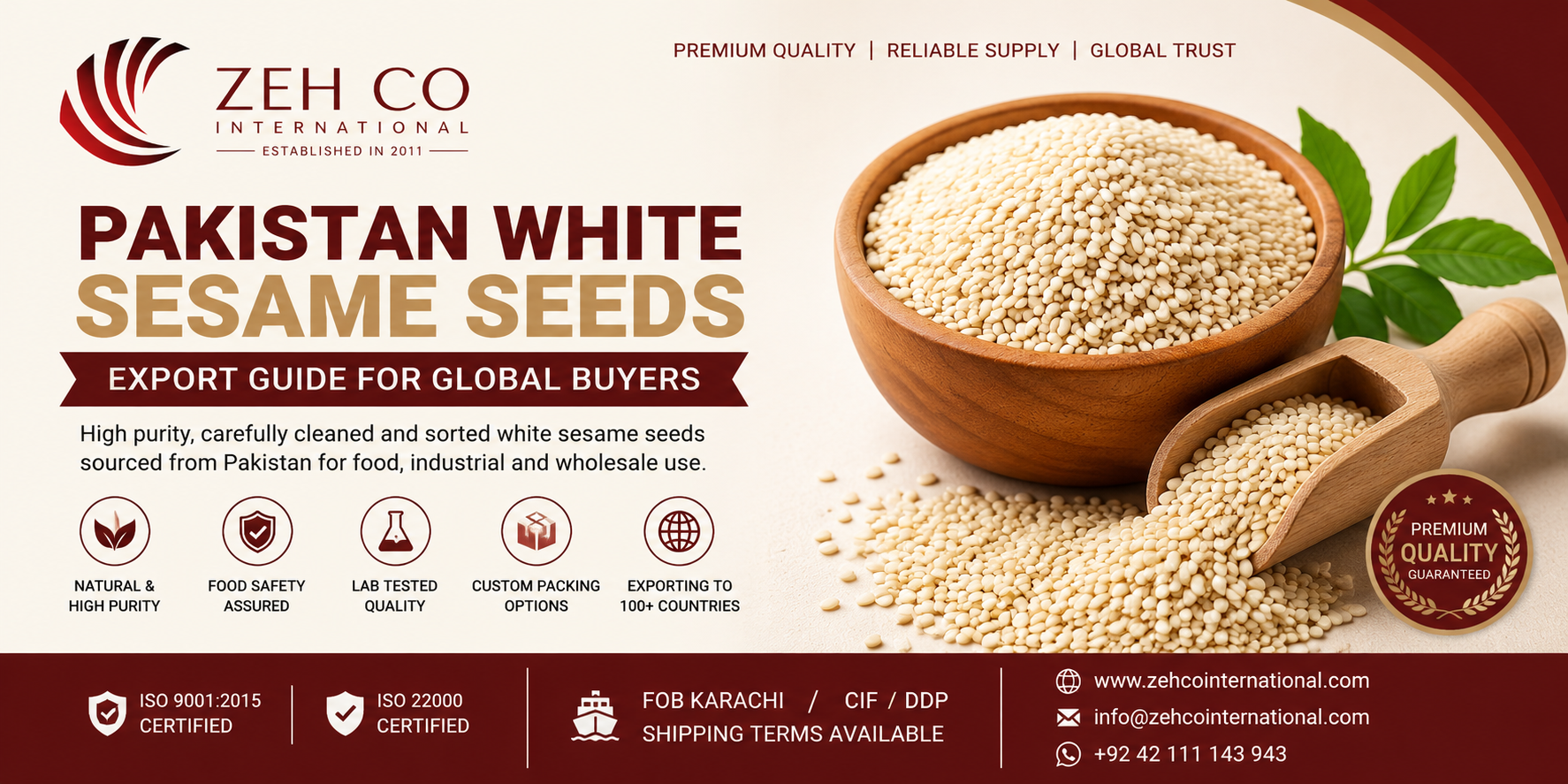
International food manufacturers, wholesalers, seed processors, tahini producers, bakeries, oil processors, and commodity traders increasingly evaluate Pakistan as a sourcing origin for sesame. A successful Pakistan white sesame seeds export program, however, depends on much more than finding an attractive price. Importers must clearly define purity, moisture, seed appearance, processing level, microbiological requirements, packaging, testing, documentation, and shipment terms before confirming a commercial order. ZEH Co supports international B2B buyers by coordinating sourcing, quality requirements, export preparation, documentation, and shipment arrangements from Pakistan.
Pakistan White Sesame Seeds Export Opportunities for International Buyers
White sesame seeds are a versatile agricultural commodity used across food manufacturing, bakery production, confectionery, tahini, spice blends, snack foods, edible oil processing, and retail food packaging. This broad range of applications creates demand from several types of buyers, each of whom may require a different specification.
A bakery ingredient distributor may prioritize consistent white color and clean seed appearance, while a tahini manufacturer may focus on processing suitability, flavor, cleanliness, and food safety. An edible oil processor may evaluate oil-bearing characteristics and commercial yield, whereas a retail packer could require tighter controls on foreign matter, color variation, seed size, and microbiological parameters.
For this reason, professional sesame sourcing should begin with an agreed specification rather than a general inquiry for “best quality sesame.” Clear technical requirements allow the exporter to source and process the appropriate material while reducing disputes after shipment.
Natural White Sesame Seeds vs. Hulled Sesame Seeds
Natural Sesame Seeds
Natural sesame seeds retain their outer seed coat and undergo cleaning and grading before export. They are used by commodity traders, food processors, bakeries, spice companies, oil processors, and manufacturers that conduct additional processing at destination.
Buyers sourcing natural sesame should specify acceptable limits for purity, moisture, foreign matter, damaged or discolored seeds, and other physical characteristics. The exact specification can vary according to the destination country and final industrial application.
Hulled Sesame Seeds
Hulled sesame seeds have their outer coat removed through additional processing. They are commonly requested for bakery toppings, hamburger buns, confectionery, tahini, sesame paste, snack production, and other applications where a cleaner and more uniform appearance is important.
Hulled sesame requires greater processing control because the product is intended for direct use by food manufacturers in many cases. International buyers should therefore define microbiological requirements, processing expectations, packaging type, and testing requirements before production begins.
Important Quality Specifications for White Sesame Seeds
One of the most important responsibilities of an importer is to establish measurable acceptance criteria. A professional purchase specification can prevent misunderstandings between buyers, exporters, processors, and inspection companies.
Purity
Purity indicates the proportion of sesame seed compared with unwanted material. Buyers requiring highly cleaned sesame generally request tighter purity specifications because foreign material can affect processing efficiency, product appearance, food safety, and finished-product quality.
The required purity level should be written into the purchase contract or proforma invoice instead of being described only as “machine cleaned” or “premium grade.”
Moisture
Moisture management is particularly important for agricultural commodities transported over long distances. Excessive moisture can contribute to quality deterioration during storage and ocean transportation. Importers should establish a maximum acceptable moisture level and request testing before loading when appropriate.
Color and Appearance
Buyers purchasing sesame for bakery, retail, confectionery, or tahini production often evaluate seed color and uniformity. Excessive dark, damaged, immature, stained, or discolored seeds can affect visual appearance and finished-product consistency.
When appearance is commercially important, buyers should approve a representative sample or reference specification before placing a large order.
Foreign Matter and Impurities
Raw agricultural products may contain dust, plant material, soil particles, stones, broken seeds, or other impurities. Cleaning, grading, aspiration, sieving, destoning, magnetic separation, and color sorting can be used depending on the required grade and processing facility.
Oil Content and Processing Performance
For oil extraction and certain industrial food applications, buyers may request information related to oil content or processing performance. Such parameters should be tested according to the buyer's agreed method rather than assumed from general origin characteristics.
How Sesame Seeds Are Prepared for Export
Commercial export preparation can involve several stages depending on the original crop condition and final buyer specification. A typical processing flow may include preliminary cleaning, screening, aspiration, size separation, destoning, magnetic separation, grading, color sorting, and final packing.
The purpose of cleaning is not simply to improve appearance. Proper processing helps remove foreign material and creates more consistent raw material for industrial users. Buyers supplying large bakery chains, tahini plants, food processors, or private-label customers often need greater consistency from shipment to shipment.
Where higher specifications are required, the exporter and processor should agree in advance on the processing steps necessary to achieve the requested standard. Specifications should be commercially realistic and supported by appropriate sampling and testing.
Food Safety Requirements for Sesame Seed Importers
Food safety is a critical consideration when purchasing sesame for human consumption. Requirements vary by importing country, customer, application, and distribution channel, so importers should provide their required testing parameters before the cargo is prepared.
Microbiological Testing
Food manufacturers may request microbiological testing depending on their internal quality system and destination regulations. Sesame seeds intended for ready-to-use food applications can require greater attention to microbiological controls than seeds intended for additional industrial processing.
Aflatoxins and Other Contaminants
Depending on the destination market, buyers may request testing for aflatoxins, pesticide residues, heavy metals, or other regulated contaminants. Maximum permitted levels can differ between jurisdictions, which means exporters should work against the buyer's destination-specific requirements rather than applying a single specification to every country.
Allergen Management
Sesame is treated as a food allergen in various international markets. Importers and food manufacturers should verify applicable labeling, handling, cross-contact, and documentation obligations within their destination country and supply chain.
For commercial orders, buyers can request a certificate of analysis or independent laboratory report covering agreed parameters. Where third-party inspection is required, the inspection scope should be specified before loading.
Packaging Options for Wholesale Sesame Seed Shipments
Packaging should protect sesame seeds against moisture, contamination, physical damage, and unwanted odors during warehousing and international transportation. Packaging configuration can be customized according to importer requirements and destination-market practices.
- 25 kg bags: Suitable for food processors, ingredient distributors, and customers requiring manageable industrial units.
- 50 kg bags: Common for bulk commodity handling where manual or warehouse handling systems permit larger bags.
- PP woven bags: Frequently used for commodity shipments, with inner liners available where additional protection is requested.
- Multiwall paper bags: Can be considered for food ingredient applications depending on customer requirements.
- Jumbo bags: Appropriate for selected industrial buyers operating bulk handling systems.
- Private-label or custom packaging: Can be discussed for distributors and brands requiring specific bag printing, labels, or retail-oriented solutions.
Bag size, material, liner requirement, printing, marking, palletization, and labeling should all be confirmed before production. Export markings can include product name, origin, lot or batch reference, net weight, production or packing details, and buyer-specific information where required.
Container Loading and Moisture Protection
A good quality sesame shipment can still be damaged by poor container preparation. Before loading, the container should be inspected for cleanliness, dryness, structural condition, unusual odors, holes, water ingress, chemical contamination, or residue from previous cargo.
Agricultural products can be sensitive to condensation during long sea voyages. Appropriate container preparation, bag arrangement, protective materials, and moisture-control measures should therefore be considered according to route, season, packaging, and buyer requirements.
Buyers should also decide whether palletized or floor-loaded cargo is preferred. Floor loading can maximize container utilization, while palletization may simplify warehouse handling at destination but can affect loading quantity and freight economics.
Export Documents for White Sesame Seed Shipments
Documentation requirements depend on the destination country, payment method, buyer contract, and applicable import rules. International buyers should confirm their customs and food import requirements before shipment.
Typical commercial and shipping documents may include:
- Commercial Invoice
- Packing List
- Bill of Lading
- Certificate of Origin
- Phytosanitary Certificate where required
- Fumigation Certificate where required by the buyer or destination
- Certificate of Analysis for agreed quality parameters
- Inspection Certificate when third-party inspection is part of the contract
- Additional health or food safety documents where required by the importing market
Import regulations can change, so buyers should verify current requirements with their customs broker, food authority, agricultural authority, or import department before shipment. This is especially important for food products entering markets with strict contaminant, traceability, or plant-health controls.
How B2B Buyers Should Request a Sesame Seed Quotation
Sending a detailed inquiry enables an exporter to prepare a more accurate commercial offer. Instead of asking only for the price per metric ton, professional procurement teams should provide the intended specification and shipment conditions.
A complete RFQ should preferably include:
- Required product: natural white sesame or hulled sesame
- Required quantity in metric tons
- Target purity level
- Maximum moisture requirement
- Foreign matter tolerance
- Color or appearance requirement
- Required laboratory tests
- Bag size and packaging material
- Private-label or bag-printing requirements
- Palletized or floor-loaded preference
- Destination port or delivery address
- Required Incoterm
- Target shipment period
- Inspection requirements
- Payment terms requested
With this information available at quotation stage, suppliers can calculate processing, packaging, laboratory testing, inland transportation, documentation, freight, and other relevant costs more accurately.
FOB Karachi, CIF and DDP Supply Options
ZEH Co can discuss different shipment structures depending on the buyer's procurement model and destination.
FOB Karachi
Under an FOB arrangement, the buyer normally controls the main ocean freight after the cargo is delivered according to the agreed FOB terms. This structure is useful for importers with established shipping contracts or nominated freight forwarders.
CIF
CIF quotations can be suitable for buyers who want the exporter to arrange ocean freight and insurance to the agreed destination port. The exact scope should always be confirmed in the commercial offer.
DDP
For selected destinations and transactions, DDP arrangements can be evaluated where commercially and legally workable. Because customs duties, taxes, importer-of-record requirements, product registrations, and local delivery conditions differ between countries, DDP feasibility must be assessed individually.
Common Mistakes When Importing Sesame Seeds
Many commodity disputes originate from incomplete specifications rather than deliberate quality problems. Importers can reduce commercial risk by avoiding several common sourcing mistakes.
- Buying only on price: Lower quotations may reflect different purity, processing, packaging, testing, or shipment conditions.
- Using vague quality terms: Words such as premium, best, or export quality are not substitutes for measurable specifications.
- Skipping sample approval: Appearance-sensitive buyers should evaluate representative samples before large-volume procurement.
- Ignoring destination regulations: Food safety, phytosanitary, contaminant, and documentation rules must be verified before loading.
- Not defining inspection procedures: The contract should identify how sampling, testing, and acceptance will be handled.
- Failing to specify packaging: Bag material, liner, net weight, labeling, and pallet requirements can materially affect the final cost.
- Comparing non-equivalent quotations: Buyers should compare offers using the same product specification, Incoterm, packaging, testing scope, and destination.
Applications for Pakistani White Sesame Seeds
White sesame can serve numerous commercial industries, which makes it important for suppliers to understand the buyer's intended use. Common B2B applications include bakery toppings, bread and bun manufacturing, biscuits and crackers, confectionery, tahini and sesame paste, snack products, seasoning blends, food ingredient distribution, retail repacking, edible oil production, and industrial food processing.
An exporter sourcing for a tahini manufacturer may need to focus on different characteristics than one supplying an oil extraction facility. Communicating the end use allows the supply chain to select a more appropriate grade and processing method.
Why International Buyers Work with ZEH Co
ZEH Co is a Pakistan-based B2B export company established in 2011 and serves international importers, wholesalers, distributors, manufacturers, and procurement organizations. The company works across agricultural commodities, fresh produce, Himalayan salt, grains and seeds, textiles, leather, gloves, and other export products.
ZEH Co holds ISO 9001:2015 and ISO 22000 certifications and can coordinate orders according to buyer specifications, packaging requirements, inspection arrangements, and international shipment terms. Supply options can include FOB Karachi, CIF, and DDP, subject to destination, product, order size, and commercial feasibility.
For sesame seed transactions, the objective is to establish specifications before procurement begins. Buyers can provide their required product type, purity, moisture, packaging, testing parameters, destination, quantity, and preferred Incoterm so that the commercial offer is built around the actual requirement rather than a generic commodity price.
Conclusion: Building a Reliable Pakistan White Sesame Seeds Export Supply Chain
A dependable Pakistan white sesame seeds export supply chain requires coordination between sourcing, cleaning, grading, testing, packaging, documentation, container preparation, and international logistics. For B2B buyers, the most effective procurement strategy is to define measurable specifications before requesting final prices and to compare suppliers on equivalent quality and shipment terms.
International importers, food manufacturers, distributors, tahini producers, bakeries, oil processors, and commodity traders can contact ZEH Co through zehcointernational.com with their required quantity, destination, sesame type, quality specification, packaging preference, testing requirements, and shipment term. A detailed RFQ allows ZEH Co to prepare a more relevant sourcing and export proposal for long-term wholesale supply from Pakistan.