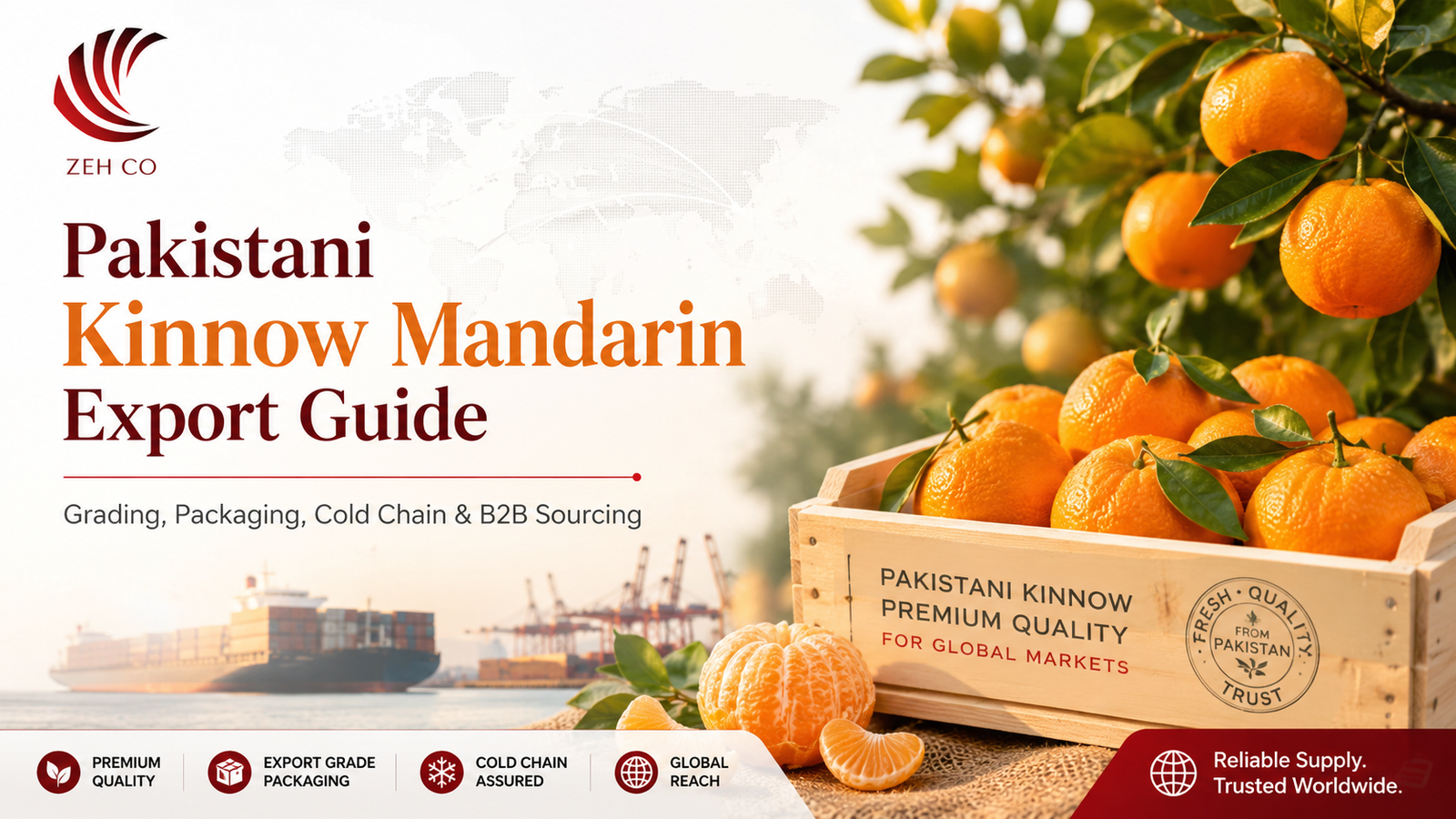
Pakistani Kinnow Mandarin export is an important seasonal opportunity for international fruit importers, supermarket distributors, wholesale markets and foodservice suppliers looking for competitively priced citrus from South Asia. Pakistan produces large quantities of Kinnow during the winter season, with commercial harvesting generally concentrated between November and March. For B2B buyers, however, successful sourcing involves much more than selecting fruit based on price. Export grade, fruit size, appearance, packing strength, post-harvest treatment, temperature management and destination-specific import rules all influence whether a shipment reaches the market in commercially acceptable condition.
ZEH Co works with international importers and wholesale buyers seeking Pakistan-origin fresh produce and can support commercial discussions related to sourcing, grading, packaging and shipment structures. Buyers planning seasonal citrus programs should establish clear specifications before ordering so that product quality, carton configuration and logistics can be aligned with their target market.
Why Pakistani Kinnow Mandarin Export Is Important for Global Buyers
Kinnow is a citrus hybrid widely cultivated in Pakistan and is particularly known for its strong flavor, high juice content and attractive orange color at commercial maturity. These characteristics make it suitable for fresh consumption as well as juice-oriented markets. Its balance of sweetness and acidity appeals to consumers across the Middle East, Asia, Eastern Europe and other markets where Pakistani citrus already has established recognition.
For importers, one of the main commercial advantages of Pakistani Kinnow is its winter availability. The November-to-March season enables buyers to add a South Asian citrus origin to their seasonal procurement programs and diversify supply sources. This can be particularly useful for distributors that do not want to depend entirely on one producing country.
Pricing can also be attractive at wholesale level, but buyers should avoid comparing quotations only on a per-kilogram basis. A lower-priced shipment with weak grading, unsuitable cartons or poor temperature management may result in higher losses after arrival. Commercial value should therefore be assessed according to usable fruit, arrival condition, shelf life and marketability.
Understanding Pakistan's Kinnow Season
Pakistan's Kinnow season generally runs from November through March, although exact harvesting schedules can vary according to weather, orchard location, maturity and market requirements. Early-season fruit may differ in sweetness, color and internal maturity from fruit harvested during peak season.
International importers should plan procurement calendars before the season begins, especially if they require weekly or recurring container volumes. Early coordination gives exporters more time to organize appropriate supply, grading, packaging materials and transport bookings.
Early Season, Peak Season and Late Season Considerations
Early-season Kinnow may be attractive to importers seeking first-to-market positioning, but buyers should pay particular attention to internal maturity and flavor development. Peak-season fruit often offers a stronger balance of color, juice and sweetness, while late-season fruit requires careful handling because mature citrus may have different shelf-life characteristics.
The ideal purchase window depends on destination, transport time and retail strategy. A buyer distributing through wholesale markets may have different requirements from a supermarket chain that expects several days of shelf life after warehouse delivery.
Export Grading Standards for Pakistani Kinnow
Consistent grading is one of the most important elements of professional citrus procurement. International buyers should avoid vague terms such as “A grade” or “premium quality” unless those terms are supported by measurable specifications.
A practical Kinnow specification can include:
- Fruit size: Defined through diameter, weight range or count per carton.
- External color: Appropriate orange coloration according to maturity and buyer requirement.
- Skin condition: Limits on scars, cuts, bruises, sunburn, punctures and excessive blemishes.
- Firmness: Fruit should be sufficiently firm for the expected transport and distribution period.
- Juice content: Commercially mature Kinnow should provide good internal juice development.
- Uniformity: Fruit within each carton should be reasonably consistent in size and appearance.
- Decay control: Fruit showing visible rot, major fungal damage or severe deterioration should be rejected during sorting.
Importers supplying supermarkets usually require tighter tolerances than buyers serving traditional wholesale markets. Consequently, the same orchard fruit can be separated into different commercial grades according to destination and customer expectations.
Why Fruit Size Matters to Importers
Fruit size directly affects carton count, retail presentation and selling price. Some markets prefer medium-sized Kinnow for household consumption, while others favor larger fruit for premium displays. Buyers should therefore specify their preferred size range instead of accepting mixed cartons.
Consistent sizing also helps importers calculate landed cost per piece. This is especially useful when supermarkets sell citrus by unit rather than by weight.
Sorting, Washing and Post-Harvest Preparation
Once harvested, Kinnow intended for export should pass through an organized post-harvest process designed to remove damaged fruit and prepare commercially acceptable lots. Handling methods can vary among packing facilities, but buyers should understand the basic stages used to protect shipment quality.
Typical post-harvest processes may include:
- Initial inspection and removal of damaged or unsuitable fruit
- Cleaning or washing according to packing-house procedures
- Drying before final packing
- Grading by size and external quality
- Approved post-harvest treatment where applicable
- Waxing where required by the commercial program and permitted by the destination market
- Final inspection before carton packing
Importers should clarify which treatments are permitted in their country. Food safety and residue requirements differ between destinations, so post-harvest practices must be compatible with the importing market's regulations.
Kinnow Packaging for International Shipments
Packaging must protect the fruit while allowing sufficient ventilation during transportation. Weak cartons can collapse during stacking, while inadequate ventilation can contribute to heat buildup and quality deterioration.
Common commercial considerations for Kinnow export cartons include:
- Strong corrugated cartons suitable for export handling
- Ventilation openings that support airflow
- Appropriate net weight based on buyer preference
- Uniform fruit placement to reduce movement
- Clear product and origin labeling
- Lot, packing date or traceability information where required
- Private-label printing for brand owners and distributors where agreed
Carton design should match the logistics route. Fruit moving directly to a nearby market may face fewer handling points than a container distributed through several warehouses after arrival. Packaging strength must therefore be selected according to the entire supply chain rather than only the initial export journey.
Private Label Kinnow Packaging
International distributors increasingly request citrus under their own brands. Private-label packaging can include buyer logos, brand colors, product information, country-of-origin statements, barcode requirements and destination-language labeling.
Private-label buyers should finalize artwork and regulatory information before packing begins. Last-minute packaging changes can delay shipment schedules during the limited Kinnow season.
Cold Chain Management for Pakistani Kinnow
Temperature control plays a major role in maintaining citrus quality after harvest. Although Kinnow is more robust than highly perishable fruits such as mangoes or berries, improper storage conditions can still cause dehydration, rind deterioration, fungal growth or reduced shelf life.
Cold-chain planning should begin before container loading. Fruit temperature, pre-shipment handling, container settings, ventilation and transit duration must work together as part of one logistics plan.
Why Pre-Cooling and Temperature Stability Matter
Removing excessive field and packing-house heat before long-distance transport can help slow quality deterioration. Equally important is maintaining a stable environment during transit. Repeated temperature fluctuations can increase condensation and contribute to quality problems.
Importers should coordinate with their logistics providers regarding the appropriate temperature and ventilation strategy for the shipment. Exact settings should be determined according to fruit condition, maturity, transit duration, packing method and destination requirements rather than relying on a single universal figure.
Sea Freight and Air Freight Options
Most large-volume Kinnow export programs are commercially suited to sea freight because citrus is typically shipped in quantities where container economics are important. Refrigerated containers can support temperature-controlled transport to international markets when properly managed.
Sea Freight
Sea freight is generally more economical for wholesale buyers importing commercial volumes. It is suitable for distributors, supermarket suppliers and produce-market importers that can plan inventory around vessel schedules.
Important considerations include:
- Transit duration
- Reefer container availability
- Port congestion risk
- Container temperature management
- Customs clearance arrangements
- Remaining shelf life after arrival
Air Freight
Air freight can be useful for urgent orders, market samples, promotional quantities or high-value retail programs where speed is more important than freight cost. However, airfreight economics are generally less suitable for large-volume citrus compared with sea transport.
Important Export Documents for Kinnow Shipments
Fresh citrus shipments can require both commercial and phytosanitary documentation. Requirements vary by destination, so importers should confirm the applicable rules before placing an order.
Typical documentation may include:
- Commercial invoice
- Packing list
- Certificate of origin where required
- Phytosanitary certificate where applicable
- Bill of lading or airway bill
- Fumigation or treatment documentation when applicable
- Additional destination-specific agricultural certificates
Importers should work with a customs broker or local agricultural authority to verify the latest entry requirements. Fresh produce can be subject to pest-control and plant-health restrictions that differ considerably between countries.
Phytosanitary and Import Compliance
Before purchasing Kinnow, buyers should verify whether Pakistani citrus is currently eligible for import into their destination and what plant-health conditions apply. Some markets may require specific orchard registration, packing-house approval, pest treatments, inspection protocols or documentation.
This step should be completed before arranging packaging, container space or promotional campaigns. A strong commercial price does not matter if the shipment cannot legally enter the destination market.
Buyers should also communicate any maximum residue limit, food-safety, labeling or traceability requirements that apply to their customers. This is particularly important for supermarket supply chains and regulated markets.
What International Buyers Should Include in a Kinnow RFQ
A detailed request for quotation helps exporters provide more accurate pricing and prevents misunderstandings. Instead of asking only for “Kinnow price per ton,” importers should provide enough commercial information to build a realistic offer.
A professional RFQ should include:
- Destination country and port
- Required quantity or number of containers
- Preferred fruit size or count
- Quality grade
- Carton net weight
- Standard or private-label packaging
- Expected shipment date
- Required Incoterm
- Any special certificates or treatments
- Expected weekly or seasonal volume
Providing these details allows the supplier to calculate packing, inland logistics, freight and documentation costs more accurately.
FOB Karachi, CIF and DDP Purchasing Options
ZEH Co can discuss different commercial shipping terms according to destination and buyer requirements, including FOB Karachi, CIF and DDP where applicable.
Under FOB arrangements, buyers typically take responsibility for main international freight after the agreed export point. CIF quotations can include cost, insurance and freight to the named destination port, while DDP arrangements may provide a more inclusive delivered structure depending on the country, product and customs requirements.
Importers should compare offers based on total landed cost rather than product price alone. Ocean freight, insurance, customs duties, port charges, inspections, inland delivery and possible storage costs can significantly affect the final cost per carton.
Choosing a Pakistani Kinnow Supplier for B2B Trade
International buyers should evaluate suppliers based on their ability to manage repeatable shipments rather than merely provide fruit during the peak season. A useful supplier assessment should examine communication quality, grading consistency, packaging capability, documentation handling and understanding of international logistics.
Buyers may consider asking suppliers about:
- Expected seasonal supply capacity
- Available fruit grades and sizes
- Packing-house procedures
- Private-label capability
- Quality inspection processes
- Previous export-market experience
- Available shipping terms
- Response procedures if quality issues arise
For new supplier relationships, a controlled trial shipment can help the buyer assess product condition on arrival before committing to a larger seasonal program.
Quality Assurance with ZEH Co
ZEH Co is a Pakistan-based B2B exporter established in 2011 and works with international importers, wholesalers and procurement managers across global markets. The company holds ISO 9001:2015 and ISO 22000 certifications and supports buyers seeking structured sourcing and export arrangements for Pakistan-origin products.
For Kinnow buyers, commercial discussions can cover fruit specifications, carton preferences, quantity, shipment schedule, documentation and applicable Incoterms. Buyers with supermarket, foodservice or distribution requirements should provide their exact quality and compliance specifications before order confirmation.
Key Markets for Pakistani Kinnow
Pakistani citrus has commercial potential across the Middle East, Asia, Europe and other regions where winter mandarins are in demand. Markets such as the UAE are particularly attractive because of proximity to Pakistan, established produce trade and strong consumer familiarity with South Asian fruits.
Additional opportunities may exist in China, Russia, the UK, Germany, Italy, Vietnam, South Korea, Turkey and other international markets, subject to current import protocols and phytosanitary eligibility.
Importers entering a new market should study both wholesale demand and regulatory access. Successful citrus trade requires a combination of competitive pricing, compliant supply and efficient distribution after arrival.
How to Reduce Risk When Importing Kinnow from Pakistan
Fresh produce always involves quality and logistics risks, but professional procurement practices can reduce them considerably. International buyers should establish written specifications, agree inspection criteria and communicate the expected destination conditions before dispatch.
Practical risk-control measures include:
- Begin with a trial order before committing large seasonal volume.
- Specify acceptable fruit sizes and quality tolerances in writing.
- Confirm destination import requirements before shipment.
- Agree carton design and net weight in advance.
- Review fruit and packing photographs where commercially appropriate.
- Select shipping schedules with sufficient time for destination distribution.
- Arrange customs clearance before the container reaches port.
- Inspect the first shipments and use arrival feedback to improve future loads.
Buyers that import several containers throughout the season should treat quality feedback as part of an ongoing procurement process. Small adjustments in grading, maturity or packaging can improve subsequent shipments and reduce losses.
Conclusion: Sourcing Pakistani Kinnow for International Markets
Pakistani Kinnow Mandarin export provides international importers with access to a flavorful and commercially important winter citrus crop. Its combination of juicy flesh, recognizable taste, seasonal availability and competitive wholesale potential makes Kinnow suitable for importers serving supermarkets, traditional produce markets, distributors and foodservice buyers.
The strongest sourcing programs are built around clearly defined grades, consistent fruit sizing, export-strength packaging, controlled post-harvest handling, reliable cold-chain management and complete import documentation. Buyers should also verify phytosanitary eligibility and destination-specific requirements before confirming commercial shipments.
ZEH Co works with international B2B buyers seeking Pakistani fresh produce and can support inquiries relating to Kinnow specifications, packaging, seasonal volumes and shipping arrangements. Importers interested in sourcing Pakistani Kinnow can visit https://zehcointernational.com/ and provide their destination, required quantity, preferred carton size and Incoterm to request a commercial quotation.