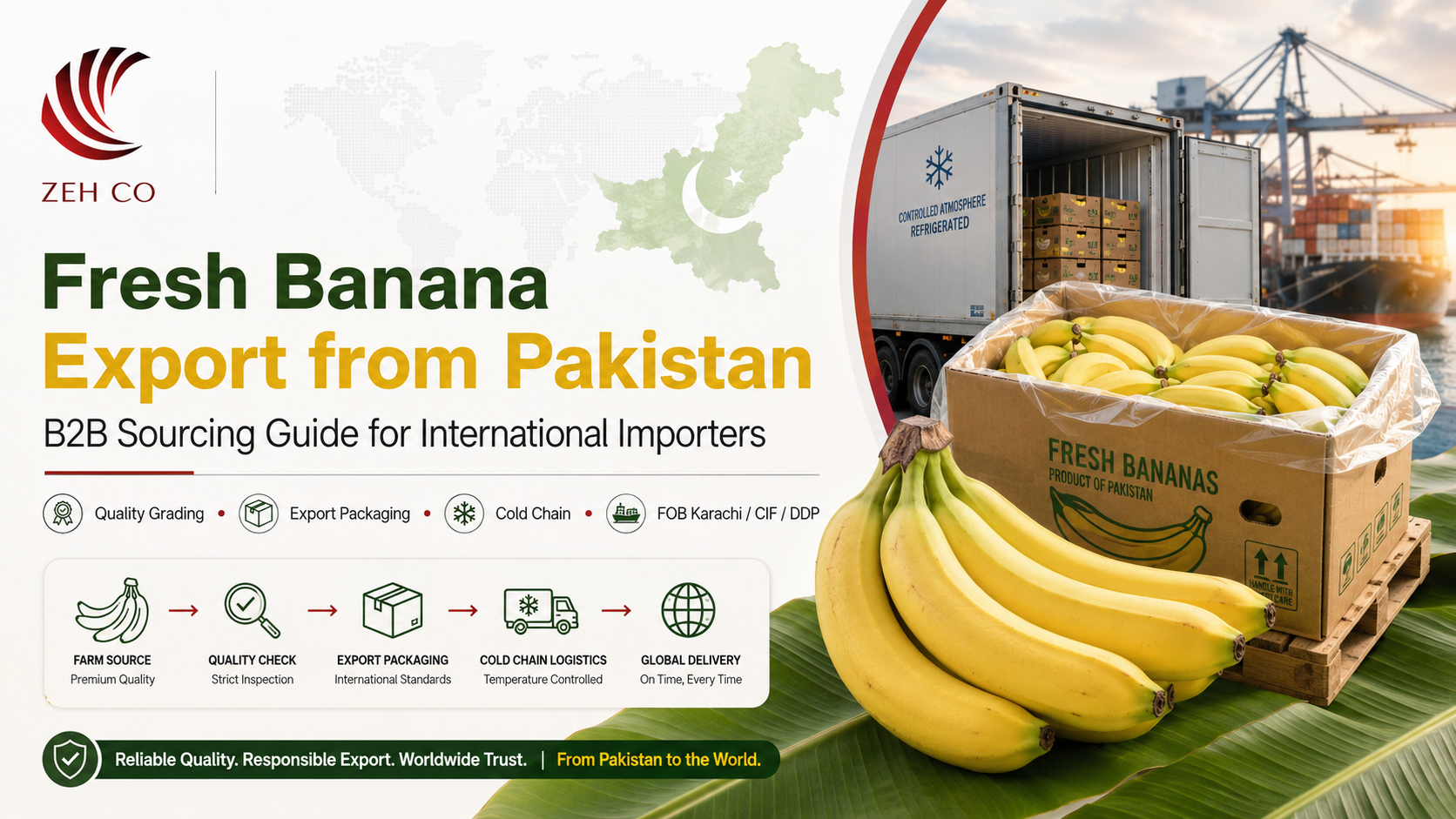
Fresh banana export from Pakistan offers international importers an additional sourcing option for supplying wholesale markets, food distributors, retailers, hotels and fresh-produce trading companies. Pakistan has suitable banana-growing regions, access to major seaports and established trade links with markets across the Middle East and Asia. However, successful banana imports depend on much more than price. Buyers must carefully evaluate maturity, fruit size, packaging strength, temperature management, transit time and the exporter’s ability to maintain consistent quality from the farm to the destination market.
This guide explains the main commercial and technical factors international buyers should review before sourcing Pakistani bananas. It is designed for importers, procurement managers and wholesale distributors seeking a dependable supply program rather than a single spot shipment.
Why Consider Fresh Banana Export from Pakistan?
Pakistan produces bananas mainly in warm agricultural regions where the climate supports commercial cultivation. Domestic farming experience, competitive production costs and proximity to Karachi’s ports create opportunities for regional exports. For buyers in the Gulf, Central Asia and nearby Asian markets, Pakistan can offer practical transit routes compared with suppliers located much farther away.
The commercial advantage is strongest when the exporter controls harvesting, grading, packing and dispatch timing. Bananas are highly sensitive to maturity and handling conditions, so a well-managed supply chain can be more important than the country of origin itself. Importers should therefore assess the exporter’s operational capability rather than making purchasing decisions only on the quoted price per carton.
Potential Advantages for Wholesale Buyers
- Competitive sourcing costs for bulk commercial orders
- Access to nearby regional markets through sea, air and road logistics
- Flexible packaging specifications for wholesalers and distributors
- Possibility of regular seasonal or program-based shipments
- Direct coordination with exporters for grading, labeling and documentation
- Availability of FOB Karachi, CIF and destination-delivery arrangements where commercially feasible
Understanding Banana Maturity for Export
Bananas intended for export are normally harvested while green and physiologically mature. The fruit must be developed enough to ripen properly after arrival but not so advanced that it begins yellowing during transit. Harvesting too early can produce weak flavor, poor texture and uneven ripening. Harvesting too late increases the risk of premature ripening, crown damage and reduced shelf life.
Importers should agree with the supplier on the required maturity stage based on the destination, shipping method and expected transit time. A shipment for a nearby market may tolerate a different maturity level from a container moving over a longer sea route. The exporter should be able to explain how harvest timing is adjusted according to the buyer’s logistics plan.
Key Maturity Indicators
Professional exporters generally evaluate fruit shape, finger fullness, peel condition, age of the bunch and expected transit duration. Angular fingers often indicate less mature fruit, while fuller and more rounded fingers show advanced development. The correct balance depends on how many days the bananas will remain in transport and storage before entering a ripening facility.
Buyers should request pre-shipment photographs, packing-line images or video inspection when placing initial orders. For large contracts, an independent inspection can also verify maturity, carton count, net weight and visible condition before loading.
Export Quality Specifications International Buyers Should Define
A clear written specification reduces disputes and prevents inconsistent grading. Terms such as “premium,” “Grade A” or “export quality” may be interpreted differently by different suppliers. The purchase contract should contain measurable requirements covering size, appearance, tolerance and packaging.
Fruit Size and Uniformity
Banana finger length and diameter should match the destination market’s retail preferences. Supermarket buyers often require a narrower size range and greater visual uniformity, while traditional wholesale markets may accept mixed commercial sizes. The importer should specify whether the shipment requires small, medium or large fingers and define acceptable tolerances.
Peel and Surface Condition
Export bananas should be green, firm and free from major cuts, deep bruises, serious latex staining, sunburn, insect damage and fungal decay. Minor natural marks may be commercially acceptable, depending on the agreed grade. The contract should state the maximum tolerance for superficial defects so that both parties understand what can be accepted.
Crown Quality
The crown is the cut section where banana hands are separated from the bunch. Poor crown cutting or inadequate treatment can lead to crown rot during transit. Crowns should be neatly trimmed, clean and handled using appropriate hygiene procedures. Importers purchasing for longer journeys should pay particular attention to crown condition because decay can spread within the carton and reduce the value of the entire shipment.
Weight and Carton Consistency
Each carton should meet the agreed net-weight specification. Significant differences between cartons create problems for inventory planning, resale pricing and customs declarations. Buyers should confirm whether the quotation is based on gross weight, net fruit weight, carton count or container load. These details should also appear consistently on the invoice and packing list.
Banana Grading and Packing Process
After harvest, banana bunches should be transported carefully to the packing area to reduce impact damage. The hands are separated, washed and graded according to size and quality. Excess latex, field dust and damaged fruit must be removed before packing.
Good packing operations separate export-grade bananas from fruit intended for local sale. The selected hands should be arranged inside the carton to minimize pressure points and movement. Protective liners, ventilation openings and suitable cushioning materials help reduce rubbing and compression during handling.
Recommended Export Packaging
Corrugated cartons are commonly used for international banana shipments. The carton must be strong enough to remain stable under stacking pressure, humidity and refrigerated conditions. Weak cartons can collapse during transport, damaging fruit in the lower layers of the pallet or container.
Packaging specifications may include:
- Ventilated corrugated export cartons
- Food-grade internal liners
- Protective pads between banana layers
- Clearly printed net and gross weight
- Country-of-origin marking
- Exporter and importer identification
- Lot, batch or packing-date information
- Private-label branding when agreed in advance
Importers should request a packaging sample or detailed carton photograph before approving the first commercial order. Carton dimensions should also be checked against pallet configuration and refrigerated-container loading plans.
Cold Chain and Temperature Management
Temperature management is one of the most critical parts of fresh banana trading. Bananas continue to respire after harvest and can ripen quickly when exposed to unsuitable temperatures. At the same time, excessively low temperatures can cause chilling injury, peel discoloration and poor ripening performance.
The correct transport temperature depends on the variety, maturity, voyage duration and technical recommendations of the shipping line or cold-chain specialist. Exporters should avoid guessing or using one temperature setting for every shipment. The final plan should be agreed based on the specific route and cargo condition.
Pre-Cooling and Loading
Fruit should not remain for long periods in direct sunlight or hot packing areas. Once packed, the cartons must be moved efficiently into a controlled environment. The refrigerated container should be clean, operational and set according to the agreed shipment plan before loading.
Airflow must not be blocked by incorrect carton placement. Overloading or poor stacking can prevent cool air from circulating through the cargo. Pallet and floor-loading patterns should therefore be designed around the container’s ventilation system.
Ethylene Control
Ethylene accelerates banana ripening. Export fruit should be kept away from ripe produce or other strong ethylene sources before and during shipment. Containers must also be checked for contamination or residues from previous cargo. Where required, shipping specialists may recommend controlled-atmosphere technology or ethylene-management solutions for longer routes.
Shipping Options for Pakistani Banana Exports
The most suitable shipping method depends on order size, destination, transit time and the importer’s required shelf-life window. Sea freight is generally used for commercial container volumes, while air freight may be considered for smaller urgent shipments, premium buyers or market testing.
Sea Freight
Refrigerated sea containers are normally the most economical option for large-volume banana exports. Before confirming a sea shipment, buyers should review the estimated port-to-port transit time, vessel schedule, transshipment points, free days at destination and possible customs-clearance delays.
A low freight rate is not always the best option if the route involves lengthy transshipment or unreliable scheduling. For perishable cargo, a faster and more stable route may protect more value than a cheaper but slower service.
Air Freight
Air freight provides faster delivery but carries a substantially higher transport cost. It may be suitable for sample orders, premium hospitality buyers, urgent replenishment or small shipments to markets where sea volumes are not yet commercially viable. The importer should compare the landed cost per kilogram with realistic wholesale selling prices before selecting air transport.
Road and Multimodal Transport
For certain regional markets, road or combined sea-road logistics may be possible. These routes require careful planning because border delays, temperature fluctuations and repeated handling can affect banana quality. Buyers should work with freight partners experienced in fresh produce rather than general cargo only.
Commercial Terms for Banana Import Contracts
Fresh-produce contracts should state precisely where the exporter’s responsibility ends and where the buyer’s responsibility begins. ZEH Co can discuss shipments under terms such as FOB Karachi, CIF and DDP, subject to destination, order size, product availability and logistical feasibility.
FOB Karachi
Under FOB terms, the exporter arranges the goods and export procedures up to loading on the nominated vessel at Karachi. The buyer controls the main freight, marine insurance and destination handling. FOB may suit experienced importers with established freight contracts and destination-clearance teams.
CIF Destination Port
CIF allows the exporter to arrange ocean freight and insurance to the named destination port. Buyers should still confirm what insurance coverage is included, because standard cargo insurance may not cover every form of quality deterioration or delay affecting perishables.
DDP or Delivered Arrangements
Delivered-duty-paid or similar destination-delivery services require detailed review of customs rules, taxes, importer-of-record requirements and local transport. These terms are not practical for every market. Buyers requesting DDP should provide the full delivery address, required import documentation and local regulatory details before expecting a final quotation.
Import Documentation and Regulatory Compliance
Fresh bananas are agricultural products and may be subject to phytosanitary rules, plant-health controls, pesticide-residue limits, labeling laws and importer registration requirements. These rules vary by destination and may change over time.
Before shipment, the buyer should provide the exporter with the latest import conditions issued by the destination authority. Depending on the market, documents may include:
- Commercial invoice
- Packing list
- Bill of lading or airway bill
- Certificate of origin
- Phytosanitary certificate
- Fumigation or treatment certificate where required
- Insurance certificate for applicable shipping terms
- Laboratory test reports when requested by the buyer or authorities
- Product traceability and packing records
The importer remains responsible for confirming whether a valid import permit is required before loading. Shipping without checking plant-health conditions can lead to delays, inspection costs, treatment orders or cargo rejection at the destination.
How to Evaluate a Pakistani Banana Exporter
Supplier selection should focus on operational reliability, not only the initial quotation. A capable exporter should provide clear answers regarding sourcing regions, harvest planning, grading standards, packaging, container loading, documentation and complaint handling.
Questions Importers Should Ask
- Which banana varieties and sizes are available?
- What maturity stage will be packed for the planned transit time?
- What is the standard net weight per carton?
- Can the supplier provide pre-shipment photos and loading evidence?
- How are crowns treated and inspected?
- What cold-chain process is followed before container loading?
- What is the minimum order quantity?
- How many containers can be supplied per week or month?
- Which shipping routes and Incoterms are available?
- What process is followed when quality claims arise?
Buyers should be cautious when an exporter gives vague answers, avoids written specifications or guarantees unrealistic shelf life without reviewing the route. Fresh produce always carries natural variation, but professional exporters should be able to define reasonable tolerances and explain how risks are controlled.
Managing Quality Claims and Arrival Inspections
The purchase contract should include a clear claims procedure. On arrival, the buyer should inspect the container promptly and document the seal number, internal temperature, carton condition, fruit maturity, visible defects and total affected quantity.
Photographs and videos should be taken before the cargo is unloaded or redistributed. If serious damage is discovered, an independent surveyor may be needed. Delayed reporting makes it difficult to determine whether the problem occurred before shipment, during transport or after delivery.
Claims should distinguish between normal commercial tolerance and genuine non-conformity. Bananas are natural products, so a small percentage of cosmetic variation may be unavoidable. However, excessive ripening, widespread crown rot, major carton collapse or significant weight shortages should be evaluated against the agreed contract.
Planning a Trial Order Before a Long-Term Supply Program
New buyers should consider starting with a controlled trial shipment. The purpose is not only to test fruit quality but also to evaluate documentation accuracy, communication speed, carton performance, loading methods and arrival condition.
After the trial, the importer and exporter can review maturity, transit performance and market feedback. Specifications may then be adjusted before regular weekly, biweekly or monthly orders begin. This step-by-step approach reduces risk and creates a more realistic foundation for long-term cooperation.
Why Work with ZEH Co for Fresh Banana Sourcing?
ZEH Co is a Pakistan-based B2B export company established in 2011, serving international importers, wholesale buyers and procurement professionals. The company handles a broad portfolio of agricultural products and export commodities, including fresh fruits and vegetables, grains, Himalayan salt, leather, textiles and industrial products.
For banana inquiries, ZEH Co can coordinate product availability, commercial grading, export packaging, documentation and shipment planning according to the buyer’s destination requirements. Shipping quotations may be discussed on FOB Karachi, CIF or DDP terms, depending on the market and practical delivery conditions.
Buyers are encouraged to provide their required fruit size, carton weight, order volume, destination port, preferred Incoterm, packaging requirements and expected shipment frequency. Complete information allows the exporter to prepare a more accurate and commercially relevant offer.
Conclusion
Fresh banana export from Pakistan can provide international wholesalers and distributors with a competitive regional sourcing opportunity, but successful trade depends on disciplined quality control and logistics. Importers should define maturity, size, packaging, weight tolerances, temperature requirements and documentation before confirming the order.
The most reliable purchasing strategy is to work with an exporter that communicates clearly, documents the packing and loading process, understands perishable-cargo handling and can adapt the shipment plan to the destination market. By beginning with a carefully monitored trial order and using detailed written specifications, buyers can reduce losses and build a stable long-term banana supply program with Pakistan.