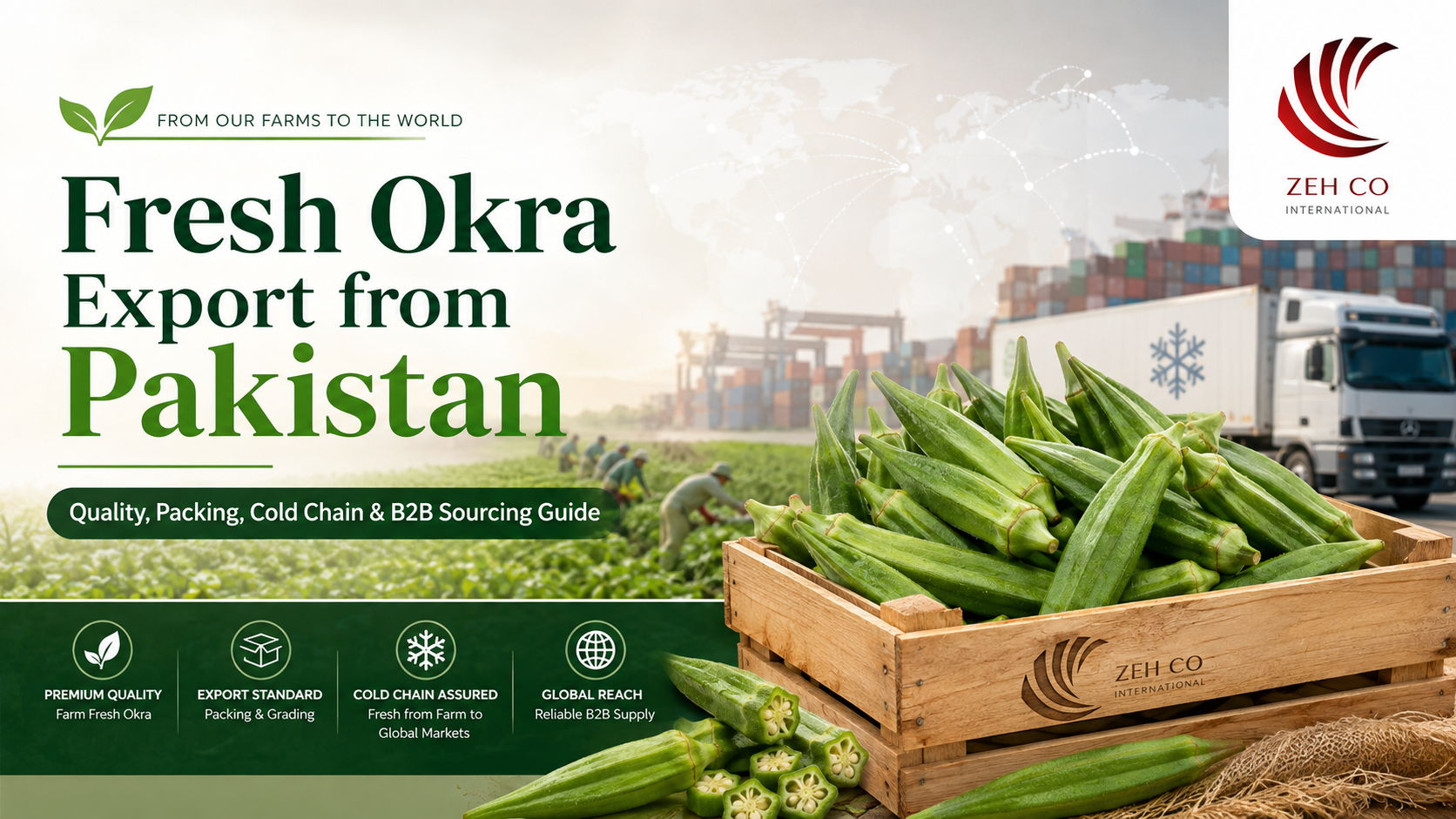
For international produce importers, fresh okra export from Pakistan offers an opportunity to source a high-demand vegetable for supermarkets, ethnic grocery distributors, fresh produce markets, foodservice companies and wholesale vegetable traders. However, successful okra procurement depends on much more than obtaining a low farm-gate price. Buyers must control pod maturity, tenderness, size uniformity, handling, packaging, temperature management, pesticide-residue requirements and transit planning. ZEH Co International supports international B2B buyers seeking Pakistani fresh produce under commercial arrangements including FOB Karachi, CIF and DDP, depending on destination and order requirements.
Fresh Okra Export from Pakistan: What B2B Buyers Need to Specify
Okra, also known as lady's finger or bhindi, is a highly perishable vegetable. Its commercial value can decline quickly when pods become oversized, tough, dehydrated, bruised or discolored. For this reason, an international buyer should never purchase fresh okra based only on a description such as "Grade A" or "export quality." A proper purchase specification should define measurable and visually identifiable quality requirements.
A buyer's specification can include pod length, acceptable diameter, color, tenderness, maturity level, straightness, freedom from major scars, cleanliness, permitted defect percentage, packaging weight and tolerance for broken or damaged pods. Importers purchasing for supermarket programs may require tighter uniformity than wholesale-market buyers, while foodservice buyers may accept broader size ranges if tenderness and freshness remain suitable.
Before confirming a commercial shipment, the exporter and importer should agree on the exact grade rather than relying on assumptions. Product photographs, videos, pre-shipment samples where practical, and packing-line inspection criteria can significantly reduce misunderstandings between supplier and buyer.
Understanding Export-Quality Okra
Pod Maturity and Tenderness
One of the most important characteristics of fresh okra is harvesting maturity. Young pods are generally preferred because they are tender and suitable for cooking, whereas pods left too long on the plant can become fibrous and commercially less desirable. Large size therefore does not automatically indicate higher value.
Importers should specify whether their market prefers small, medium or larger pods and establish an acceptable length range for each shipment. The correct specification depends on destination-market preferences rather than one universal export grade.
Color and Appearance
Fresh okra intended for premium retail distribution should generally have an attractive natural green appearance appropriate to the variety, without excessive yellowing, blackened areas, severe bruising, decay or major mechanical damage. Surface damage is particularly important because damaged pods may deteriorate faster during transportation.
Export packing teams should handle pods carefully during harvesting, sorting, washing or cleaning where applicable, grading and final packing. Excessive compression inside cartons should also be avoided because it can increase physical damage during transport.
Uniformity
Uniformity improves presentation and simplifies retail packing at destination. Commercial importers should therefore define whether mixed sizes are acceptable or whether the shipment must be separated into specific size grades. Uniform cartons can also make it easier for wholesalers to maintain consistent pricing across a shipment.
Fresh Okra Grading Before Export
A structured grading process should remove pods that do not meet the agreed commercial specification. Depending on the buyer's requirements, inspection criteria may include:
- Pod length and size range
- Tenderness and appropriate maturity
- Fresh green appearance
- Freedom from significant decay
- Absence of excessive bruising or cuts
- Freedom from serious insect damage
- Acceptable shape and straightness
- Removal of over-mature or fibrous pods
- Cleanliness appropriate to the destination market
- Consistent net weight per package
Buyers should define acceptable tolerance levels before production and packing begin. This becomes particularly important for repeat programs, where the importer expects future containers or airfreight shipments to match the quality of the initial order.
Food Safety and Pesticide-Residue Requirements
International fresh produce buyers increasingly evaluate suppliers not only on appearance but also on food-safety compliance. Importers should communicate destination-country requirements concerning pesticide residues, traceability, phytosanitary documentation and any laboratory testing that may be required.
Maximum residue limits can differ between importing markets and between individual pesticide active ingredients. A shipment acceptable in one country may therefore require different compliance checks for another destination. Buyers should provide their applicable residue specification or regulatory requirements before procurement begins rather than requesting testing only after the product has already been harvested.
For supermarket, institutional or high-volume distribution programs, buyers may also request information concerning farm origin, harvest dates, lot identification, packing dates and inspection procedures. These requirements should be discussed during quotation because additional testing, certification or documentation can affect cost and lead time.
Packaging Options for Fresh Okra
Packaging must protect okra while allowing efficient handling through the export supply chain. The best format depends on transport method, destination, customer distribution system and required net weight.
Common commercial approaches may include ventilated corrugated cartons, suitable produce boxes or other food-grade export packaging agreed with the buyer. Different net weights can be prepared according to wholesale or retail requirements. Smaller packages may help reduce compression, while larger commercial packs can reduce packaging cost per kilogram.
When requesting a quotation, buyers should state:
- Required net weight per carton
- Preferred carton dimensions if applicable
- Number of packs or liners inside each carton
- Whether ventilation holes are required
- Labeling and barcode requirements
- Importer name or private-label requirements
- Country-of-origin marking requirements
- Preferred palletization, where applicable
Private-label and importer-specific cartons should be confirmed before printing. Artwork approval, carton strength, ventilation and packing configuration should all be considered because attractive graphics alone do not guarantee that packaging is suitable for fresh-produce logistics.
Cold-Chain Management for Fresh Okra
Temperature management is one of the most important elements of successful okra export. Okra loses moisture rapidly and is also sensitive to excessively low temperatures. Postharvest planning therefore requires a balance between slowing deterioration and avoiding chilling-related damage.
For commercial postharvest handling, okra is commonly managed at approximately 7–10°C with very high relative humidity. Actual shipment settings should nevertheless be confirmed according to variety, harvest condition, packaging configuration, transit duration, transport provider and the buyer's receiving protocol.
Reducing field heat after harvesting and limiting unnecessary exposure to high ambient temperatures can help preserve quality. The cold chain should continue through packing, temporary storage, transportation to the airport or seaport, export handling and onward delivery wherever the logistics system allows.
Importers should be cautious about simply requesting the lowest possible reefer temperature. Okra is susceptible to chilling injury when held below its suitable range. A technically incorrect temperature instruction can damage the shipment even though the buyer intended to extend shelf life.
Air Freight vs Sea Freight for Okra
Air Freight
Airfreight can be suitable for premium fresh okra programs where speed, freshness and shorter transit time justify the higher transportation cost. It may be attractive for importers supplying supermarkets, restaurants or markets that sell fresh okra at a premium.
Buyers considering airfreight should request a quotation based on both product weight and packed shipment dimensions because airline freight calculations can be influenced by chargeable weight. Airport handling, customs clearance and last-mile distribution should also be included when calculating landed cost.
Sea Freight
Sea freight can offer substantially lower transportation cost per kilogram for larger quantities, but fresh okra's perishability makes route selection and transit planning especially important. A shipment should not be planned solely because reefer space is available. Total journey time, port handling, transshipment risk, clearance speed and remaining shelf life at destination should be evaluated first.
For some destinations, airfreight or combined produce shipments may make greater commercial sense than committing to a large sea shipment. ZEH Co can discuss shipping arrangements according to buyer volume, destination and commercial requirements rather than applying one transport method to every market.
FOB Karachi, CIF and DDP Purchasing Options
International buyers should compare quotations using the same Incoterm and scope of supply. A low product price can become misleading when inland transportation, export handling, freight, destination charges or customs-related costs are excluded.
ZEH Co International can work with buyers under FOB Karachi, CIF and DDP arrangements where commercially and operationally applicable.
FOB Karachi
Under an FOB arrangement, the buyer generally takes greater control over international freight from the agreed port. This can be suitable for importers with established freight-forwarding contracts or consolidated shipping programs.
CIF
CIF pricing can help buyers compare the combined product and ocean-freight cost to the destination port. Importers should still clarify which destination charges, customs expenses and local delivery costs remain outside the seller's quoted scope.
DDP
DDP can be useful for buyers seeking a more comprehensive delivered solution, subject to feasibility, destination regulations and the agreed contractual structure. Before accepting DDP pricing, buyers should confirm delivery location, customs treatment, taxes, importer-of-record responsibilities and any charges excluded from the quotation.
Export Documentation Buyers Should Discuss
Fresh-produce documentation varies by destination country, buyer requirements and applicable regulations. Before shipment, the importer should verify the documents required by its customs authority and food or plant-health regulators.
A commercial shipment may involve documents such as:
- Commercial invoice
- Packing list
- Certificate of origin where required
- Phytosanitary certificate where applicable
- Bill of lading or air waybill
- Inspection or laboratory certificates requested by the buyer
- Insurance documentation depending on the sales arrangement
- Additional destination-specific import documentation
Buyers should provide documentation instructions before dispatch. Correcting certificates or commercial documents after cargo has reached the destination can cause unnecessary delays, storage charges and clearance problems.
How Importers Should Request an Okra Quotation
The fastest way to obtain an accurate commercial quotation is to provide complete purchasing details in the first inquiry. Asking only "What is your price per kilogram?" often produces a figure that cannot be meaningfully compared with another supplier's offer.
A professional RFQ for fresh okra should include:
- Destination country and city or port
- Required quantity
- Preferred Incoterm: FOB, CIF or DDP
- Airfreight or sea-freight preference
- Required pod size or grade
- Packaging weight and format
- Private-label or carton-printing requirements
- Required certificates and laboratory testing
- Target shipment date
- Expected order frequency
For recurring supply, the importer should also disclose forecast volume. A weekly purchasing program should be planned differently from a one-time trial shipment because sourcing, farm coordination, packaging material and logistics capacity may need to be reserved in advance.
Why a Trial Shipment Can Reduce Import Risk
New importers may benefit from beginning with a commercially reasonable trial order before committing to a larger recurring program. A trial shipment allows both parties to evaluate grading accuracy, packaging performance, documentation, logistics execution and product condition upon arrival.
Receiving teams should record arrival temperature, carton condition, net weight, visual quality, defect percentage and shelf-life performance. Photographs and structured feedback are more useful to an exporter than a general statement that quality was "good" or "bad."
Information from the first shipment can then be used to refine size specifications, packaging ventilation, carton weight, cooling procedures and dispatch scheduling for subsequent orders.
Calculating the True Landed Cost of Imported Okra
Professional importers evaluate cost per saleable kilogram rather than simply cost per shipped kilogram. Fresh produce naturally carries risks relating to trimming, moisture loss, rejected pieces and deterioration. A supplier offering a slightly higher initial price but better grading and postharvest handling may therefore produce a lower effective cost at destination.
A landed-cost calculation should consider product price, packaging, domestic transportation, export handling, international freight, insurance where applicable, customs charges, import duties or taxes, inspection expenses, destination handling, local distribution and expected product loss.
For retail programs, buyers should also consider labor needed for re-sorting or repacking. Poorly graded produce can create additional warehouse cost even if the original purchase price was attractive.
Why Source Fresh Produce Through ZEH Co International?
ZEH Co International is a Pakistan-based B2B export company established in 2011, serving international buyers across a broad portfolio of agricultural products and other Pakistani goods. The company works with international importers, wholesalers, distributors and procurement teams and supports export arrangements based on buyer specifications.
ZEH Co holds ISO 9001:2015 and ISO 22000 certifications and offers commercial shipping options including FOB Karachi, CIF and DDP, subject to the product, destination and order structure. For fresh-produce buyers, the objective is to establish specifications before procurement so that sourcing, grading, packing, documentation and logistics can be coordinated around the requirements of the destination market.
International buyers can visit https://zehcointernational.com/ to review ZEH Co's export portfolio and submit inquiries for fresh vegetables and other Pakistani products.
Conclusion: Building a Reliable Fresh Okra Supply Program
Successful fresh okra export from Pakistan requires coordination across harvesting, grading, packaging, temperature management, documentation and transportation. International importers should avoid purchasing solely on the lowest quoted price and instead establish detailed specifications covering pod size, tenderness, quality tolerances, packaging, food-safety requirements and delivery terms.
For wholesale buyers, distributors, supermarkets and foodservice importers seeking a Pakistani okra supplier, a clear RFQ followed by a controlled trial shipment can provide a strong foundation for recurring business. ZEH Co International can work with buyers to develop export quotations based on required quantity, destination, packaging, quality specifications and preferred FOB Karachi, CIF or DDP terms.