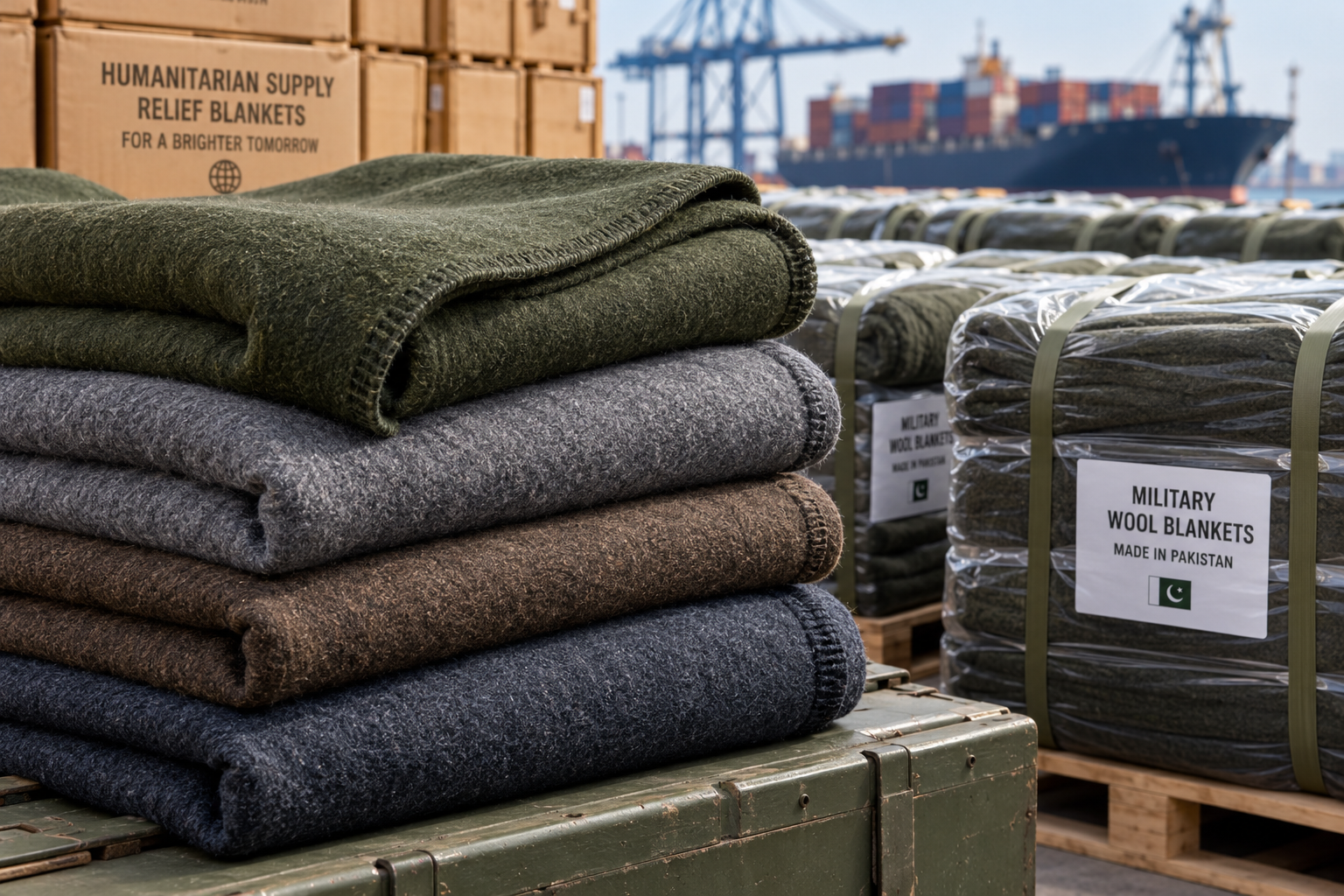
Military Wool Blankets from Pakistan: A Technical Guide for International Procurement
Military wool blankets are essential textile products used by defense organizations, emergency relief agencies, government institutions, disaster response teams, and international humanitarian procurement programs. Unlike ordinary household blankets, military and institutional blankets are generally purchased against clearly defined specifications covering fabric composition, weight, dimensions, insulation performance, durability, and packaging.
Pakistan has an established textile manufacturing industry capable of producing wool, blended-fiber, and institutional blankets for domestic and international markets. For overseas procurement managers, sourcing military wool blankets from Pakistan can provide access to textile manufacturing expertise, customizable specifications, and bulk export arrangements.
However, choosing an appropriate supplier requires more than comparing blanket prices. Understanding grams per square meter (GSM), wool percentages, fabric construction, testing requirements, and shipment specifications is essential for ensuring that delivered products meet the intended procurement contract.
ZEH Co International, a Pakistan-based B2B export company established in 2011, assists international buyers with sourcing and coordinating export supplies, including institutional textile products. This guide explains the technical and commercial considerations buyers should evaluate before purchasing military wool blankets in bulk.
1. What Makes a Military Wool Blanket Different?
A military wool blanket is generally designed for institutional use where practical performance, consistent manufacturing specifications, and durability are important purchasing considerations.
Unlike decorative household blankets, military blankets may be required to withstand repeated handling, folding, storage, transport, and use in demanding environments. Depending on the procurement contract, buyers may specify neutral colors, standardized dimensions, particular wool-blend ratios, or individual packaging.
Common applications include:
- Military accommodation: Bedding for barracks, training facilities, and temporary military housing.
- Emergency relief: Distribution during floods, earthquakes, displacement emergencies, and severe winter conditions.
- Humanitarian operations: Institutional blanket procurement for displaced populations and vulnerable communities.
- Government procurement: Supplies for public institutions, shelters, and emergency stockpiles.
- Temporary accommodation: Bedding for labor camps, field facilities, and temporary residential centers.
The correct blanket specification depends on the intended application, climate, procurement budget, and any mandatory technical standards.
2. Understanding GSM in Military Wool Blankets
GSM stands for grams per square meter and measures the mass of fabric across a defined area. It is an important specification in blanket purchasing because it helps buyers evaluate material usage, approximate product weight, and consistency across production batches.
A blanket with a higher GSM generally contains more material per unit area. However, GSM alone does not determine warmth, softness, insulation, or overall quality.
Typical GSM Considerations
- 300–400 GSM: A possible specification range for relatively lightweight institutional blankets where compact handling and lower weight are priorities.
- 400–500 GSM: A possible range for medium-weight blankets intended for general institutional applications.
- 500–600 GSM: A heavier specification range that may suit procurement programs requiring greater fabric mass.
- Above 600 GSM: A potential option for particularly heavy blanket requirements, subject to practical handling and performance considerations.
These figures are illustrative sourcing ranges rather than universal military classifications or guaranteed product offerings. A supplier must confirm available manufacturing specifications for each inquiry.
How to Calculate Blanket Weight from GSM
The approximate fabric weight of a blanket can be calculated by multiplying its surface area by GSM.
For example, a blanket measuring 150 cm by 200 cm has an area of 3 square meters.
At 500 GSM, the theoretical fabric weight is approximately 1,500 grams, or 1.5 kilograms.
Actual finished weight may differ because of edge binding, stitching, fringes, dimensional tolerances, and finishing processes.
International importers should always clarify whether the quoted weight represents the fabric mass, finished blanket net weight, or packaged unit weight.
3. Wool Percentage and Fiber Composition
Fiber composition significantly influences blanket cost, moisture management, durability, comfort, and care requirements.
Military-style blankets may be produced using wool-rich fabrics, wool and synthetic fiber blends, or other compositions permitted by the buyer's specifications.
100% Wool Blankets
Pure wool blankets are valued for their natural insulating properties and moisture-handling characteristics. Wool fibers can help maintain comfort under changing environmental conditions, although actual thermal performance depends on fabric thickness, construction, density, and moisture exposure.
Pure wool products can be more expensive than some blended alternatives and may require particular attention to shrinkage, cleaning instructions, and fiber verification.
Wool and Polyester Blends
Wool-polyester blends are another option for institutional blanket manufacturing. Depending on the formulation and construction, polyester may contribute dimensional stability, strength, and potentially lower material costs.
Illustrative blend specifications include:
- 80% wool and 20% polyester.
- 70% wool and 30% polyester.
- 60% wool and 40% polyester.
- 50% wool and 50% polyester.
These ratios are examples of possible procurement specifications and should not be interpreted as automatically available stock compositions.
The appropriate blend depends on contractual requirements, durability expectations, target pricing, and the intended users.
Buyers should request fiber-content declarations supported by suitable testing whenever composition is a critical contractual requirement.
4. Standard Dimensions and Blanket Size Selection
Dimensions affect user comfort, product weight, container utilization, and total procurement costs.
Commonly requested blanket sizes may include:
- 150 × 200 cm: A practical reference dimension for a single-person institutional blanket.
- 160 × 210 cm: An alternative size where additional coverage is required.
- 180 × 220 cm: A larger option for institutional or specialized bedding applications.
- Custom dimensions: Sizes manufactured according to an approved technical specification or tender document.
These dimensions are illustrative rather than a single internationally mandated military standard.
Government procurement contracts and humanitarian organizations may establish their own dimensional tolerances. Exporters and manufacturers should confirm finished measurements after production and conditioning where required by the testing method.
5. Fabric Construction and Surface Finishing
Fabric construction plays an important role in blanket performance. Two blankets with identical GSM and fiber composition may behave differently because of their yarn characteristics, weave structures, and finishing processes.
Woven Blanket Construction
Woven blankets are produced by interlacing warp and weft yarns. Fabric density and yarn selection influence strength, flexibility, dimensional behavior, and surface characteristics.
Brushed and Raised Surface Finishes
Brushing or raising processes create a softer surface by lifting fibers from the woven fabric. These finishing methods can affect the way a blanket traps air and feels against the body.
The degree of raising must be controlled because excessive surface fiber release may increase linting or reduce the desired appearance over time.
Edge Binding and Stitching
Edge construction is especially important where blankets undergo frequent handling.
Buyers may specify:
- Reinforced stitching along blanket edges.
- Fabric binding or overlocked edge finishes.
- Consistent stitch density and secure thread ends.
- Finishing suitable for repeated folding and institutional use.
Approved reference samples help establish acceptable workmanship before mass production begins.
6. Quality Testing Requirements for Military Wool Blankets
Institutional buyers should establish measurable quality requirements rather than relying only on supplier descriptions such as premium, heavy-duty, or military-grade.
Testing requirements should be selected according to the relevant purchasing contract and applicable standards.
Fiber Composition Testing
Laboratory analysis can verify whether the wool and synthetic fiber percentages meet the declared blend ratio. ISO 1833 methods may be relevant to quantitative fiber analysis, depending on the particular fiber mixture and selected test method.
Fabric Mass Testing
Fabric mass per unit area can be evaluated using an appropriate standard method, such as ISO 3801 where applicable. This helps verify compliance with specified GSM requirements.
Dimensional Stability
Blankets may experience changes in size after washing, cleaning, or exposure to moisture. Dimensional stability testing helps determine whether the textile meets allowable shrinkage limits.
Colorfastness Testing
Colorfastness evaluation can determine resistance to color changes or staining under specified conditions. The relevant ISO 105 test method should be selected according to the intended exposure and care conditions.
Strength and Durability
Where required, buyers may request tensile strength, tear resistance, abrasion, or other tests appropriate to the fabric construction.
Additional checks can include visual appearance, shade consistency, edge finishing, excessive loose fibers, and packaging integrity.
No single laboratory test establishes suitability for every military or humanitarian application. Buyers should identify the precise standards, test editions, acceptance limits, sampling plans, and testing responsibilities in their purchase documentation.
7. Military Blanket Colors and Custom Specifications
Military and institutional blankets are often specified in practical, neutral colors. However, color requirements vary by purchasing organization and should not be assumed.
Potential color options include:
- Olive green.
- Military gray.
- Dark brown.
- Navy blue.
- Charcoal.
- Other colors approved against a physical or digital reference.
Large institutional orders may also require special labels, batch identification, care instructions, carton markings, or purchaser-specific packaging.
When a blanket is intended for a government tender, the supplier should manufacture against the officially approved specification rather than substituting commercially similar products.
8. Bulk Packaging for International Blanket Exports
Packaging directly influences freight efficiency, handling costs, protection during transportation, and inventory management at the destination.
International buyers can consider several packaging arrangements.
Individual Blanket Packaging
Each blanket may be folded and packed individually, depending on the buyer's handling, labeling, and distribution requirements.
Multi-Unit Bale Packaging
Multiple blankets may be grouped into export bales where appropriate. Bale quantities and compression levels should be selected according to fabric characteristics, approved packaging specifications, and transportation conditions.
Carton Packaging
Export cartons may be suitable for buyers requiring organized distribution, retail-compatible presentation, or controlled stock handling.
Typical external markings can include the product description, blanket dimensions, declared composition, quantity, batch identification, gross weight, net weight, and country of origin.
For humanitarian distribution, packaging requirements may also specify unit identification and beneficiary distribution quantities.
Buyers should obtain packing lists showing actual package dimensions and weights before requesting a final freight quotation.
9. Procurement for Humanitarian and Emergency Relief Programs
Military-style wool blankets may also be suitable for humanitarian procurement when they comply with the relevant relief organization's specification.
Emergency relief purchasing emphasizes functional performance, consistency, transport efficiency, and dependable delivery.
A humanitarian blanket tender may require defined insulation properties, fiber composition, weight, dimensions, durability, labeling, and packaging standards.
Importers working with nongovernmental organizations, government relief agencies, or international procurement programs should supply the complete tender specification to the exporter before production.
Blankets should not be described as compliant with a particular humanitarian agency's requirements unless the applicable specifications have been reviewed and compliance has been demonstrated.
10. How to Request a Bulk Military Wool Blanket Quotation
A precise request for quotation helps exporters identify suitable manufacturers and prepare more reliable commercial offers.
International buyers should include the following information:
- Product type: Military wool blanket, institutional wool blanket, or humanitarian relief blanket.
- Quantity: Required number of blankets and anticipated repeat-order volumes.
- Fiber composition: Required wool percentage and permitted blending fibers.
- GSM: Target mass per square meter and allowable tolerance.
- Dimensions: Finished length and width, including dimensional tolerance.
- Color: Approved color reference or sample.
- Construction: Fabric weave, finishing, and edge-binding requirements.
- Testing: Applicable standards, laboratory reports, and inspection requirements.
- Packaging: Individual packs, cartons, bales, labels, and shipping marks.
- Destination: Import country and receiving seaport or delivery location.
- Trade terms: Preferred Incoterms and named delivery point.
- Delivery schedule: Required dispatch or arrival period.
Where available, buyers should attach a technical data sheet, reference photographs, tender documentation, or an approved physical sample.
11. FOB, CIF and DDP Shipping Options
International blanket buyers may require different delivery arrangements based on their logistics capabilities and purchasing contracts.
FOB Karachi
Under an agreed FOB Karachi arrangement for suitable sea shipments, the seller's responsibility is generally to deliver the goods on board the vessel at the named port, while the buyer arranges the main carriage. Risk allocation and detailed obligations should follow the agreed Incoterms rules.
CIF Destination Port
Under CIF terms, the seller arranges and pays for the agreed cost, freight, and required minimum insurance coverage to the named destination port, while risk transfers according to the applicable CIF rule.
DDP Named Destination
Delivered Duty Paid arrangements may be considered where legally and operationally feasible. They require careful assessment of destination-country import formalities, taxes, regulatory restrictions, and the seller's ability to meet the necessary obligations.
ZEH Co International handles B2B export inquiries involving FOB Karachi, CIF, and DDP arrangements, subject to product, destination, logistics feasibility, and agreed commercial terms.
For bulky textile shipments, freight quotations should consider both cargo weight and shipment volume. A comparatively lightweight shipment may still require substantial container space because of its packing dimensions.
12. Why International Buyers Consider Pakistan for Institutional Blanket Sourcing
Pakistan's textile industry includes manufacturers, yarn suppliers, fabric processors, finishing facilities, and garment and made-up textile production businesses.
These industrial capabilities provide a sourcing base for buyers seeking institutional textile products manufactured to defined commercial specifications.
Potential purchasing advantages include:
- Access to textile manufacturing and finishing expertise.
- Opportunities for customized blanket dimensions and material compositions.
- Bulk-order sourcing for institutional purchasing programs.
- Options for buyer-specific labeling and export packaging.
- International shipment arrangements through Pakistan's established export logistics channels.
Nevertheless, actual manufacturing capability, minimum order quantities, pricing, quality standards, and lead times must be confirmed with the selected production facility.
13. Quality Assurance Before Shipment
A structured quality assurance process helps reduce disputes and protects buyers from receiving products that differ from agreed specifications.
Before confirming mass production, buyers should review material declarations, reference samples, technical specifications, and applicable testing requirements.
During or after manufacturing, inspection may cover:
- Random measurement of blanket dimensions.
- Weight and GSM verification.
- Visual examination of fabric defects.
- Edge stitching and finishing checks.
- Color consistency across production batches.
- Verification of labels and package quantities.
- Review of laboratory reports where required.
- Final carton or bale counts before shipment.
For larger institutional contracts, independent third-party inspection may provide additional assurance when its scope, sampling method, and acceptance criteria are agreed in advance.
14. Common Mistakes to Avoid When Importing Military Wool Blankets
One common purchasing mistake is selecting a blanket based only on its unit price. Lower quotations may reflect differences in wool percentage, finished weight, construction, finishing, packaging, or quality control.
Another problem is comparing blankets with different dimensions or GSM values as though they were identical products.
Buyers should also avoid assuming that the term military-grade represents an independently verified or universally recognized technical standard.
Other important considerations include confirming destination import regulations, distinguishing fabric weight from gross shipping weight, approving physical samples where necessary, and obtaining written agreement on quality tolerances.
Clearly documented technical and commercial terms can help procurement teams evaluate competing offers consistently.
15. Source Military Wool Blankets with ZEH Co International
ZEH Co International, also known as Zawar-E-Hussain Company, is a Pakistan-based B2B export business established in 2011. The company serves international trading and procurement requirements across multiple product categories, including institutional textile sourcing.
ZEH Co International reports ISO 9001:2015 and ISO 22000 certifications as part of its company profile. Buyers should request current certification documents and confirm their scope where certification is relevant to a procurement contract. Such company-level certifications do not independently establish that a particular blanket complies with a military or humanitarian product standard.
For international buyers seeking military wool blankets from Pakistan, ZEH Co International can review product inquiries, requested technical specifications, available sourcing options, packaging requirements, and appropriate export terms.
Whether purchasing blankets for institutional distribution, government supply contracts, commercial wholesale, or humanitarian programs, buyers should submit their target quantity, required wool composition, dimensions, GSM, destination, and delivery requirements for evaluation.
Contact ZEH Co International: https://zehcointernational.com/
Request a bulk quotation: Share your military wool blanket specifications, quantity, destination port, and preferred shipping terms with the ZEH Co International team.
Frequently Asked Questions About Military Wool Blankets from Pakistan
What GSM is suitable for a military wool blanket?
The required GSM depends on the intended use and procurement standard. Buyers may evaluate medium-weight or heavier constructions, but warmth and durability must also be assessed through composition, fabric structure, and appropriate performance testing.
Are military wool blankets always made from 100% wool?
No. Military-style blankets can be made from pure wool or approved fiber blends. The required composition should be explicitly stated in the purchasing specification and verified when necessary.
Can military wool blankets be manufactured in customized dimensions?
Custom dimensions may be possible depending on manufacturer capabilities, order quantity, and production requirements. Buyers should confirm dimensional tolerances before ordering.
Can Pakistan supply military wool blankets for humanitarian relief?
Pakistani textile manufacturers may be able to produce institutional blankets for humanitarian programs. Suitability depends on compliance with the purchasing organization's specific technical, testing, and documentation requirements.
What information is needed for a wholesale quotation?
Buyers should provide quantity, blanket dimensions, target GSM, fiber composition, color, quality standards, packaging instructions, destination, and preferred delivery terms.
Does higher GSM always mean better insulation?
No. GSM measures fabric mass per unit area. Insulation also depends on fiber characteristics, fabric thickness, trapped air, construction, and environmental conditions.
Can military wool blankets be shipped under FOB or CIF terms?
Yes, these terms may be used for appropriate international sea shipments when agreed by both parties. The final quotation should identify the named port and applicable Incoterms edition.
Conclusion: Technical Specifications Are the Foundation of Reliable Bulk Procurement
Successful military wool blanket procurement depends on clear specifications, appropriate testing, consistent manufacturing, and effective export coordination.
International buyers should carefully evaluate GSM, wool content, construction, dimensions, durability, packaging, inspection requirements, and delivery conditions before confirming purchase orders.
Pakistan's textile sourcing capabilities offer opportunities for international institutions, defense supply contractors, distributors, and humanitarian procurement teams seeking blankets manufactured to clearly defined requirements.
ZEH Co International welcomes bulk sourcing inquiries for military wool blankets from Pakistan. Visit https://zehcointernational.com/ to discuss your purchasing specifications, shipment destination, and wholesale export requirements.