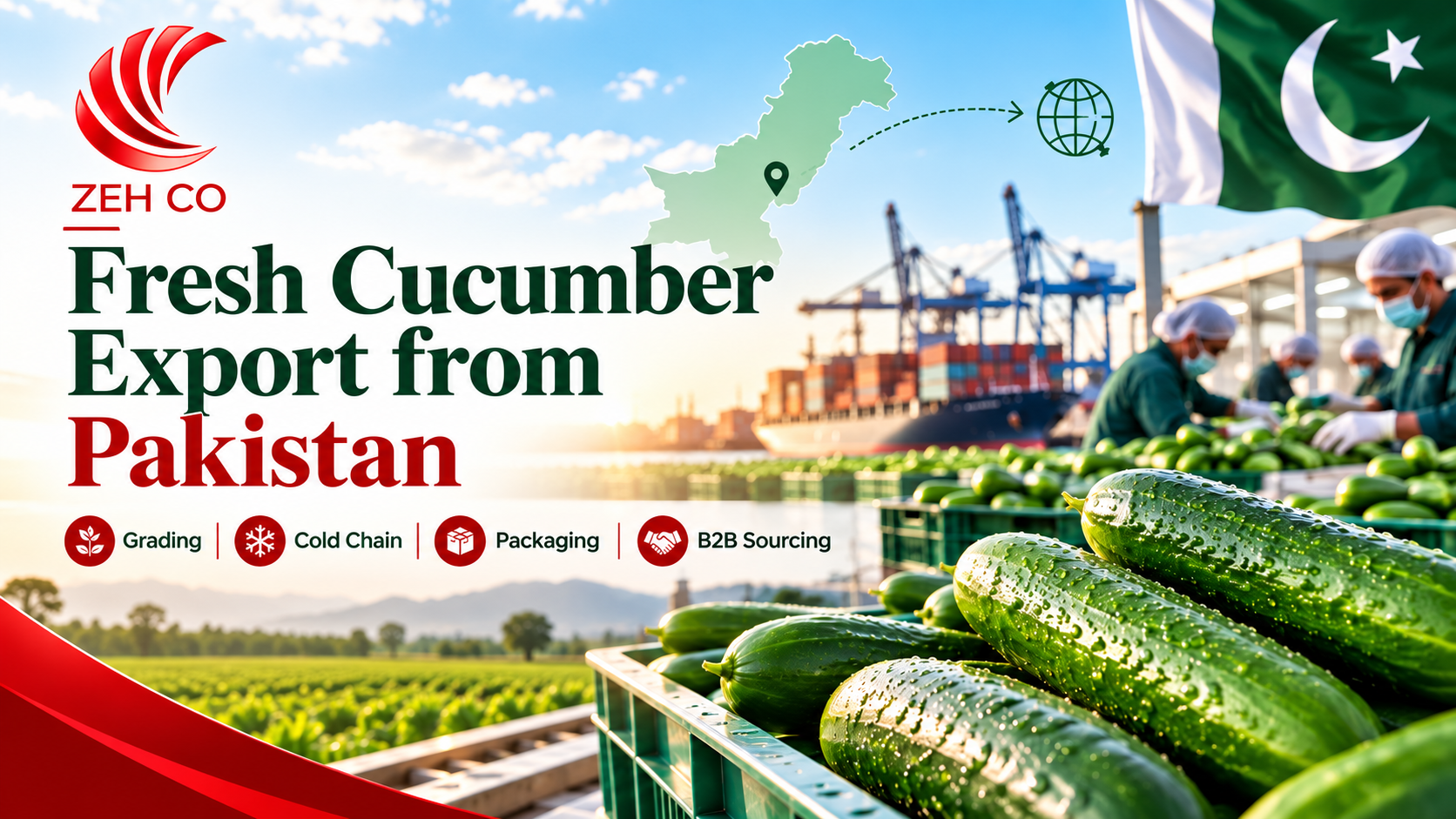
Fresh cucumber export from Pakistan presents sourcing opportunities for international vegetable importers, wholesale distributors, foodservice suppliers and fresh produce traders. However, cucumbers are highly perishable vegetables that require careful harvesting, consistent grading, appropriate packaging and controlled transportation. Successful procurement depends on more than obtaining an attractive price per kilogram.
For international buyers, the important questions concern variety, maturity, physical quality, shelf life, temperature control, shipping duration and destination-country import requirements. This guide explains the essential commercial and technical considerations when purchasing Pakistani fresh cucumbers in wholesale quantities.
Understanding Fresh Cucumber Export from Pakistan
Pakistan produces cucumbers for domestic vegetable markets, with commercial sourcing possibilities depending on agricultural season, growing region, variety and supplier availability. Export suitability must be evaluated separately from ordinary domestic-market quality because international shipments involve additional handling, transport and inspection requirements.
Importers should establish the intended market segment before ordering. Supermarket chains may require consistent appearance and retail-ready specifications, while wholesale markets and foodservice distributors may accept different size ranges or packing formats. A cucumber suitable for immediate local consumption is not necessarily suitable for several days of international distribution.
ZEH Co International can evaluate fresh vegetable sourcing enquiries against available supply, buyer specifications and commercially feasible transport arrangements. Product availability and export eligibility should always be confirmed before a purchase commitment.
Fresh Cucumber Grades, Varieties and Buyer Specifications
There is no single universal commercial cucumber size specification applicable to every destination market. Buyers should define the required product characteristics in a written specification instead of relying only on descriptions such as premium, Grade A or export quality.
Size, Shape and Appearance
Fresh export cucumbers should be evaluated for consistent length, diameter, shape and external appearance. Depending on the variety and market preference, buyers may request straight or moderately curved cucumbers, uniform green coloration, firm texture and minimal visible defects.
Specifications should identify acceptable and unacceptable characteristics, including yellowing, bruising, soft ends, cuts, scars, insect damage, decay and severe shape irregularities. Cosmetic allowances should be agreed in advance because commercial tolerance levels differ between wholesale and retail buyers.
Harvest Maturity and Firmness
Cucumbers are generally harvested while botanically immature, before their seeds become fully developed and hard. Buyers should look for firm fruit with the expected skin appearance for the selected variety.
Overmature cucumbers may develop yellow coloration, less desirable texture and reduced market appeal. Mixed maturity within the same carton can also cause inconsistent shelf life. Buyers should therefore request representative samples or clear photographs from the actual supply lot before approving a shipment.
Harvesting and Postharvest Handling
Correct harvesting practices have a direct effect on export performance. Cucumbers should be removed carefully from the plant rather than pulled aggressively, which may damage the stem end or skin. Handling equipment, harvesting containers and sorting surfaces should be kept clean and maintained to reduce contamination and mechanical damage.
After harvest, cucumbers should be protected from unnecessary heat exposure and excessive handling. Produce left in direct sunlight can lose moisture and firmness before reaching the packing facility.
A practical postharvest workflow includes initial visual inspection, separation of damaged fruit, sorting by agreed dimensions, appropriate cooling, packing and preparation for dispatch. Each stage should protect the original quality of the produce rather than attempt to restore quality already lost.
Cold Chain Management for Fresh Cucumber Export from Pakistan
Temperature management is one of the most important factors in cucumber export logistics. Unlike certain vegetables that tolerate temperatures close to freezing, cucumbers are sensitive to chilling injury.
University of California, Davis postharvest guidance identifies approximately 10–12.5°C and 95% relative humidity as reference storage conditions for cucumbers. These are general technical benchmarks, not a guarantee of shelf life for every variety, packing method or transport route.
Prolonged storage below the appropriate temperature range can cause surface pitting, water-soaked areas and subsequent decay. Excessively warm conditions may accelerate yellowing, moisture loss and deterioration. The selected temperature programme should therefore account for variety, produce condition, intended transport duration and carrier capabilities.
Humidity, Ventilation and Ethylene Exposure
Maintaining adequate humidity helps reduce shriveling and weight loss, but condensation and surface moisture must also be controlled. Packaging should permit appropriate airflow without creating unnecessary dehydration.
Cucumbers are sensitive to ethylene, a natural plant hormone released by various ripening fruits. Exposure can accelerate yellowing and quality deterioration. Mixed-load plans should therefore consider commodity compatibility, especially when tomatoes, bananas or other ethylene-producing produce are involved.
Temperature monitoring records and suitable data loggers can help exporters and importers identify interruptions in the cold chain and resolve quality disputes.
Export Packaging and Carton Specifications
Packaging should preserve cucumber firmness, reduce compression damage and maintain airflow during transport. Depending on buyer requirements and shipping conditions, suitable options may include ventilated corrugated cartons or approved reusable produce crates.
Carton selection should consider product size, net weight, stacking strength, ventilation openings, moisture resistance and pallet compatibility. Excessive filling can crush lower layers, while poorly secured or oversized cartons may allow damaging movement during transit.
Importers should confirm the required net weight per carton, permissible weight tolerance, number of layers, carton dimensions, labeling format and pallet arrangement. Retail buyers may also request specific presentation or individual protective wrapping where permitted and appropriate.
Any food-contact packaging material, treatment or labeling claim must comply with the importing market's applicable requirements. Printed country-of-origin information, traceability identifiers and other mandatory declarations should be approved before production.
Quality Assurance, Inspection and Sampling
Importers should establish an inspection programme before shipment rather than depend on visual approval at destination. A useful quality control checklist covers product identity, size distribution, firmness, color, visible damage, cleanliness, evidence of pests, carton condition and consistency between packing units.
Representative samples should reflect the actual variety and proposed commercial grade. Because cucumbers are perishable, sample transportation conditions and the time elapsed after harvesting must be considered when interpreting sample quality.
Lot Traceability and Inspection Records
Commercial traceability records can include grower or sourcing area, harvest date, packing date, lot identification, number of cartons and dispatch details. Buyers may request packing photographs, loading records, temperature readings or independent inspection reports where commercially justified.
For food safety verification, relevant documentation may include supplier hygiene records, pesticide residue test reports or laboratory analysis where required by the importing country or buyer agreement. A certificate of analysis should identify the actual tested lot, test parameters and issuing laboratory. It should not be assumed that every shipment automatically carries the same certificates.
Where certifications such as ISO 9001:2015 or ISO 22000 are mentioned in supplier credentials, buyers should verify their scope, issuing body and applicability to the specific handling or production operation.
Export Documentation and Destination Import Compliance
Fresh vegetable exports require careful document preparation and confirmation of market access. A typical commercial documentation package may include a commercial invoice, packing list, transport document, agreed certificate of origin and other documents required by the applicable transaction.
Phytosanitary certification and plant quarantine requirements should be checked with Pakistan's Department of Plant Protection and the destination-country plant protection authority. Export permission from Pakistan does not automatically establish that a particular cucumber variety is admissible into every importing country.
Buyers should confirm import permits where applicable, pest-related conditions, pesticide maximum residue limits, food safety rules, labeling obligations and any inspection requirements before shipment. Requirements can vary by destination, commodity, intended use and regulatory updates.
Importers should not assume that a general statement such as export quality, organic or internationally certified is equivalent to documented regulatory compliance.
Transportation Options and Delivery Terms
The best transport route depends on destination, transit duration, customs clearance arrangements, product shelf life and the available cold chain infrastructure.
Air freight may be considered for urgent deliveries or high-value markets where speed is critical. Refrigerated road transportation or reefer sea freight may be commercially practical for suitable destinations when actual transit time and cucumber shelf life are compatible. Long routes require particular caution because cucumbers have a relatively short postharvest marketing life.
ZEH Co International can discuss FOB Karachi, CIF and commercially feasible DDP arrangements according to the shipment and destination. Buyers should clarify responsibilities for inland transport, refrigeration, insurance, customs clearance, duties, unloading and destination inspections. A quoted Incoterm should identify the named place and the agreed contractual version.
How to Request a Wholesale Cucumber Export Quotation
An accurate quotation depends on clear technical and commercial instructions. Buyers are encouraged to include the following information in their request for quotation:
- Destination country, port or delivery city and consignee requirements.
- Preferred cucumber variety, length, diameter, shape and maturity characteristics.
- Required quality grade, acceptable defect tolerances and inspection criteria.
- Requested quantity, shipment frequency and proposed delivery window.
- Carton net weight, packing format, labeling requirements and pallet specifications.
- Required certificates, laboratory tests, import permits and traceability documents.
- Preferred transportation method and Incoterm.
- Payment conditions, sample requirements and any independent inspection arrangements.
Providing these details helps suppliers evaluate availability, identify potential regulatory obstacles and prepare a quotation based on realistic logistical assumptions rather than unsupported promises.
Common Buyer Risks and Practical Solutions
Major procurement risks include inconsistent grading, harvesting at unsuitable maturity, poor handling, temperature excursions, delayed clearance, incompatible mixed cargo and inadequate destination market access verification.
These risks can be reduced through written product specifications, an agreed acceptance procedure, realistic shipping schedules, documented cold chain responsibilities and pre-shipment checks. For a new supplier relationship, a controlled trial order can help evaluate product quality, packing performance and delivery reliability before larger recurring purchases.
Buyers should also agree in advance on how damage, shortage, delays and quality disputes will be documented and resolved. Clear commercial procedures are particularly important with perishable produce.
Conclusion: Building a Reliable Cucumber Import Supply Chain
Successful fresh cucumber export from Pakistan requires coordination between growers, sorting facilities, exporters, freight providers and importing businesses. Accurate grading, careful harvesting, suitable packaging, temperature management and regulatory preparation are essential to reducing preventable losses.
ZEH Co International welcomes B2B sourcing enquiries from importers, wholesalers and procurement teams seeking Pakistani fresh vegetables. Buyers can submit detailed cucumber specifications, destination information and delivery requirements through https://zehcointernational.com/ for a supply and logistics feasibility review.