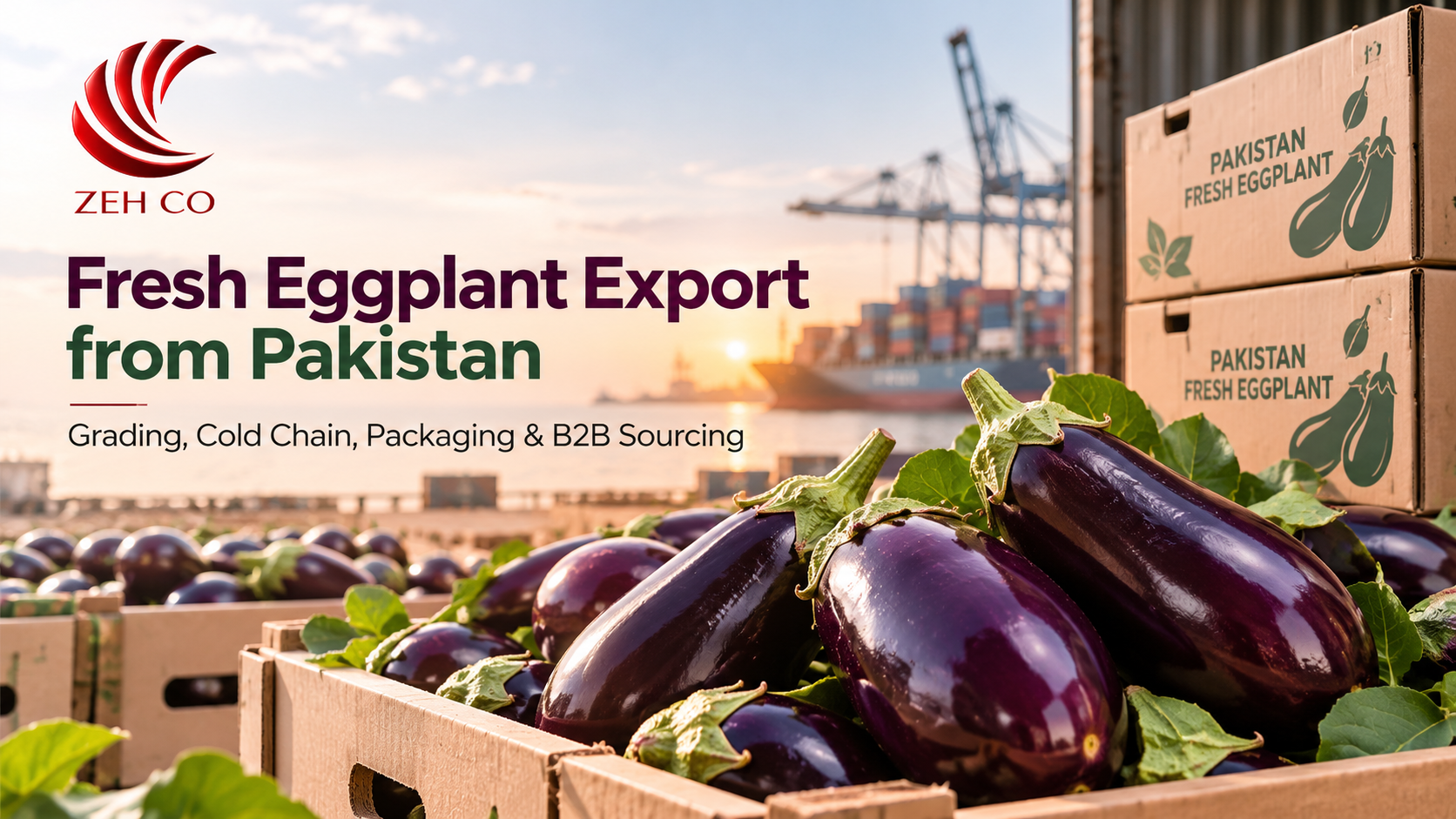
Fresh eggplant export from Pakistan presents a potential sourcing opportunity for international vegetable importers, wholesale distributors, ethnic grocery suppliers and foodservice procurement companies. Eggplant, also called aubergine or brinjal, is a delicate vegetable whose commercial value depends on its shape, maturity, skin appearance, firmness and condition upon arrival. Successful international trade therefore requires more than obtaining a competitive farm-gate price.
For importers evaluating Pakistani supply, the important questions include which eggplant variety suits the destination market, how the produce will be graded, whether harvesting and packing procedures protect its appearance, and whether the intended transport route can maintain an appropriate temperature. This guide explains the practical procurement, inspection, packaging and shipping considerations that should be discussed before confirming a commercial order.
1. Understanding Commercial Eggplant Varieties and Market Requirements
Eggplants are not a uniform commodity. Different markets purchase different colors, lengths, diameters, shapes and presentation styles. Some retailers prefer medium-sized oval purple eggplants, while other buyers require long slender varieties or smaller fruit intended for particular cuisines.
Buyers should specify their preferred commercial type rather than describing the product simply as fresh eggplant. Photographs, reference samples and written dimensions help avoid misunderstandings, particularly when a variety name is interpreted differently by the grower and importer.
Important Variety Selection Criteria
- Shape: oval, elongated, cylindrical or round, depending on the commercial variety.
- Skin color: uniform deep purple or another agreed variety-specific color.
- Length and diameter: stated measurement ranges suitable for the buyer's packaging and retail channel.
- Surface condition: smooth, glossy skin without significant scratches, scarring or discoloration.
- Intended market: fresh retail, wholesale distribution, restaurant supply or processing.
Before accepting a large purchase order, confirm that the requested variety and quantities are actually available during the intended shipment period. Availability should be established through current grower and packing-source confirmation, not assumed from general seasonal descriptions.
2. Eggplant Maturity, Harvesting and Commercial Grading
Eggplants are normally marketed while botanically immature, before the seeds become significantly enlarged and hard. Fruit that is excessively mature may develop tougher flesh, prominent seeds and an undesirable eating texture. Commercial harvesting decisions should consider firmness, skin gloss, size and the maturity characteristics of the selected variety.
Physical Quality Indicators
- Firm fruit with no substantial soft or collapsed areas.
- Glossy, variety-appropriate skin without extensive mechanical damage.
- Fresh-looking green calyx and an appropriately trimmed stem.
- No visible decay, serious pest damage or objectionable foreign material.
- Consistent sizing within the limits established by the purchase specification.
- No excessive seed development, internal browning or sponginess in sampled fruit.
Eggplants should be cut carefully from the plant rather than pulled or torn. Rough handling can injure the calyx, puncture neighboring fruit or cause bruises that become more visible during distribution.
For export purchasing, quality categories should be defined through a signed specification sheet. Buyers can use internationally recognized produce standards as a reference where commercially relevant, but the actual grade, defect allowances and size tolerances must be agreed in the contract and checked against destination-market requirements.
3. Sorting, Quality Inspection and Supplier Traceability
Professional eggplant sourcing requires a quality inspection process beginning at harvest and continuing through packing and dispatch. Fruit from different farms, harvesting dates or commercial varieties should not be mixed without proper identification and buyer approval.
At receiving, sorting staff should remove visibly damaged, decayed, overmature or unsuitable fruit. Packing-line inspections should evaluate the agreed dimensions, calyx condition, skin quality and packaging cleanliness. A representative inspection plan is preferable to checking only a few attractive cartons near the packing-line entrance.
Recommended Pre-Shipment Quality Records
- Farm or supplier identification and harvest date.
- Batch or lot reference linked to packed cartons.
- Variety, packing date and agreed quality grade.
- Sample inspection results and photographs of representative cartons.
- Recorded fruit or pulp temperature where required.
- Packaging inspection and final dispatch approval.
Importers should request laboratory analysis when justified by their market and risk assessment. Pesticide-residue screening, for example, must be evaluated against the applicable maximum residue limits of the importing jurisdiction. A laboratory certificate of analysis should refer to the actual tested lot, sampling method and analytical scope. A generic supplier certificate must not be presented as proof that every shipment has passed laboratory testing.
4. Postharvest Cooling and Temperature Management
Temperature management is one of the most important considerations in fresh eggplant export from Pakistan. Eggplants lose commercial quality through dehydration, bruising, physiological chilling injury and decay. They cannot automatically be transported under the same conditions used for every other vegetable.
The University of California, Davis postharvest guidance identifies approximately 10–12°C and 90–95% relative humidity as suitable reference conditions for eggplant storage. These figures are technical planning references rather than guarantees of shelf life. The practical temperature plan should account for variety, harvest condition, journey duration, packaging and the characteristics of the refrigeration equipment.
Eggplants are sensitive to prolonged exposure to temperatures below their recommended range. Chilling injury may appear as skin pitting, discoloration, internal browning or deterioration following unloading. Conversely, excessively warm or dry conditions may cause wilting, calyx browning and loss of glossy appearance.
Cold-Chain Management Checklist
- Arrange suitable cooling soon after harvest to remove field heat.
- Check pulp temperatures rather than relying only on surrounding air readings.
- Keep packing and staging areas protected against excessive heat.
- Use clean transport equipment with reliable temperature monitoring.
- Avoid loading warm produce into equipment expected to perform primary cooling.
- Review compatibility before mixing eggplants with other commodities, including ethylene-producing produce.
- Record temperature conditions throughout the agreed transport stages wherever practical.
Eggplant has a relatively limited postharvest marketing window. Importers should therefore assess the total farm-to-destination journey, including border clearance, port dwell time, sea transit, inspection and final delivery, before choosing an economical but potentially unsuitable route.
5. Export Packaging and Carton Specifications
Appropriate packaging protects eggplants from compression, abrasion, moisture loss and damage to their stems and calyxes. The correct carton design depends on fruit size, shipment duration, handling method and customer presentation requirements.
Common commercial approaches include appropriately ventilated corrugated cartons, protective paper or suitable liners, and internal arrangements that minimize movement. Packaging materials intended to contact food should be suitable for that purpose. Protective liners must be evaluated for both moisture retention and condensation risk.
Packaging Details to Confirm Before Production
- Net weight per carton and agreed weight tolerance.
- Carton dimensions, board strength and ventilation openings.
- Fruit count or approximate count range per carton.
- Arrangement of fruit to limit rubbing, crushing and stem punctures.
- Use of separators, tissue wrapping or approved liners when needed.
- Carton labeling, batch identification and country-of-origin information.
- Pallet pattern, stacking limits and airflow requirements.
Packaging should be validated through practical handling and transport assessments. Excessively deep cartons and heavy stacking can cause pressure damage even when the vegetables appear acceptable immediately after packing. Do not assume a universal carton capacity or pallet loading quantity without confirming the actual dimensions and weight of the selected product.
6. Samples, Trial Shipments and Buyer Approval
A buyer should evaluate a representative sample before approving a new commercial supply arrangement. An effective sample includes the requested variety and maturity, a realistic size distribution and the proposed packing presentation. Photographs alone cannot establish internal quality, eating texture or transport resistance.
For initial procurement, buyers may consider a supervised sample inspection or a small trial shipment where regulatory and logistics conditions permit. The sample approval should identify the agreed tolerances and packaging rather than being treated as an unlimited promise that every fruit will look identical.
Trial shipments are particularly valuable for testing arrival quality, packaging performance, cooling practices and the actual time between harvest and shelf delivery. The lessons should be converted into revised written specifications before scaling up orders.
7. Phytosanitary Certification and Export Documentation
Fresh vegetable trade is subject to plant-health controls and destination-specific import conditions. Pakistan's Department of Plant Protection handles phytosanitary export certification through processes integrated with Pakistan Single Window. The relevant procedure may involve inspection, documentation review, sampling or treatment depending on applicable requirements.
Importers should first verify that their destination allows imports of fresh eggplant from Pakistan and determine whether an import permit, specific pest declaration, inspection, residue testing or other authorization is necessary. A Pakistani phytosanitary certificate does not automatically guarantee admission into every importing country.
Commercial and Regulatory Documentation
- Commercial invoice with an accurate product description and declared shipment details.
- Packing list showing carton quantities, weights and lot identification.
- Transport document appropriate to the selected shipping mode.
- Phytosanitary certificate where required under applicable export procedures.
- Origin documentation if requested or legally required.
- Import permits, laboratory reports or treatment records where applicable.
- Insurance documentation when required by the contractual arrangement.
The buyer and exporter should also verify the correct tariff classification, labeling rules, pesticide restrictions and documentary deadlines before dispatch. Requirements differ by destination and can change; they must be confirmed with the relevant authorities and logistics providers for the specific shipment.
8. Air Freight, Reefer Transport and Incoterms
Air freight may be commercially appropriate for smaller quantities, premium retail distribution, urgent orders or routes where short transit time is essential. However, air transport costs, airport handling, delivery schedules and clearance arrangements must be evaluated before confirming a quotation.
Refrigerated road or sea transport may be considered where actual transit conditions, market access and remaining shelf life permit. A reefer container provides temperature management, but it does not make an unsuitable journey automatically safe for a highly perishable product.
International buyers can request quotations on FOB Karachi or other agreed origin terms, CIF to a named destination port, or DDP where operationally and legally feasible. FOB and CIF are sea or inland-waterway Incoterms; air shipments require an appropriate alternative term. For DDP transactions, the parties must verify whether the exporter can legally undertake destination import clearance, duties and other responsibilities.
The quotation should distinguish produce cost, packing, pre-cooling, documentation, inland transport, international freight, insurance and destination services according to the selected Incoterm. Importers should compare the complete landed-cost exposure rather than relying on the lowest nominal price per kilogram.
9. Common Procurement Risks and How to Reduce Them
Commercial problems frequently arise when buyers and sellers agree on quantity and price without defining the physical and logistical characteristics of the shipment.
- Wrong variety: approve photographs, reference samples and measurable dimensions.
- Uneven grading: establish a written grading specification and representative inspection plan.
- Temperature damage: document cooling procedures and review temperature records.
- Packaging failure: approve carton construction and realistic stacking arrangements.
- Regulatory rejection: confirm market access and phytosanitary requirements before procurement.
- Residue concerns: adopt a risk-based testing plan that addresses destination-specific limits.
- Transit deterioration: calculate realistic door-to-door time, including clearance delays.
- Commercial disputes: define inspection methods, defect tolerances, claim periods and supporting evidence in the contract.
Where possible, assign responsibility for each important stage, from sourcing and harvest approval through documentation, loading and delivery. Clear responsibility reduces preventable disagreements if the shipment encounters a quality or clearance problem.
10. Requesting a Bulk Eggplant Export Quotation
A useful request for quotation should provide enough detail for the supplier to evaluate physical availability and logistical feasibility rather than issue a speculative price.
- Destination country, city and port or airport.
- Required eggplant variety, shape, color and size range.
- Expected order quantity and shipment frequency.
- Target grading standard and acceptable defect tolerances.
- Preferred carton size, net weight and labeling requirements.
- Required inspection, sampling and laboratory documentation.
- Desired shipping method and applicable Incoterm.
- Expected delivery window and payment arrangements.
ZEH Co International, a Pakistan-based international trading company established in 2011, can be contacted to discuss a fresh-produce sourcing inquiry and to assess supplier availability and shipment feasibility. Specific eggplant grades, quantities, testing arrangements and destination service capabilities must be confirmed through an individual quotation rather than assumed.
Conclusion: Building a Reliable Eggplant Import Program
Successful fresh eggplant export from Pakistan depends on combining appropriate variety selection, maturity control, measurable grading, careful packing, suitable temperature management and accurate trade documentation. The condition of the vegetables when they arrive is ultimately more important than their appearance at the point of harvest.
For importers considering a new supply route, the best approach is to verify destination-market access, approve samples, agree on measurable specifications and evaluate realistic transport conditions before committing to regular wholesale shipments. ZEH Co International welcomes detailed B2B sourcing inquiries through https://zehcointernational.com/.