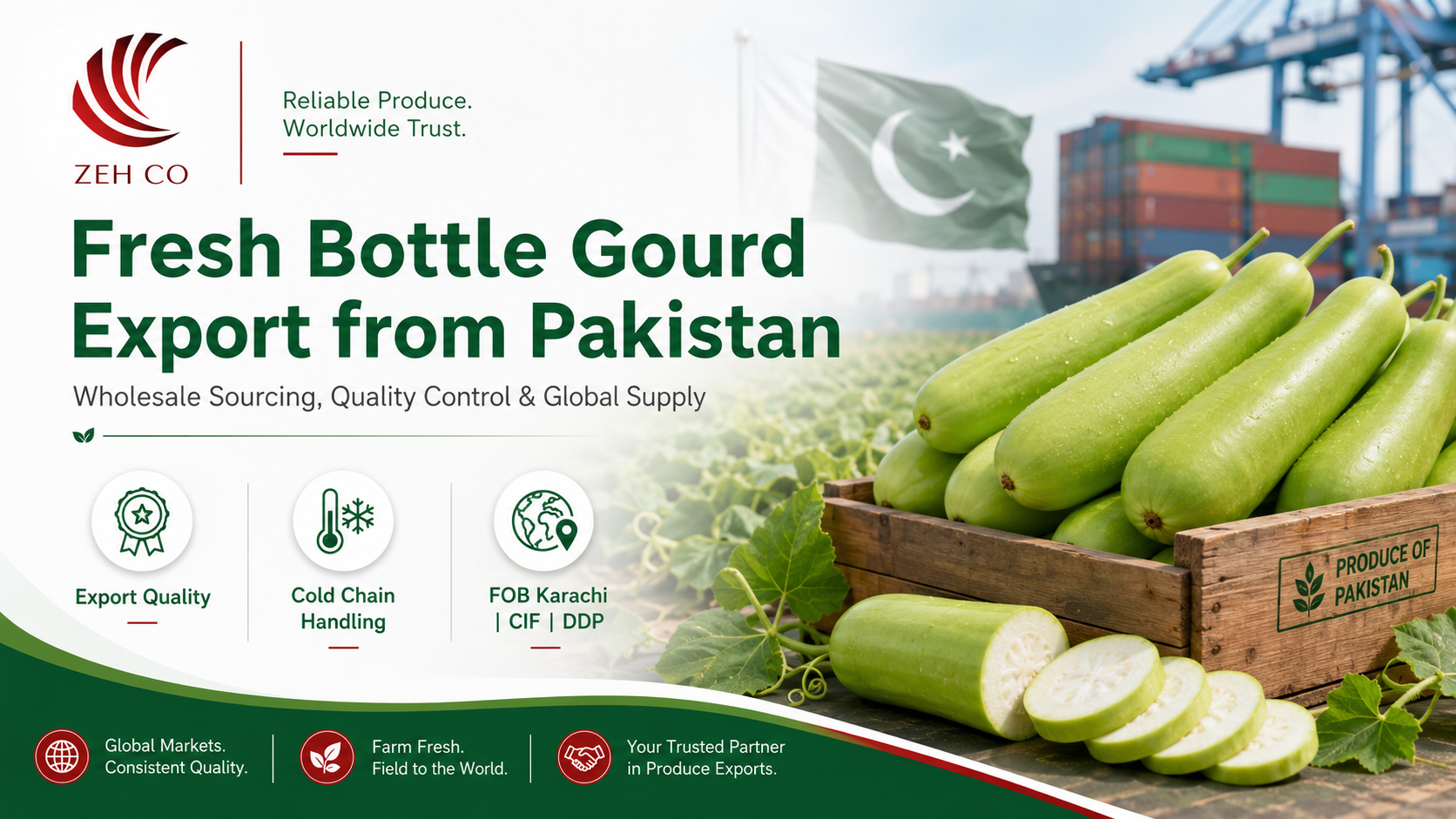
Fresh bottle gourd export from Pakistan offers an opportunity for international vegetable importers, ethnic grocery distributors, wholesalers and foodservice suppliers seeking dependable access to South Asian produce. Known locally as lauki or ghiya, bottle gourd (Lagenaria siceraria) is a popular cooking vegetable with tender flesh and a distinctive elongated or rounded appearance, depending on the variety.
Successful international procurement requires more than identifying an agricultural supplier. Bottle gourds must be harvested at the correct maturity, sorted to buyer specifications, protected against bruising and dehydration, and transported under suitable conditions. Importers also need clear agreements regarding quality tolerances, packaging, inspection and destination-country requirements.
ZEH Co International, a Pakistan-based exporter established in 2011, works with international buyers on product specifications, commercial sourcing, export documentation and shipment planning. This guide explains the practical considerations for purchasing Pakistani bottle gourds for wholesale distribution.
Understanding Fresh Bottle Gourd Varieties and Market Requirements
Bottle gourds belong to the Cucurbitaceae family. Commercial edible varieties may differ in length, diameter, shape, skin colour and maturity characteristics. Long cylindrical types and rounded forms serve different consumer preferences. Buyers should not assume that all varieties are interchangeable in wholesale or retail markets.
Before placing an order, importers should identify the intended market and confirm the required appearance. Some retailers prefer straight, uniformly sized green gourds, while others accept natural variation. The maturity stage is particularly important because bottle gourds intended for cooking are generally harvested young, before the flesh becomes excessively fibrous and the seeds harden.
Important Buyer Specifications
- Variety and shape: Long, cylindrical, rounded or another agreed commercial type.
- Size: Defined length and diameter ranges, measured according to the buyer's specifications.
- Weight: An agreed weight range per piece or an appropriate mixed-size program.
- Appearance: Fresh green skin, acceptable curvature and consistent visual quality.
- Maturity: Tender edible produce suitable for the intended retail or foodservice application.
- Defect tolerance: Written limits for cosmetic marks, deformation, bruising and other imperfections.
These specifications should be agreed before sampling and incorporated into the purchase confirmation rather than relying on informal descriptions such as premium grade.
Quality Grading and Pre-Shipment Inspection
Export-quality bottle gourds should be firm, fresh, clean and free from serious mechanical damage, visible decay or pest infestation. The skin should have the appearance expected for the agreed variety. Excessively mature, shrivelled, cracked or badly bruised produce should be removed during sorting.
There is no reason to assume that a supplier's commercial grades automatically correspond to a legally recognized grading system in the importing country. Buyers and exporters should define mutually accepted Grade A, Grade B or other commercial categories using measurable characteristics and photographic references.
Suggested Inspection Checkpoints
- Verify the agreed variety, shape, maturity, length and weight range.
- Inspect for soft spots, cuts, punctures, decay and transportation damage.
- Check surface cleanliness, freshness and signs of water loss.
- Examine representative produce for internal quality when appropriate.
- Confirm that packing cartons contain consistent sizes and acceptable quality.
- Record inspection findings using batch references and dated photographs.
A written inspection protocol should define the sampling method, acceptance criteria and procedure for handling rejected products. This reduces disputes when a shipment reaches its destination.
Harvesting, Sorting and Postharvest Handling
Bottle gourds should be harvested at a commercially suitable stage of maturity using clean tools and careful handling practices. Rough pulling, dropping and excessive stacking can damage the skin or flesh and shorten marketable life.
After harvest, produce should be moved promptly into a shaded, hygienic handling area. Sorting operations should separate damaged, overmature or otherwise unsuitable pieces. Where washing is necessary, the water quality, sanitation method and drying procedure should be appropriate for fresh produce.
Wet produce should not be sealed into packaging without sufficient drainage or drying because trapped surface moisture may contribute to deterioration. The time between harvest, grading, packing and dispatch should be minimized and documented where practical.
Temperature Management and Cold Chain Planning
Fresh bottle gourd contains substantial moisture and requires careful management of both dehydration and chilling risk. Exposure to excessive heat can accelerate deterioration, while excessively low temperatures may damage chilling-sensitive vegetables. Buyers should therefore avoid assuming that the coldest possible setting is automatically the best transport condition.
The appropriate temperature and relative humidity range must be established for the actual variety, maturity, packaging configuration and intended shipping duration. An exporter should validate the handling plan with a qualified postharvest specialist or logistics provider before accepting an extended refrigerated transit.
For temperature-controlled shipments, the plan should address pre-shipment product condition, equipment readiness, airflow, loading patterns and temperature monitoring. Data loggers may help document conditions during transit. The destination receiver should also be ready to unload, inspect and distribute the product without unnecessary delay.
Export Packaging and Carton Selection
Packaging must balance protection, ventilation, handling convenience and commercial cost. Depending on the order, suitable options may include ventilated corrugated cartons or appropriately designed reusable produce crates. The final packaging system should be tested against the product dimensions and expected transport conditions.
Cartons should be sufficiently strong for the planned stacking arrangement and resistant to the expected handling environment. Overpacking increases pressure damage, while excessive movement inside a carton can lead to rubbing, skin abrasions and bruising.
Buyers should confirm net weight, units per carton, carton dimensions, ventilation, internal protection, stacking limits and palletization requirements. If a destination requires specific labelling, packaging material compliance or pallet treatment, these conditions should be checked before production.
Packaging artwork and carton markings can be coordinated according to the importer's requirements, subject to applicable destination-market rules and agreed order quantities.
Food Safety, Traceability and Quality Assurance
A responsible fresh vegetable sourcing program should include supplier identification, harvest or packing dates, batch traceability and documented handling procedures. Buyers may request pesticide application records, residue analysis or other food-safety testing where required by the destination market or commercial contract.
One product-specific food-safety concern is abnormal bitterness. Although edible bottle gourd is ordinarily mild, unusually bitter bottle gourd may contain elevated cucurbitacins, naturally occurring compounds associated with poisoning. Such produce must not be offered for consumption; cooking does not reliably eliminate the hazard. Suppliers should maintain a clear process for investigating and rejecting suspected abnormal lots rather than treating bitterness as an acceptable cosmetic or flavour variation.
A Certificate of Analysis (COA) should identify the tested sample, laboratory, analytical parameters, methods and results. It should not be presented as proof of compliance for an untested shipment. Buyers should agree on testing scope and acceptance criteria before ordering.
ZEH Co International references ISO 9001:2015 and ISO 22000 within its company information. Buyers should verify the current certification scope and the applicability of relevant management systems to individual farms, packing operations and supply sources. A general company-level statement must not be treated as certification of every production lot.
Export Documentation and Import Compliance
International buyers should confirm whether fresh bottle gourd is permitted for import from Pakistan into their specific destination country. Market access, plant-health requirements and food-safety conditions may differ by jurisdiction and can change over time.
The Pakistan Department of Plant Protection administers phytosanitary export procedures for regulated plant products. Applicable consignments may require official inspection, phytosanitary certification and additional measures dictated by the destination country's plant protection authority.
Commercial documentation commonly involves an invoice, packing list and appropriate transport document, with a certificate of origin, import permit, treatment records or other certificates where applicable. Commodity classification, labelling, pesticide residue limits and customs requirements should be verified with the importer and relevant authorities before shipment.
Choosing the Right Shipping Method and Incoterms
The appropriate transport mode depends on the destination, order size, product condition, available transit schedules and required arrival quality. Air freight may suit selected time-sensitive orders, while refrigerated road or sea transport can be evaluated where routes, handling and commercial volumes make them feasible.
A cheaper freight quotation does not necessarily produce the lowest delivered cost if long transit times cause deterioration or significant rejection. Importers should evaluate expected transit duration, loading and unloading exposure, temperature controls, clearance arrangements and contingency plans.
ZEH Co International can discuss FOB Karachi and CIF arrangements, as well as DDP where commercially and legally feasible. Each quotation should identify the named destination, agreed Incoterms rule and version, included services, excluded costs, cargo responsibilities and payment terms. DDP should only be offered where import clearance and tax obligations can actually be fulfilled.
Samples, Trial Shipments and Bulk Procurement
For a new destination or buyer relationship, a sample or controlled trial shipment can help establish commercial suitability. The buyer should evaluate external appearance, size consistency, actual usable quality, packaging performance and product condition after the expected distribution period.
Samples are not a substitute for a clear bulk purchase specification. Harvest conditions, weather, farm sources and handling may vary between consignments, so repeat orders require agreed quality checkpoints.
Information to Include in a Bottle Gourd RFQ
- Destination country, port or delivery location.
- Preferred variety, shape, length, diameter and maturity.
- Required quantity and proposed delivery schedule.
- Acceptable defects and commercial quality grade.
- Desired packaging type, net weight and private-label requirements.
- Required testing, documentation and inspection arrangements.
- Preferred shipping mode and Incoterms, such as FOB Karachi or CIF.
- Payment terms and whether a sample or trial order is required.
A complete request for quotation allows the supplier to assess feasibility, confirm available sourcing and provide a proposal based on actual requirements rather than unsupported general estimates.
Conclusion: Building a Reliable Bottle Gourd Supply Program
Successful fresh bottle gourd export from Pakistan depends on product consistency, careful postharvest handling, appropriate packaging and compliance with destination-market requirements. Importers should prioritize traceability, agreed inspections, realistic transit planning and transparent shipment documentation instead of relying solely on a low product price.
ZEH Co International welcomes inquiries from wholesale buyers, importers and distributors seeking Pakistani fresh vegetables. Share your preferred bottle gourd specifications, quantity, destination and shipping terms through https://zehcointernational.com/ to discuss sourcing feasibility, samples and a tailored export quotation.