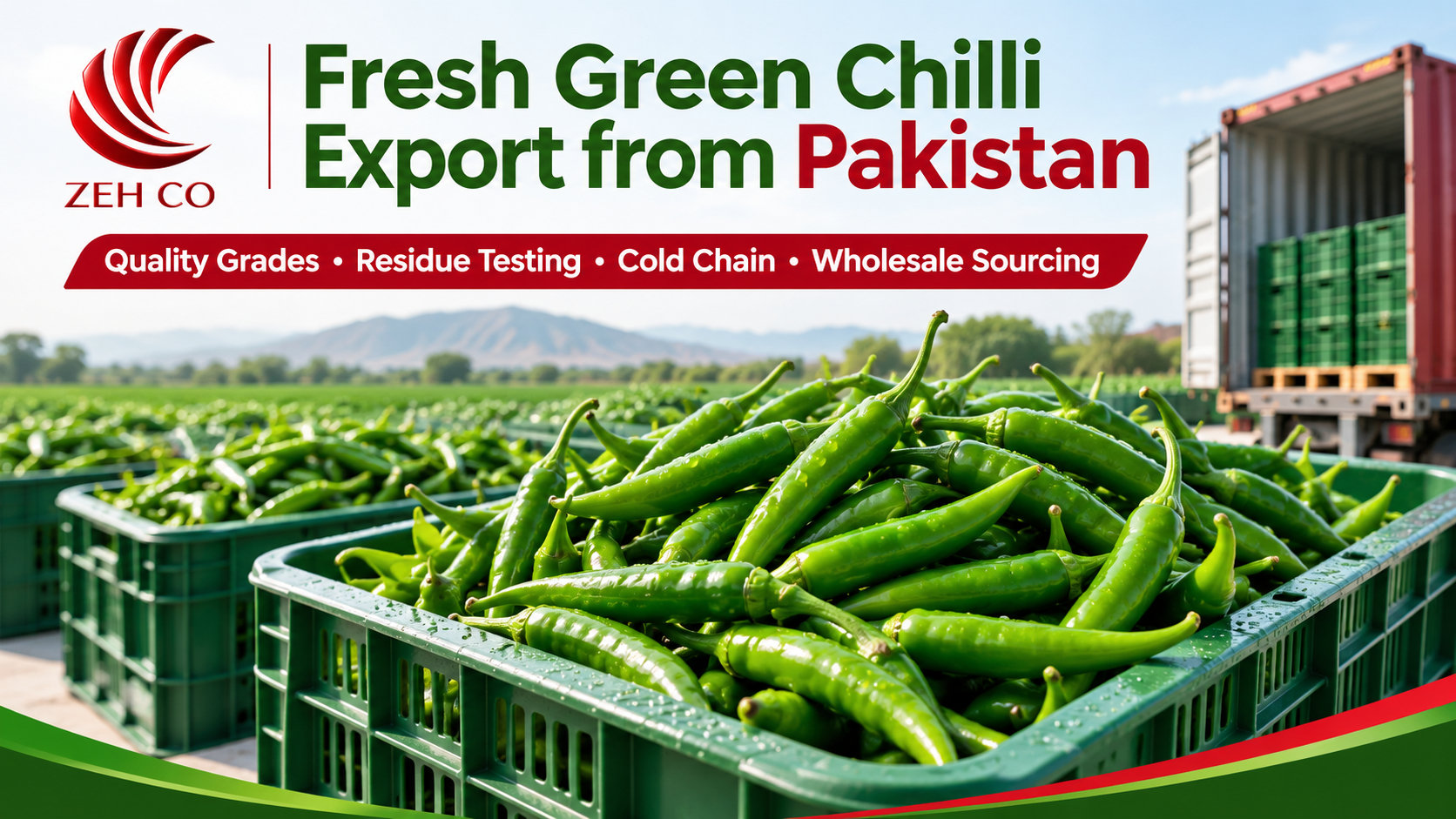
Fresh green chilli export from Pakistan offers international vegetable importers, food distributors and wholesale buyers an opportunity to source a widely used culinary ingredient. Green chillies serve retail markets, restaurants, catering businesses and food processors, but successful procurement requires more than obtaining a competitive quotation. Variety, pungency, appearance, pesticide residues, packing quality and postharvest handling can all determine whether a shipment meets its intended commercial purpose.
For buyers sourcing from Pakistan, the most reliable approach is to establish measurable specifications before placing an order. ZEH Co International works with international wholesale trading requirements and can discuss sourcing arrangements according to product availability, destination requirements and commercially feasible shipping terms. This guide explains the principal decisions importers should make before confirming a fresh green chilli consignment.
Understanding Fresh Green Chilli Varieties and Buyer Requirements
Not all green chillies are interchangeable. Commercial types can differ in length, diameter, skin thickness, pungency, colour and suitability for transportation. Some buyers require slender, strongly pungent chillies for South Asian cuisine, while others prefer relatively mild or thicker-fleshed types for different cooking and processing applications.
Importers should communicate the intended market and preferred chilli type rather than relying on a generic description such as fresh green chilli. Actual availability and cultivar identification should be confirmed with the sourcing team before accepting the order.
Heat Level, Size and Appearance
Capsaicinoids are responsible for chilli pungency, and heat intensity can vary with genetics, growing conditions and fruit maturity. Buyers requiring consistent pungency should agree on an evaluation method, potentially including representative sensory assessment or laboratory analysis where commercially justified. A named variety alone should not be treated as a guarantee of a particular heat level.
- Colour: agree on acceptable green shades and the maximum proportion of yellowing or red-coloured fruit.
- Size: specify the preferred length and diameter ranges rather than vague descriptions.
- Shape: define whether curved, straight, slender or thick-fleshed chillies are acceptable.
- Stems: confirm whether intact stems are required and whether excessive stem length is a defect.
- Pungency: identify the intended heat profile and whether formal testing is necessary.
- Condition: require firm fruit with no unacceptable decay, severe shrivelling, crushing or insect damage.
Developing Clear Export Quality Grades
Commercial quality grades should be agreed between buyer and supplier using measurable acceptance criteria. Terms such as premium, Grade A or export quality may describe marketing expectations but do not establish an internationally uniform specification by themselves.
A practical purchase specification should define size tolerances, permitted colour variation, acceptable superficial marks, physical damage limits and allowable defects. Photographs of approved and rejected fruit can supplement written descriptions, especially for repeat shipments.
Pre-Shipment Sampling and Approval
Before a substantial purchase, request recent product photographs, packing demonstrations and representative samples where transport conditions make sampling practical. Samples should reflect the intended commercial grade rather than specially selected fruit that cannot be reproduced in bulk.
Buyers may also request a pilot shipment to evaluate arrival quality. Any approved sample should be linked to the written specifications, and natural crop variation should be addressed through agreed tolerances. A satisfactory sample does not replace inspection of the commercial consignment.
Harvesting, Sorting and Packhouse Management
Fresh chillies are vulnerable to water loss, bruising, stem punctures and microbial deterioration. Harvest timing, careful handling and hygienic packing practices therefore have a direct impact on marketable quality. Fruit should be harvested at the agreed maturity, protected from excessive field heat and transferred promptly for sorting and packing.
At the packhouse, personnel should remove fruit showing visible decay, unacceptable damage, contamination or excessive maturity. Sorting by size and appearance helps buyers obtain a more consistent product, while avoiding overfilled containers reduces compression damage.
If washing is used, water quality, sanitation and effective surface drying require attention. Inadequately managed wash water can introduce contamination, while residual free moisture can contribute to deterioration. Whether chillies are washed or dry-cleaned should be established according to the operation and destination requirements.
Food Safety, Pesticide Residues and Quality Assurance
Pesticide compliance is a particularly important consideration for fresh chilli importers. Maximum residue limits and permitted pesticide uses vary across destination markets. A product acceptable under one market's rules may not comply with another market's requirements.
Before shipment, buyers should establish the destination country's applicable pesticide residue limits, relevant product classification, sampling expectations and any required import testing. Supplier declarations and farm-level spray records may support traceability, but they do not automatically demonstrate laboratory compliance.
Laboratory Reports and Certificates of Analysis
Where required, a suitable laboratory should perform a pesticide residue analysis using an appropriate method and scope. The testing arrangement should identify the sampled lot, collection date, laboratory, substances tested, reporting limits and results. The buyer should confirm that the analytical scope covers the substances relevant to its market.
A Certificate of Analysis is meaningful only when it relates to the correct sample or shipment lot. Historical test reports should not be presented as proof that a new consignment meets the same criteria. Additional microbiological or contaminant testing may be necessary depending on the destination, buyer specifications and assessed risks.
Quality management certifications and food safety certifications should also be distinguished from individual product approvals. Company-level certifications do not establish that every supplying farm, packing facility or commercial lot is separately certified. The current scope and applicability of any certificate should be checked before making product-level claims.
Packaging for Wholesale and International Distribution
Suitable export packaging protects fresh green chillies from compression, moisture loss and handling damage while allowing appropriate ventilation. Depending on destination and buyer preference, possible solutions include ventilated cartons, produce-grade plastic crates and approved retail-ready packs inside protective master cartons.
Packaging should be agreed according to net weight, product dimensions, ventilation requirements, stacking strength, pallet arrangement and the anticipated distribution route. Excessive packing density may crush lower layers, whereas insufficient packing support can allow movement during transport.
Inner liners or perforated films may assist moisture management in some applications, but the packaging system should be validated so that unwanted condensation and restricted airflow do not increase decay risks.
Labels and Traceability
Carton identification may need to include product description, country of origin, net weight, exporter or packer details, lot identification and other destination-specific information. Language, retail labelling, barcode and traceability obligations should be confirmed for the receiving market before labels are printed.
Cold Chain Management and Transit Planning
Fresh green chillies should be cooled promptly and handled under a temperature regime suited to their particular type and journey. Temperatures that are too high can accelerate water loss and deterioration, while excessively low temperatures over prolonged periods may cause chilling injury. Appropriate temperature and relative humidity settings should be determined with reference to the chilli type, packaging, expected transit duration and receiver requirements.
Pre-cooling, correct reefer operation, adequate airflow and careful loading practices are more dependable than relying on refrigeration to remove large amounts of field heat after dispatch. Where feasible, shipment temperature records can help investigate claims arising from temperature excursions.
Air Freight Versus Sea Freight
Air freight may suit urgent deliveries, relatively small orders or demanding freshness requirements, although logistics costs and handling arrangements must be evaluated. Refrigerated sea freight may be considered for suitable volumes and routes, but it requires realistic assessment of transit time, port congestion, shelf-life exposure and arrival distribution.
A buyer should not assume that all fresh chilli varieties are suitable for extended sea transport. Shipment mode should be selected only after evaluating product condition, route conditions and commercially acceptable arrival quality.
Export Documentation and Destination Compliance
Import rules differ by country and may change. Before contracting, the importer should verify market access for Pakistani fresh chillies and confirm the applicable phytosanitary, customs, food safety, labelling and inspection requirements.
Depending on the transaction and destination, documentation may include a commercial invoice, packing list, transport document, phytosanitary certificate, certificate of origin where applicable, relevant test reports and any buyer-required declarations. Import permits or additional official inspections may also be necessary.
Pakistan's Department of Plant Protection administers phytosanitary export procedures for regulated plant products. Buyers and exporters should confirm the destination's current requirements and make any required inspection or certification arrangements before dispatch rather than assuming that documentation can be corrected after shipment.
FOB, CIF and DDP Procurement Considerations
ZEH Co International can discuss FOB Karachi, CIF and commercially feasible DDP structures, subject to product, route and transaction conditions. The appropriate term should be identified together with a named place or port and the applicable Incoterms edition in the sales agreement.
Under FOB arrangements, the buyer normally manages the main international carriage. CIF quotations require careful examination of freight and insurance arrangements, while DDP requires the seller to assess destination import clearance, duties, taxes and other obligations. DDP should not be promised without confirming that the proposed legal and operational structure is workable.
The parties should separately agree on quality inspection, payment arrangements, transit temperature expectations, delivery milestones and procedures for handling arrival discrepancies.
Common Buyer Risks and Practical Controls
- Inconsistent chilli varieties: approve identifiable product characteristics and representative images before production allocation.
- Unacceptable pesticide residues: establish destination-specific testing criteria and lot traceability.
- Moisture loss and shrivelling: plan timely cooling, suitable packaging and temperature-controlled handling.
- Damage during packing: define carton weights, packing density and stacking procedures.
- Unexpected import restrictions: verify market access and official documentation before shipment booking.
- Quality disputes at destination: agree on inspection timing, independent evidence and claims procedures in advance.
What to Include in a Fresh Green Chilli Export RFQ
A complete request for quotation helps the supplier evaluate sourcing and shipping feasibility without repeatedly requesting missing details. Buyers should provide the destination country and port or delivery address, required chilli type, size and colour specifications, preferred heat profile, estimated order quantity, packaging format, intended shipment period and requested Incoterm.
Also identify pesticide residue requirements, laboratory reporting expectations, labelling instructions, inspection arrangements, payment preferences and any additional destination-specific documents. Suppliers can then assess whether the requirement can be met and provide a quotation based on a defined commercial scope rather than unsupported assumptions.
Conclusion: Building a Reliable Green Chilli Supply Programme
Successful fresh green chilli export from Pakistan depends on matching the harvest and packing operation to the buyer's commercial specification and destination regulations. Transparent grading, relevant laboratory testing, traceable lots, appropriate packaging and well-managed transport are more valuable than relying on an undefined premium-quality claim.
International importers, distributors and food-service buyers can contact ZEH Co International through https://zehcointernational.com/ to discuss fresh produce sourcing, available product specifications, sample arrangements and appropriate export quotation terms. All availability, certifications, test results and shipping commitments should be confirmed for the specific proposed consignment.