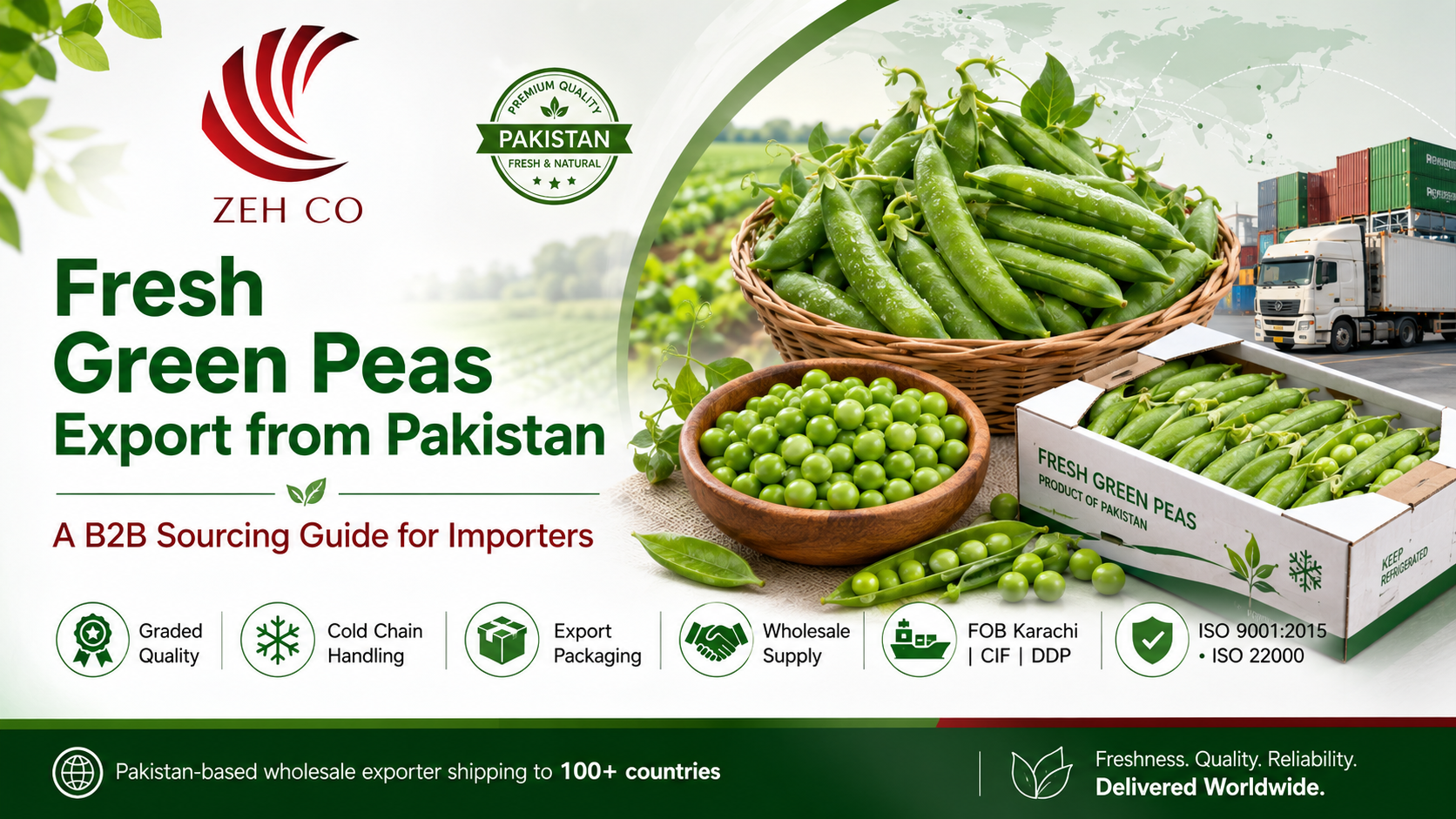
For importers seeking a fast-moving and versatile vegetable for retail, foodservice, and processing channels, fresh green peas export from Pakistan offers a practical sourcing opportunity. Pakistan’s agricultural base, experienced produce packers, and access to international air and sea freight routes allow wholesale buyers to procure green peas in commercial volumes when product specifications, harvesting schedules, packaging, and cold-chain controls are clearly agreed before shipment.
Why Fresh Green Peas Export from Pakistan Matters to B2B Buyers
Fresh green peas are used by supermarkets, vegetable wholesalers, hotels, restaurants, catering companies, food processors, and institutional kitchens. Their broad demand makes them suitable for importers who need a product that can be distributed across several customer segments rather than sold to one narrow market.
Buyers may import peas in pods for fresh retail presentation or source shelled peas for processing, repacking, and foodservice use. The appropriate product format depends on destination-market preferences, available processing facilities, required shelf life, and the importer’s customer base.
Pakistan can serve regional and selected international markets through flexible shipment planning. Nearby Gulf and Asian destinations can benefit from shorter transit options, while buyers in Europe and other distant markets may evaluate air freight, controlled-temperature sea freight, or processed alternatives according to their shelf-life requirements.
The commercial success of a shipment depends on more than the country of origin. Harvest maturity, rapid movement from farm to packhouse, pre-cooling, lot selection, packaging ventilation, transit time, and continuous temperature management all influence the condition of green peas at destination.
Product Specifications Importers Should Confirm
A professional purchase inquiry should define the required product in measurable terms. Descriptions such as “premium-quality peas” are not sufficient because suppliers and buyers may interpret them differently. A clear specification sheet reduces disputes, unnecessary sorting, rejected cartons, and quality claims after delivery.
Pod Quality and Appearance
- Colour: Bright, natural green pods without excessive yellowing, browning, or dullness.
- Maturity: Tender peas with properly developed kernels, excluding excessively hard, starchy, or over-mature pods.
- Pod condition: Clean, firm, and reasonably uniform, with no serious cracks, decay, insect damage, or dehydration.
- Freshness: Pods should show minimal wilting and have no sour, fermented, or abnormal odour.
- Foreign matter: Soil, leaves, stems, stones, and unrelated plant material should remain within the agreed tolerance.
- Food safety: The shipment should comply with the pesticide-residue, hygiene, and traceability requirements of the destination market.
Size and Grading Requirements
Importers should specify whether they require small, medium, large, or mixed-size pods. Uniform grading improves retail presentation and allows distributors to price the product consistently. Supermarket buyers normally require tighter size and appearance tolerances, while traditional wholesale markets may accept a broader grade when the price reflects the specification.
The purchase contract should define acceptable defects, size variation, weight tolerance, packaging tare, maturity level, and inspection procedures. It should also clarify whether quality acceptance will be determined at the packing facility, departure point, destination port, or buyer’s warehouse.
Green Pea Harvesting and Post-Harvest Handling
Green peas can lose sweetness, firmness, and visual quality after harvesting if they remain exposed to field heat. Harvesting and post-harvest timing are therefore important procurement issues. Buyers should ask how quickly the produce moves from field collection to sorting, packing, and cooling.
Lots harvested during cooler parts of the day and transferred promptly to a packhouse generally have a better chance of maintaining quality during transportation. Long delays between harvesting and cooling can cause moisture loss, yellowing, wilting, and faster deterioration.
At the packhouse, peas should be inspected to remove damaged, over-mature, diseased, contaminated, or insect-affected pods. Clean crates, hygienic handling surfaces, trained workers, controlled washing procedures, and effective waste separation contribute to a more consistent export lot.
Where washing is required, the process should use suitable-quality water and avoid leaving excessive moisture on the pods. Packing wet produce without proper drying or ventilation can increase condensation and decay during transport.
Pre-Cooling and Temperature Management
Pre-cooling removes field heat before the product enters long-distance transport. The method may vary according to the packhouse, order size, and packaging format, but the commercial objective remains the same: reduce product temperature promptly without causing freezing injury or excessive moisture loss.
Importers should request a documented cold-chain plan covering packhouse handling, temporary storage, refrigerated vehicle loading, airport or seaport transfer, transshipment, destination storage, and final delivery. Every transfer point should be considered because even a well-packed shipment can deteriorate if it remains unrefrigerated during loading or customs procedures.
Temperature data loggers can be valuable for sensitive or high-value consignments. A logger placed inside the load helps identify whether deterioration resulted from farm quality, delayed pre-cooling, interrupted refrigeration, prolonged customs clearance, or unsuitable destination handling.
This information supports fair claims management and allows the exporter, freight provider, and importer to improve future shipments using verifiable evidence rather than assumptions.
Export Packaging Options for Fresh Green Peas
Packaging must protect the pods from crushing, contamination, moisture loss, and excessive heat while providing sufficient ventilation. The correct format depends on the shipment method, buyer preference, retail strategy, destination regulations, and expected handling conditions.
- Ventilated corrugated cartons: Suitable for commercial handling, palletization, branding, and private-label presentation.
- Plastic crates: Useful for regional trade and short-distance distribution where returnable packaging systems are practical.
- Consumer pouches: Appropriate for supermarket programs when shelf-life testing, ventilation, labelling, and condensation control have been completed.
- Retail trays: Useful for premium presentation but may increase packaging and freight costs.
- Bulk inner bags: May help reduce moisture loss inside cartons when ventilation and condensation risks are properly managed.
Carton weight should be selected according to the strength of the packaging and the number of handling stages. Overfilled cartons may crush lower layers during stacking, while underfilled cartons increase freight cost per kilogram and allow produce to move during transport.
Each carton should display the product name, country of origin, net weight, packer or exporter identification, lot number, and handling instructions. Packing dates, production codes, grower references, or traceability information may also be required by the destination market or retail customer.
Importers should provide destination-language, barcode, and regulatory labelling requirements before packing begins. Private-label buyers should approve artwork, carton dimensions, print quality, barcode format, and mandatory declarations before commercial production.
Air Freight Versus Sea Freight
Air Freight for Premium and Time-Sensitive Orders
Air freight is generally suitable when buyers require rapid delivery, smaller commercial lots, premium freshness, or supply for time-sensitive retail programs. Reduced transit time can help preserve visual quality, but air freight increases landed cost and requires precise coordination.
Harvesting, grading, packing, flight booking, airport handling, customs documentation, and destination distribution must be aligned. A delay at any stage can remove much of the shelf-life advantage gained by using air transport.
Importers should calculate whether their market can absorb the higher logistics cost. The selling price, expected wastage, distribution margin, and shelf life available after customs clearance should all be considered before confirming an airfreight program.
Sea Freight and Regional Refrigerated Transport
Refrigerated sea freight may be considered for suitable routes, larger volumes, and programs supported by validated shelf-life performance. It requires stronger control over pre-cooling, container loading, airflow, temperature settings, transit duration, and destination clearance.
For nearby markets, refrigerated road transport or combined transport may also be commercially attractive. Before confirming a large sea shipment, buyers should conduct a trial consignment or review previous performance on the same route rather than relying on general shelf-life assumptions.
The packaging used for airfreight shipments may not automatically be suitable for sea freight. Longer transit periods can create different ventilation, humidity, and stacking requirements, so packaging should be tested under the expected transport conditions.
Documents and Import Compliance Requirements
Import requirements differ by country. Buyers should confirm the applicable rules with their destination authority, customs agent, plant-health department, or licensed import consultant before placing an order.
Common commercial and plant-health documents may include:
- Commercial invoice showing the buyer, seller, product description, quantity, value, and agreed Incoterm.
- Packing list stating carton quantities, net weight, gross weight, and packaging details.
- Certificate of origin confirming Pakistan as the country of origin.
- Phytosanitary certificate issued according to destination plant-health requirements.
- Transport document such as an airway bill, bill of lading, or road consignment document.
- Inspection certificate where required by the buyer, bank, government authority, or destination market.
- Laboratory report when pesticide-residue, microbiological, or other testing has been agreed.
Buyers should also check maximum residue limits, traceability requirements, approved production areas, packaging-material rules, pest restrictions, and any required import permits. A shipment may meet visual quality expectations and still face delay or rejection if its documentation is incomplete.
The purchase order should assign responsibility for certificates, laboratory testing, inspections, treatment costs, document legalization, and submission deadlines. Copies of critical documents should be reviewed before the shipment departs Pakistan.
FOB, CIF, and DDP Buying Options
ZEH Co can discuss FOB Karachi, CIF, and DDP arrangements according to the destination, order size, transport method, and transaction structure.
Under FOB terms, the buyer generally controls the main international freight after the agreed port stage. This option can suit experienced importers who have established freight contracts or prefer to manage shipping directly.
CIF allows the exporter to arrange cost, insurance, and freight to the named destination port. It can simplify freight coordination, although the buyer remains responsible for destination customs clearance, port costs, and onward delivery unless otherwise agreed.
DDP may provide a more complete delivered solution where operationally and legally feasible. Buyers should nevertheless confirm customs duties, taxes, import licensing, inspection charges, and local-delivery responsibilities in writing.
The lowest quoted product price is not always the lowest landed cost. Importers should compare freight, destination handling, customs clearance, inspection, duty, wastage, repacking, and last-mile delivery.
A slightly higher offer with better grading, stronger packaging, and reliable cold-chain execution may produce a better commercial return than a cheaper shipment with high rejection, shrinkage, or customer complaints.
How to Evaluate a Pakistani Green Peas Supplier
Before placing a full order, buyers should evaluate the supplier’s operational capability rather than relying only on photographs and price. Request recent product images or videos, packaging samples, proposed specifications, shipment lead time, payment terms, loading capacity, and information about the intended sourcing region.
For large programs, a third-party inspection or pre-shipment quality check can provide additional confidence. Inspection criteria must be agreed in advance so that the inspection company measures the same characteristics expected by the buyer.
- Confirm whether the supplier supervises field sourcing and packhouse operations.
- Ask how damaged or over-mature pods are identified and removed.
- Review how lot numbers and source records are maintained.
- Request the proposed cold-chain plan from harvesting to final handover.
- Agree on inspection timing, claim procedures, and evidence requirements.
- Confirm how replacement, discount, or settlement claims will be handled.
- Begin with a trial shipment when testing a new route, grade, or packaging format.
A trial order should be large enough to represent normal commercial handling. Extremely small samples may travel under different conditions and may not reveal the stacking, temperature, and handling risks of a full shipment.
Commercial Planning, MOQ, and Pricing
Green pea prices can vary according to crop availability, maturity, grade, labour costs, packaging, order volume, freight capacity, and destination demand. Buyers requesting quotations should provide complete commercial information instead of asking only for a price per kilogram.
A useful quotation request should include:
- Required total quantity and expected order frequency.
- Preferred pod size, maturity, colour, and acceptable defect tolerance.
- Carton or consumer-pack weight.
- Required labels, branding, and private-label artwork.
- Destination airport, seaport, warehouse, or delivery city.
- Preferred Incoterm, such as FOB, CIF, or DDP.
- Target shipment and delivery dates.
- Any laboratory testing, inspection, or certification requirements.
Minimum order quantity should be discussed in relation to packaging and freight economics. A supplier may be able to prepare a smaller lot, but the landed cost may become unattractive when freight, inspection, and documentation expenses are spread over limited volume.
For recurring programs, importers can negotiate rolling forecasts, shipment schedules, packaging inventory, seasonal volume estimates, and quality review procedures. Advance planning allows exporters to coordinate farm sourcing and packing capacity instead of purchasing produce from the open market at the last moment.
Why International Buyers Source Through ZEH Co
ZEH Co is a Pakistan-based B2B export company established in 2011. The company serves international importers, wholesalers, distributors, retailers, and procurement teams in more than 100 countries.
ZEH Co’s stated certifications include ISO 9001:2015 and ISO 22000, supporting a quality- and food-safety-oriented approach to international trade. For fresh produce orders, the company can coordinate buyer specifications, sourcing, grading, export packaging, documentation, and shipping discussions.
Customers can request quotations under FOB Karachi, CIF, or DDP terms where available. Clear communication before harvesting and packing allows both parties to align product grade, carton configuration, labelling, shipment timing, inspection requirements, and destination compliance.
ZEH Co can also work with buyers planning trial shipments, recurring wholesale programs, foodservice supply, supermarket packaging, or mixed fresh-vegetable orders. Buyers should share detailed requirements early so that the proposed product and logistics plan match the intended sales channel.
Conclusion
Fresh green peas export from Pakistan can provide international wholesalers and importers with a flexible product for retail, foodservice, institutional, and processing channels. Successful procurement requires more than finding a competitive farm price. It depends on clearly defined grades, suitable maturity, prompt pre-cooling, ventilated packaging, accurate documentation, regulatory compliance, and an uninterrupted cold chain.
Buyers planning a trial, seasonal, or recurring green peas program should share their required quantity, packaging, destination, Incoterm, quality standard, and delivery schedule with ZEH Co. A detailed inquiry enables the exporter to prepare a commercially relevant proposal covering product specifications, packing arrangements, shipment planning, and available delivery terms.