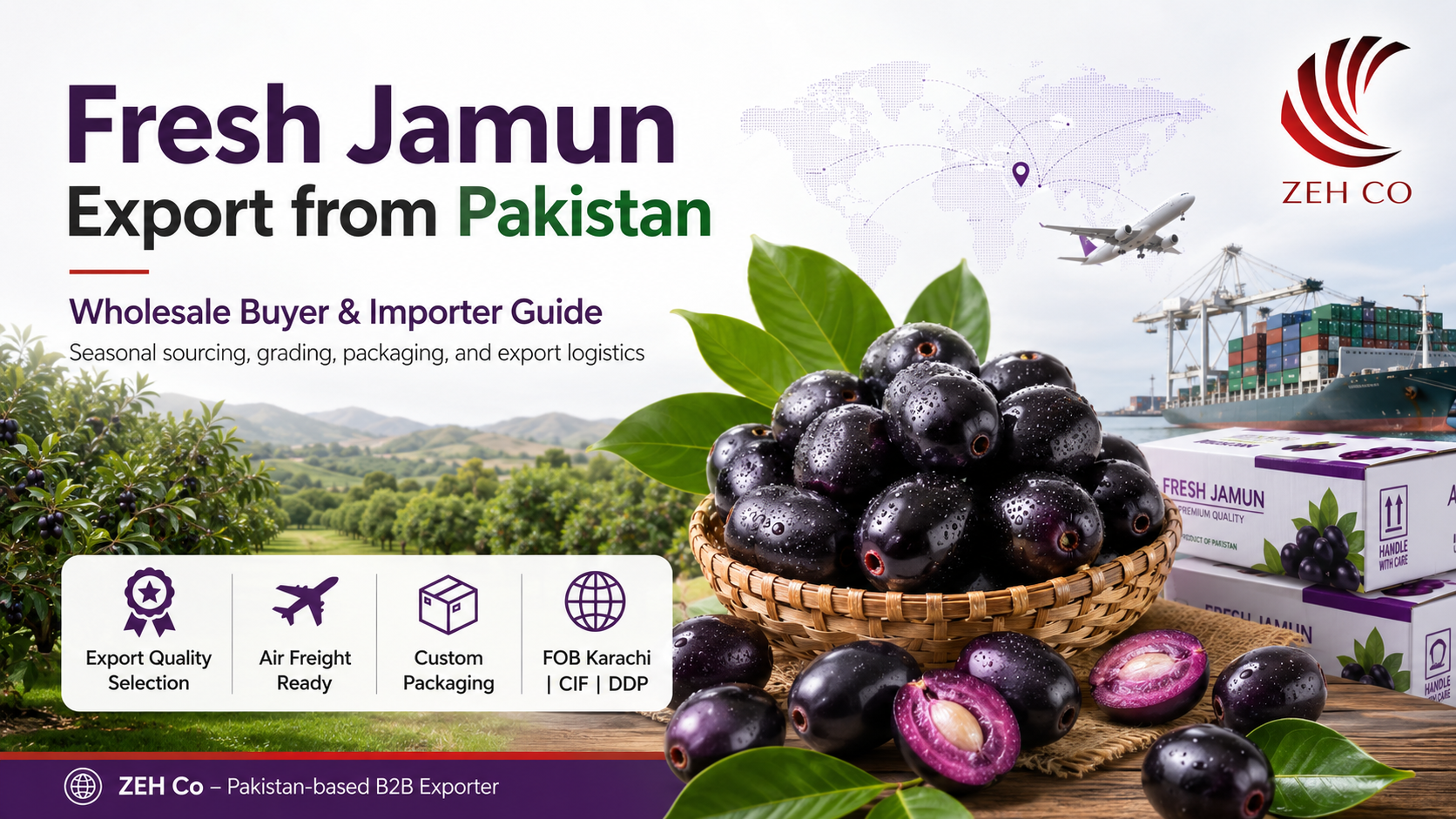
Fresh jamun export from Pakistan offers international produce buyers a seasonal opportunity to add a distinctive South Asian fruit to ethnic retail, wholesale, foodservice, and specialty distribution programs. Also known as Java plum, black plum, or jambolan, jamun is valued for its deep purple colour, sweet-tart flavour, and strong recognition among South Asian consumer communities. However, it is a delicate fruit with a limited commercial window, so successful importing depends on disciplined harvesting, grading, packaging, temperature management, and fast logistics rather than price alone.
Why Fresh Jamun Has B2B Market Potential
Jamun is not a conventional high-volume fruit like mango, banana, or citrus. Its commercial strength comes from differentiation. Importers can position it as a seasonal specialty item, while ethnic supermarkets can use it to attract customers seeking familiar regional produce. Restaurants, juice businesses, dessert manufacturers, and specialty food distributors may also use jamun for beverages, sauces, frozen pulp, preserves, and culinary applications.
The product is especially suitable for markets with established Pakistani, Indian, Bangladeshi, Sri Lankan, and broader South Asian communities. Demand can rise quickly during the season, but the selling period is short. Buyers therefore need pre-season planning, realistic volume forecasts, and coordinated promotional activity so the fruit moves rapidly after arrival.
Fresh Jamun Export from Pakistan: Product and Supply Planning
Pakistan produces jamun during the summer, with availability influenced by growing region, weather, fruit maturity, and orchard management. Importers should avoid treating the entire season as one uniform supply period. Fruit size, colour, firmness, sweetness, and shelf life can change between early, peak, and late harvests.
A practical sourcing program begins with a written specification and a shipment calendar. The importer should share the target market, preferred arrival date, expected weekly quantity, carton size, labelling language, permitted residue requirements, and acceptable defect tolerance. This allows the exporter to match orchard procurement, packing capacity, transport, and documentation with the buyer’s commercial needs.
Information Buyers Should Confirm Before Ordering
- Target market: Country, city, retail channel, and expected customer profile.
- Required maturity: Firm-ripe fruit suitable for transport instead of overripe fruit intended for immediate local sale.
- Preferred grade: Size range, colour uniformity, firmness, and defect tolerance.
- Pack format: Net weight per punnet, tray, or master carton.
- Shipment method: Air freight for premium fresh programs or another validated method for processed formats.
- Import requirements: Phytosanitary, food safety, labelling, pesticide residue, and customs documentation.
Harvest Maturity and Quality Selection
Jamun must be harvested at a stage that balances flavour development with transport durability. Immature fruit may have weak colour and excessive astringency, while overripe fruit can soften, leak, split, or deteriorate before retail sale. For export orders, the packing team should select fruit with developed external colour, suitable firmness, clean skin, and no visible decay.
Gentle harvesting is essential because bruising may not be obvious immediately. Damage can become more visible during handling and transit. Fruit should be protected from direct sunlight after picking and transferred promptly to a shaded handling area. Containers used in the field should be clean, smooth, shallow enough to prevent compression, and free from rough surfaces that could puncture the skin.
Recommended Commercial Grading Criteria
Because jamun does not have one universal international retail grade, the buyer and exporter should agree on measurable acceptance criteria before packing. A commercial product specification can include:
- Minimum and maximum fruit diameter or an agreed count range.
- Uniform dark-purple colour appropriate to the requested maturity.
- Firm texture without shrivelling, leakage, or fermentation.
- Freedom from insects, mould, soil, foreign matter, and unpleasant odours.
- Defined tolerance for undersized, misshapen, scarred, or mechanically damaged fruit.
- Agreed net weight and permissible weight variation per retail pack and carton.
Pre-shipment photographs and sample inspection reports can help confirm that the packed product matches the approved standard. For repeat supply programs, maintaining the same written specification reduces disputes and supports more consistent retail presentation.
Packaging for Fresh Jamun Shipments
Packaging must protect jamun against compression, vibration, moisture accumulation, and excessive handling. Large loose packs may reduce packaging costs but can increase pressure damage. Smaller consumer punnets or shallow trays placed inside ventilated master cartons generally provide better portion control and reduce repeated handling at the destination.
The final packaging format should be selected according to transit duration, airline or carrier requirements, importer preference, and retail channel. Packaging should be food-grade, clean, sufficiently ventilated, and strong enough to remain stable when stacked. Absorbent material may be considered where permitted and technically suitable, but it must not create contamination or ventilation problems.
Essential Carton and Label Information
- Product name: Fresh Jamun, Java Plum, or another buyer-approved market name.
- Country of origin: Pakistan.
- Exporter and importer details where required.
- Net weight, lot number, packing date, and traceability code.
- Storage and handling instructions.
- Required language, barcode, phytosanitary, and regulatory markings.
Retail labels should be approved before production begins. Late label changes can delay packing and create unnecessary costs during a highly time-sensitive export season.
Cold-Chain and Logistics Management
Jamun is highly perishable, making time and temperature control central to shipment success. Exporters should minimize the interval between harvest, sorting, packing, cooling, and dispatch. Buyers should also arrange rapid customs clearance and refrigerated handling at the destination. A properly managed origin process can still fail if cartons remain on an unrefrigerated airport pallet or inside a warm customs area.
The precise temperature, humidity, ventilation, and packaging combination should be validated for the selected fruit maturity, pack design, and transport journey. Importers should not assume that handling parameters used for grapes, plums, berries, or mangoes will automatically be suitable for jamun. A trial shipment with temperature monitoring is advisable before increasing to a larger weekly supply program.
Why Air Freight Is Often Preferred
For premium fresh jamun, air freight is generally the more practical option because it shortens transit time and helps preserve marketable quality. The commercial calculation should include freight costs, airport handling, customs clearance, expected saleable yield, selling price, and the risk of rejection or shrinkage.
The cheapest freight quotation does not necessarily produce the lowest landed cost. A slower or poorly coordinated service may reduce the percentage of fruit that can be sold, resulting in a higher effective cost per saleable kilogram.
Inspection, Traceability, and Export Documentation
International buyers should request shipment-level traceability from the orchard or collection point through packing and dispatch. Each lot should be identifiable through supplier records, packing date, quantity, inspection details, and destination. A structured quality-control process should check fruit condition, pack weight, carton strength, label accuracy, cleanliness, and visible defects before loading.
Documentation requirements vary by destination, so the importer should confirm them before the season begins. Depending on the market and contract, documents may include:
- Commercial invoice.
- Packing list.
- Certificate of origin.
- Phytosanitary certificate.
- Airway bill or transport document.
- Pre-shipment inspection record.
- Food safety or laboratory documentation requested by the buyer.
- Other customs or destination-specific certificates.
The buyer remains responsible for verifying product admissibility, import permits, maximum residue limits, labelling rules, and other market-specific requirements before confirming the shipment.
How Importers Can Reduce Commercial Risk
A controlled trial is the best starting point for a new destination. The initial shipment should be large enough to test handling and customer demand but small enough to limit financial exposure. Importers should record arrival temperature, carton condition, fruit firmness, leakage, decay, saleable percentage, and shelf performance.
This information should be shared with the exporter to improve the next shipment. Adjustments may include maturity selection, pack size, ventilation, carton strength, dispatch timing, flight selection, or destination handling procedures.
Payment terms, claim procedures, quality tolerances, and responsibility for transport delays should be included in the sales agreement. Product photographs alone cannot replace an agreed written specification. Buyers should also define how quickly a quality claim must be reported and what evidence is required, such as arrival photographs, temperature records, independent survey reports, and affected carton counts.
Pre-Shipment Buyer Checklist
- Approve the product specification and tolerance levels.
- Confirm the retail pack and master-carton design.
- Verify import permits and phytosanitary requirements.
- Approve labels and the traceability format.
- Confirm the flight schedule, clearance agent, and refrigerated delivery arrangement.
- Agree on the Incoterm, payment terms, insurance responsibility, and claim procedure.
- Prepare sales and promotional activities before the cargo arrives.
FOB, CIF, and DDP Quotation Considerations
ZEH Co can discuss FOB Karachi, CIF, and DDP supply structures depending on the destination, shipment feasibility, and buyer requirements. Each option changes the division of freight, insurance, customs, taxes, and delivery responsibilities. Importers should compare quotations on the same commercial basis and review everything included rather than comparing only the headline price per kilogram.
A useful quotation request should state the destination airport or delivery location, expected order quantity, packaging format, shipment frequency, preferred Incoterm, and required documentation. For DDP inquiries, the buyer must provide complete destination details so duties, local charges, customs clearance, and last-mile delivery can be evaluated accurately.
Potential Sales Channels for Imported Jamun
Jamun performs best when the importer selects distribution channels before placing the order. Suitable channels may include ethnic supermarkets, wholesale produce markets, premium fruit shops, online grocery services, restaurants, juice bars, catering companies, and food processors.
Retailers should educate customers by displaying familiar alternative names such as Java plum or black plum where appropriate. Clear product-origin information, seasonal messaging, serving suggestions, and attractive packs can support faster stock movement. Because the fruit is seasonal and delicate, importers should prioritize rapid turnover instead of holding excessive inventory.
Fruit that does not meet premium fresh-retail appearance standards should only be diverted to processing when it remains safe, sound, and suitable for that purpose. Buyers interested in frozen pulp, puree, beverages, preserves, or ingredient applications should develop separate processing specifications rather than using fresh-retail standards.
Why Source Fresh Jamun Through ZEH Co?
ZEH Co is a Pakistan-based B2B exporter established in 2011 and serving buyers across more than 100 countries. The company supports international importers, wholesalers, and procurement teams with produce sourcing, export coordination, documentation, and flexible shipping terms. Its ISO 9001:2015 and ISO 22000 certifications support a structured approach to quality and food safety management.
For fresh jamun inquiries, ZEH Co can coordinate buyer specifications, seasonal availability, grading, packaging, shipment planning, and commercial documentation. Final supply details depend on crop condition, order size, destination requirements, and logistics availability, making early communication particularly important.
Buyers should provide their required quantity, destination, packaging preference, delivery schedule, and quality specification when requesting a quotation. Complete information allows ZEH Co to evaluate product availability and recommend a commercially practical shipment structure.
Conclusion: Building a Reliable Fresh Jamun Export from Pakistan Program
A successful fresh jamun export from Pakistan program requires more than locating fruit during the season. Importers need clear specifications, firm-ripe harvesting, gentle handling, protective packaging, validated cold-chain conditions, fast customs clearance, and a sales plan suited to the product’s limited shelf life.
Starting with a controlled trial and improving each shipment through recorded quality data can turn jamun from a high-risk seasonal purchase into a differentiated wholesale opportunity. International buyers seeking a reliable Pakistan supplier can contact ZEH Co with their destination, required quantity, packaging format, and delivery terms to request a tailored export proposal.