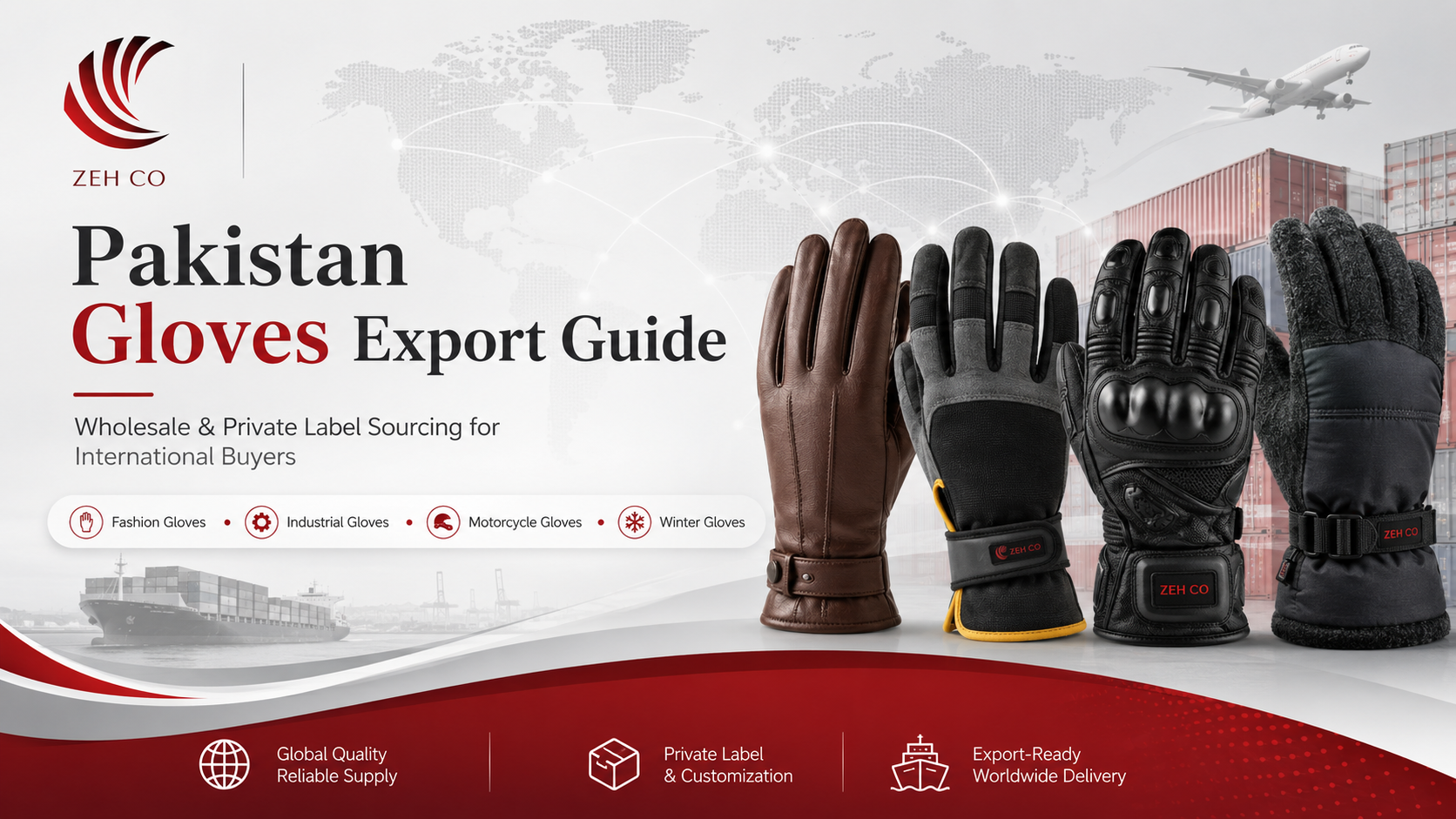
Working with a reliable Pakistan gloves exporter gives international importers access to a broad manufacturing base covering fashion gloves, industrial work gloves, motorcycle gloves and insulated winter gloves. Pakistan has established expertise in leather processing, textile production, stitching, protective equipment and export packaging, allowing buyers to source both standard wholesale products and fully customized private label collections. For distributors, safety suppliers, motorcycle accessory brands and retail chains, the main opportunity lies in combining competitive production costs with flexible materials, branding and order specifications.
Why Source Gloves from Pakistan?
Pakistan’s glove industry benefits from several connected supply sectors. The country produces and processes leather, cotton fabrics, knitted textiles, synthetic materials and protective workwear components. This supply-chain access enables manufacturers and exporters to develop different glove categories without depending entirely on imported raw materials.
International buyers can source entry-level products for price-sensitive markets as well as higher-specification gloves designed for professional, retail or branded applications. Production can be adapted according to the buyer’s target market, intended use, preferred material, packaging format and required price range.
Another advantage is manufacturing flexibility. Importers may request changes to palm material, cuff design, lining thickness, stitching pattern, color combinations, reinforcement areas, logo placement and retail packaging. This makes Pakistan suitable for wholesalers purchasing ready designs and for brands developing exclusive product lines.
Glove Categories Available for International Buyers
Fashion Leather Gloves
Fashion gloves are commonly produced for men, women and unisex collections. Depending on the required appearance and price level, buyers may select genuine leather, suede, synthetic leather, knitted fabric or mixed-material construction.
Common customization options include polyester, fleece or wool-blend linings; decorative stitching; touch-screen-compatible fingertips; elastic wrists; snap closures; custom colors; embossed logos; metal badges and branded hangtags. Buyers should define whether the gloves are intended for everyday winter use, premium fashion retail, promotional campaigns or corporate gifting because each application requires a different balance of appearance, durability and cost.
Industrial and Safety Gloves
Industrial gloves are sourced by construction suppliers, warehouses, factories, agricultural companies, logistics operators and safety equipment distributors. These gloves may be designed for general handling, mechanical work, abrasion resistance, grip support or protection from minor workplace hazards.
Frequently requested constructions include leather palm gloves, split-leather work gloves, cotton gloves, coated grip gloves and reinforced handling gloves. Buyers should clearly state the intended workplace application so that the exporter can recommend suitable palm materials, cuff styles, thicknesses and reinforcement points.
General-purpose work gloves should not automatically be treated as certified protection against chemicals, extreme heat, electrical hazards or cutting risks. Where regulated protection is required, buyers should request relevant test reports, technical specifications and conformity documentation for the exact model being purchased.
Motorcycle Gloves
Motorcycle gloves are a specialized category requiring a combination of grip, flexibility, abrasion resistance and rider comfort. Products may range from lightweight urban riding gloves to reinforced touring, racing-style and winter motorcycle gloves.
Typical features include padded palms, reinforced knuckle areas, adjustable wrist straps, breathable panels, touch-screen fingertips, pre-curved finger construction and anti-slip grip materials. Premium models may incorporate molded knuckle protection, additional wrist coverage and multiple layers in high-wear areas.
Importers should define whether the product is intended for fashion use, casual riding or certified protective motorcycle equipment. This distinction affects material selection, product engineering, testing requirements and price.
Winter and Thermal Gloves
Winter gloves can be produced from fleece, knitted fabrics, synthetic shells, leather or blended materials. The level of insulation should match the climate in which the gloves will be sold. Lightweight lined gloves may be suitable for mild winters, while colder markets may require thicker insulation, wind-resistant outer layers and extended cuffs.
Wholesale buyers can request thermal linings, waterproof or water-resistant outer materials, ribbed cuffs, elastic wrists, reflective details and retail-ready packaging. For very cold climates, importers should evaluate insulation performance through samples and testing rather than relying only on the visual thickness of the product.
Materials Used by a Pakistan Gloves Exporter
Material selection directly influences performance, durability, comfort, appearance and landed cost. Leather gloves may use cowhide, goatskin or sheepskin depending on the required strength, flexibility and surface finish. Cow leather is often selected for durable work applications, while softer leather may be preferred for fashion and comfort-focused products.
Textile and synthetic gloves may include cotton, polyester, nylon, fleece, spandex, microfiber, polyurethane-coated fabric and synthetic leather. Some products combine several materials, such as a synthetic back with a reinforced leather palm or a breathable textile shell with protective overlays.
Buyers should request a complete material breakdown before approving production. The specification should identify the outer material, palm material, lining, padding, closures, reinforcement components and any coatings. Clear material documentation reduces the risk of receiving a product that looks similar to the approved sample but performs differently.
Private Label and OEM Glove Manufacturing
Private label sourcing allows importers to sell gloves under their own brand while using an exporter’s manufacturing and supply capabilities. Customization may range from adding a logo to an existing design to developing a completely new glove according to the buyer’s technical drawing, reference sample or product concept.
Common OEM services include custom colors, woven labels, printed logos, embroidery, heat-transfer branding, embossed leather logos, rubber badges, branded straps, printed polybags, header cards, retail boxes and master cartons. Buyers can also request barcode labels, size stickers, care labels, country-of-origin labels and multilingual packaging.
For custom development, the buyer should provide accurate artwork files, logo dimensions, color references, packaging requirements and size specifications. Brand owners should confirm that all submitted trademarks, team names and design elements are legally authorized for commercial use.
Sample Development Process
A structured sampling process is essential for customized gloves. The first sample normally confirms the general design, materials and measurements. After receiving feedback, the exporter may produce a revised or pre-production sample that reflects the final construction, branding and packaging.
Importers should evaluate samples for fit, finger length, wrist opening, lining comfort, stitching consistency, grip, flexibility, logo position, color accuracy and overall workmanship. Bulk production should begin only after the buyer has approved a clearly identified final sample and written specification.
Glove Sizing and Measurement Requirements
Incorrect sizing is one of the most common reasons for product returns in the glove business. A size label such as small, medium or large does not guarantee identical measurements across different manufacturers or markets.
Buyers should approve a size chart containing palm width, hand circumference, total glove length, middle-finger length, cuff width and wrist opening. Tolerance limits should also be agreed upon because small variations can occur during cutting, stitching and finishing.
Retailers targeting Europe, North America, the Middle East or Asia may require different sizing proportions. A reliable supplier should develop sizing according to the buyer’s customer base rather than applying one universal chart to every order.
Quality Control for Wholesale Glove Orders
Quality control should begin before production rather than only after the goods are completed. Raw materials should be checked for color consistency, thickness, surface defects, strength and compliance with the approved sample. Cutting templates and stitching instructions should be standardized before bulk production starts.
During manufacturing, inspectors should monitor seam strength, skipped stitches, loose threads, material alignment, reinforcement positioning and size accuracy. For lined gloves, the lining should fit securely without twisting, bunching or pulling out during normal use.
Final inspection should include visual checks, measurement verification, pair matching, logo inspection, packaging confirmation and carton counting. Depending on the product type, additional tests may be required for abrasion resistance, tear strength, colorfastness, grip performance, seam strength or restricted substances.
Compliance and Market-Specific Requirements
Import regulations vary by market and by the intended function of the glove. Fashion gloves, general work gloves and certified personal protective equipment may fall under different legal and testing requirements.
Buyers should identify the destination country and intended product claim before placing an order. Where gloves are sold as personal protective equipment, technical documentation and testing may be necessary under the destination market’s applicable standards. Product claims should match the actual performance demonstrated by testing.
Importers may also require material declarations, labeling information, care instructions, origin marking and restricted-substance compliance. These requirements should be communicated during quotation rather than after production has started.
Minimum Order Quantity, Pricing and Production Capacity
Glove pricing depends on material quality, product complexity, number of sizes, order quantity, logo method, lining, protective components and packaging. A basic cotton or synthetic glove will have a different cost structure from a leather motorcycle glove with molded protection and custom retail packaging.
Minimum order quantities may apply per design, color and size assortment. Orders containing many colors or a large number of custom components usually require higher quantities because the manufacturer must purchase separate materials and prepare individual production setups.
To receive an accurate quotation, buyers should provide the glove category, reference image or specification sheet, required materials, quantity, size ratio, branding method, packaging, destination and preferred Incoterm. Quotations based only on a photograph should be treated as preliminary until materials and construction details are confirmed.
Production capacity should be assessed according to the exact model rather than the factory’s total monthly output. Complex gloves require more stitching operations, specialized materials and longer inspection times than simple designs.
Packaging Options for Retail and Industrial Markets
Packaging should protect the gloves while supporting the buyer’s distribution method. Industrial buyers may prefer economical polybag packing with bulk quantities per carton, while retail brands may require individual header cards, hangtags, printed boxes or display-ready packaging.
Each pair should be matched by size, color and appearance before packing. Carton markings may include product name, style number, size breakdown, quantity, gross weight, net weight, carton dimensions, country of origin and buyer-specific shipping marks.
For e-commerce and retail distribution, barcodes, SKU labels and scannable carton markings can simplify warehouse handling. Packaging dimensions should also be optimized to avoid unnecessary freight costs, especially when lightweight gloves are shipped in bulky retail boxes.
Shipping Gloves from Pakistan
Gloves can be shipped by sea, air or courier depending on order volume, delivery deadline and product value. Samples and urgent small orders are commonly dispatched by international courier or air freight, while commercial wholesale quantities are generally more economical by sea.
ZEH Co can discuss shipments under FOB Karachi, CIF and DDP terms depending on the destination, product type and commercial arrangement. Buyers should compare Incoterms carefully because each option allocates freight, insurance, customs and delivery responsibilities differently.
Before shipment, commercial documentation may include the commercial invoice, packing list, certificate of origin, transport document and any compliance documents required by the importing country. Product descriptions, quantities, values and carton information should remain consistent across all documents.
Questions to Ask Before Selecting a Supplier
- Which glove categories and materials does the supplier regularly export?
- Can the supplier reproduce a buyer-approved specification consistently?
- What is the minimum order quantity per design, color and size?
- Are private label branding and custom packaging available?
- Which inspections and performance tests can be arranged?
- Can the supplier provide material details and relevant compliance documents?
- What is the estimated sample and bulk production lead time?
- Which shipping terms and freight options are available?
- How are defects, shortages or specification differences handled?
- Can production capacity support repeat seasonal orders?
Why International Buyers Work with ZEH Co
ZEH Co is a Pakistan-based B2B exporter established in 2011, serving international importers, wholesalers and procurement companies. The company supports the sourcing of fashion, industrial, motorcycle and winter gloves according to customer specifications, target pricing and packaging requirements.
ZEH Co can coordinate product selection, supplier communication, sample development, private label requirements, quality checks, export documentation and international shipping. Its broader experience in textiles, leather products and safety equipment helps buyers consolidate related products through a single export partner.
The company operates with ISO 9001:2015 and ISO 22000 certifications and supports shipments to international markets under FOB Karachi, CIF and DDP arrangements where commercially applicable. Buyers can request quotations for standard glove designs or submit technical details for customized development.
Conclusion: Choosing the Right Pakistan Gloves Exporter
Selecting the right Pakistan gloves exporter requires more than comparing unit prices. International buyers should evaluate material accuracy, sizing control, stitching quality, compliance capabilities, private label support, packaging standards and delivery reliability.
A detailed product specification, approved sample and written quality criteria create the foundation for successful bulk production. By working with ZEH Co, importers can source multiple glove categories from Pakistan while receiving support with customization, inspection, export documentation and global logistics. This structured approach helps wholesalers and brands reduce sourcing risks and build a dependable long-term glove supply program.