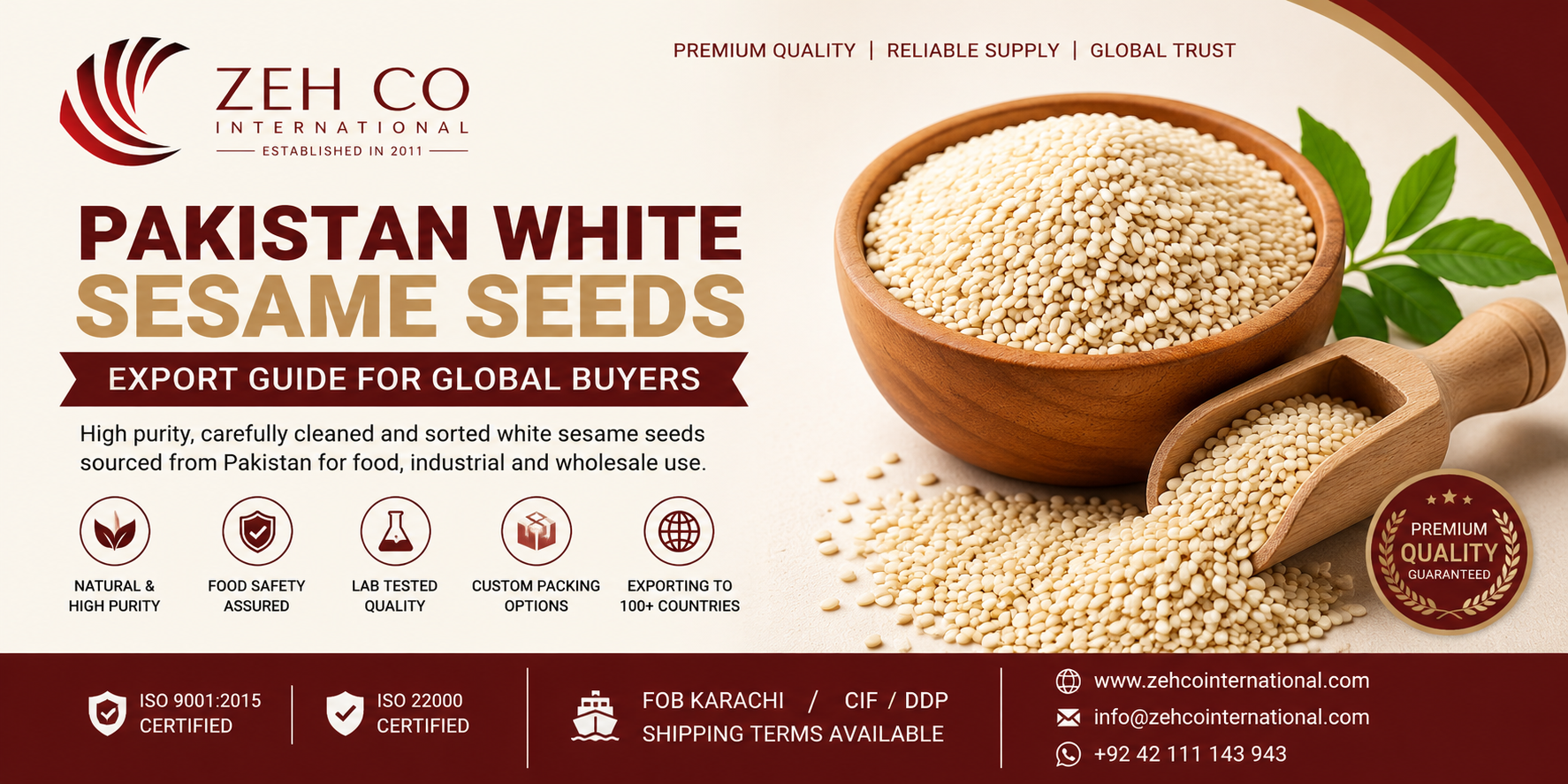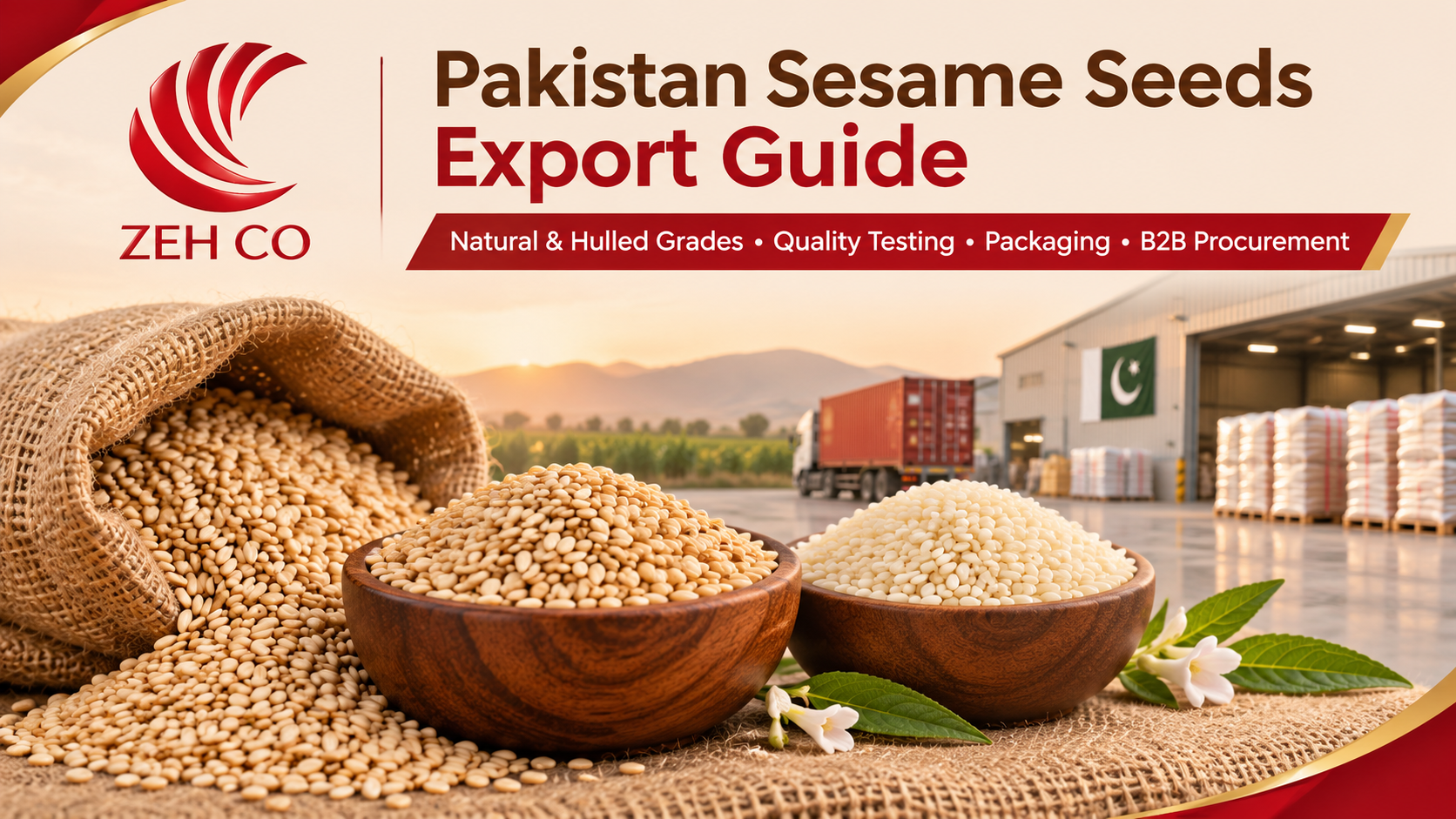
Sesame seeds are an internationally traded agricultural commodity used in bakery products, tahini, confectionery, edible oil processing, seasoning blends and packaged foods. For importers, food manufacturers and agricultural commodity distributors, sesame seeds export from Pakistan offers a sourcing opportunity across several commercial applications. Successful procurement, however, depends on selecting the appropriate seed type, defining measurable quality requirements and establishing reliable inspection and shipping procedures.
ZEH Co International, established in 2011, supports international wholesale buyers in evaluating agricultural sourcing opportunities from Pakistan. This guide explains the practical considerations involved in purchasing natural and hulled sesame seeds for commercial import.
Understanding Pakistani Sesame Seed Grades
Sesame seeds should be purchased against an agreed commercial specification rather than appearance or price alone. Different processing methods affect their colour, texture, flavour and suitability for industrial applications.
Natural Sesame Seeds
Natural sesame seeds retain their outer hull. Their appearance can range from light cream to beige or darker shades depending on variety, growing conditions and processing. Natural sesame is commonly purchased for oil extraction, traditional foods, bakery applications and further processing.
Buyers should define acceptable colour variation, foreign matter, damaged seeds and cleaning requirements before approving a shipment.
Hulled Sesame Seeds
Hulled sesame seeds undergo processing to remove the outer seed coat. They generally have a lighter appearance and are widely used in tahini, confectionery, bakery toppings and processed food products.
For this category, buyers should pay particular attention to residual hulls, colour uniformity, broken seeds, moisture and hygienic processing. A visually attractive sample does not independently establish microbiological safety.
Oil Extraction and Industrial Grades
Sesame intended for oil extraction may be purchased under specifications that differ from those used for bakery or ready-to-eat food ingredients. Oil content, extraction yield, moisture and impurity levels can influence manufacturing economics. Industrial buyers should communicate their intended application so that the proposed grade can be evaluated appropriately.
Commercial Specifications for Sesame Seeds Export from Pakistan
Importers should request a written product specification containing measurable acceptance criteria. Commercial purity levels such as 99%, 99.5% or 99.95% may be requested, subject to processing capability, agreed testing methods and actual lot results. These figures are examples of buyer specifications, not guaranteed characteristics of every shipment.
- Seed type: Natural, hulled or processing grade.
- Colour: Agreed shade and acceptable variation.
- Purity: Minimum acceptable percentage of qualifying sesame seeds.
- Moisture: Maximum acceptable moisture under an agreed test method.
- Foreign matter: Permitted limits for non-sesame material.
- Defects: Limits for damaged, discoloured and broken seeds.
- Oil content: Required where extraction performance is commercially important.
- Food safety: Applicable microbiological, contaminant and pesticide residue requirements.
The contract should also define sampling procedures, inspection responsibilities and remedies when a shipment fails the agreed specification.
Quality Assurance and Laboratory Testing
Sesame quality cannot be assessed completely through photographs or visual inspection. A suitable quality assurance programme combines physical inspection, representative sampling, laboratory analysis and traceability.
Physical Inspection and Cleaning
Depending on the supply source, processing may include screening, aspiration, destoning, gravity separation and optical sorting. Buyers should confirm which cleaning operations are actually performed and whether additional processing is necessary for their intended application.
Food Safety and Contaminant Testing
Sesame seeds can present microbiological and chemical food safety risks. Salmonella, pesticide residues, heavy metals and relevant mycotoxins should be considered according to the destination market, product application and buyer risk assessment.
Testing requirements and acceptable limits must be verified against current destination-market regulations. Where a validated microbial reduction treatment is required, buyers should confirm that the processing facility can provide appropriate evidence. Cleaning or hulling alone must not be treated as proof of pathogen elimination.
Certificate of Analysis and Traceability
A Certificate of Analysis, commonly called a COA, should identify the tested lot, relevant parameters, analytical methods and results. Importers should verify that the report corresponds to the shipment being offered rather than relying on a generic historical certificate.
ZEH Co International identifies ISO 9001:2015 and ISO 22000 within its company information. The scope, validity and applicability of these certifications to individual facilities, supply sources and product lots must be confirmed before relying on them for procurement approval.
Bulk Packaging and Private Label Options
Packaging should protect sesame seeds against moisture, contamination, bag damage and unwanted odours during storage and international transport.
- Food-grade polypropylene woven sacks with suitable inner liners where required.
- Multiwall paper sacks for compatible food ingredient distribution systems.
- Commercial bag weights such as 25 kg or 50 kg, subject to agreement.
- Customized retail or private label packaging, subject to production feasibility.
- Palletized or floor-loaded shipments according to buyer and logistics requirements.
Bag markings should include the product identity, net weight, country of origin, lot identification and other information required by the importing market. Sesame allergen declarations and cross-contact controls should be evaluated according to applicable regulations and the intended product use.
Storage and International Transportation
Sesame seeds should be stored in clean, dry, ventilated environments away from direct moisture, pests, chemicals and strong-smelling products. Storage conditions should be compatible with the agreed shelf-life specification and packaging material.
Before loading, shipping containers should be inspected for cleanliness, structural damage, moisture, odours and previous cargo contamination. Condensation risks should be evaluated in relation to the route, season and cargo conditions. Appropriate moisture-control measures may be considered where necessary.
Actual container loading quantities depend on packaging dimensions, cargo density, palletization, container specifications and applicable transport weight restrictions. Buyers should request a confirmed loading plan rather than rely on an assumed container capacity.
Export Documentation and Shipping Terms
Documentation depends on the importing country, product classification and agreed commercial terms. Common documents may include:
- Commercial invoice and packing list.
- Certificate of origin where required.
- Bill of lading or other applicable transport document.
- Phytosanitary certificate where required by the importing authority.
- Lot-specific Certificate of Analysis when agreed.
- Treatment, fumigation or other supporting documents when applicable and legally required.
ZEH Co International can discuss FOB Karachi, CIF and commercially feasible DDP arrangements. Each quotation should identify the named port or destination, applicable Incoterms version, freight responsibilities, insurance obligations and customs responsibilities.
DDP should only be agreed after confirming that the seller can legally and practically fulfil the relevant import clearance, duty and tax obligations in the destination country.
How to Request Samples and a Commercial Quotation
Buyers should approve representative samples before committing to substantial volumes. Sample acceptance should be based on the agreed specification and intended manufacturing application. A retained reference sample can help resolve later quality disputes, although it does not replace shipment-level inspection.
A detailed request for quotation should include:
- Required sesame seed type and intended application.
- Purity, moisture, colour and defect tolerances.
- Required laboratory tests and food safety documentation.
- Order quantity and expected purchasing frequency.
- Preferred packaging, bag weight and labelling requirements.
- Destination country, port and preferred shipping terms.
- Sample requirements and expected delivery schedule.
- Independent inspection requirements, where applicable.
Complete RFQ information allows suppliers to evaluate processing feasibility, packaging costs, documentation requirements and shipment arrangements more accurately.
Common Procurement Risks for International Importers
Important purchasing risks include inconsistent purity between batches, excess moisture, microbiological contamination, inaccurate laboratory reports, packaging failures and destination-market rejection. Seasonal availability and changes in freight costs may also affect commercial offers.
Buyers can reduce these risks by approving written specifications, verifying supply sources, requesting lot-specific test reports, arranging independent inspections when justified and defining contractual procedures for rejected or non-conforming cargo.
Comparing suppliers solely by the quoted price per kilogram may overlook differences in processing quality, inspection costs, usable yield and potential losses after arrival. The total cost of compliant, usable material provides a more meaningful purchasing comparison.
Conclusion
Sesame seeds export from Pakistan can support international buyers sourcing natural and hulled sesame for food manufacturing, agricultural distribution and industrial processing. Reliable procurement requires clear specifications, representative samples, appropriate food safety testing, suitable packaging and accurate export documentation.
International importers, wholesalers and procurement managers can contact ZEH Co International through https://zehcointernational.com/ to discuss product availability, commercial specifications, samples, bulk packaging and destination-specific quotations. All supply commitments, certification applicability and regulatory requirements should be confirmed before finalizing an order.