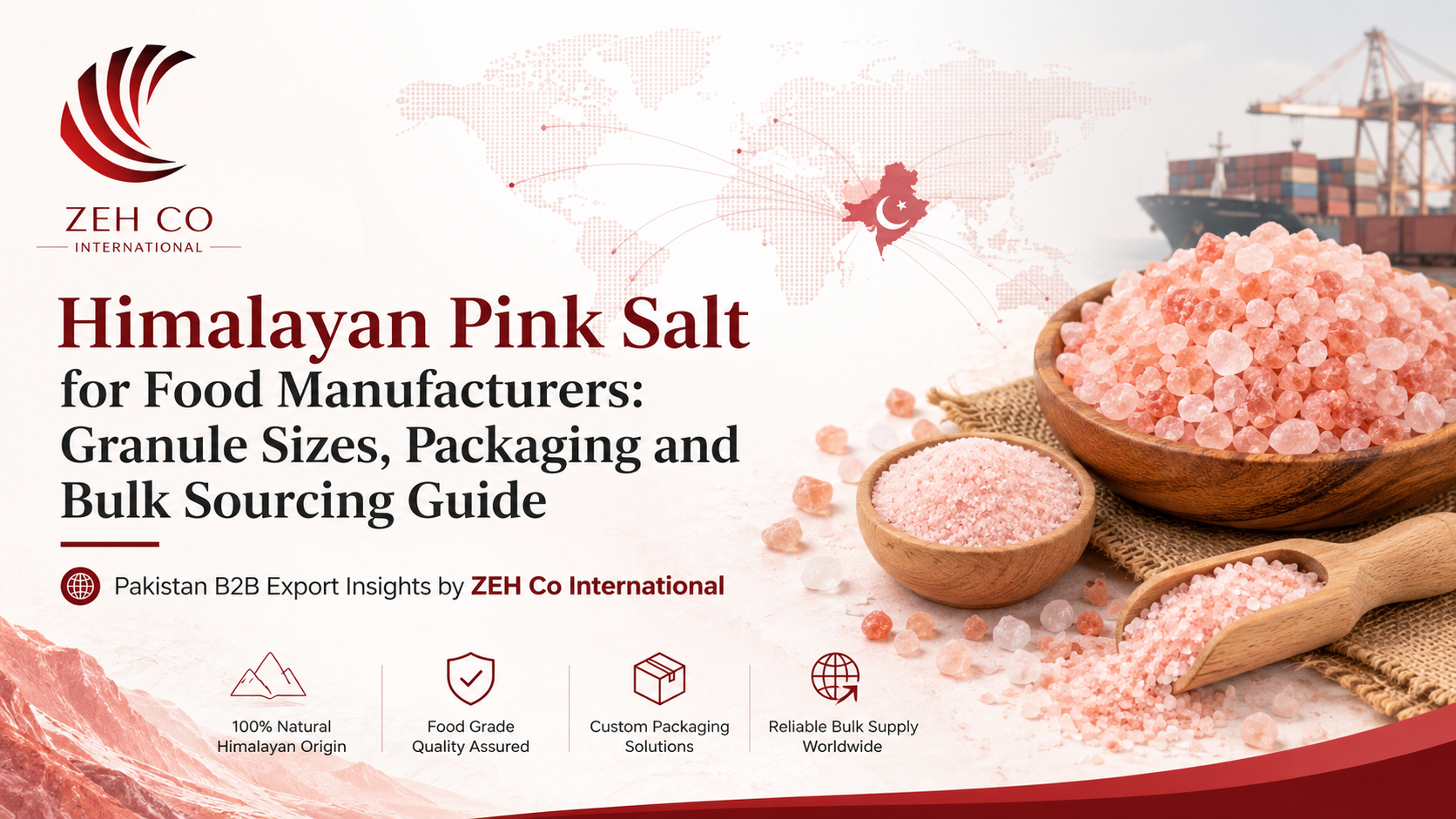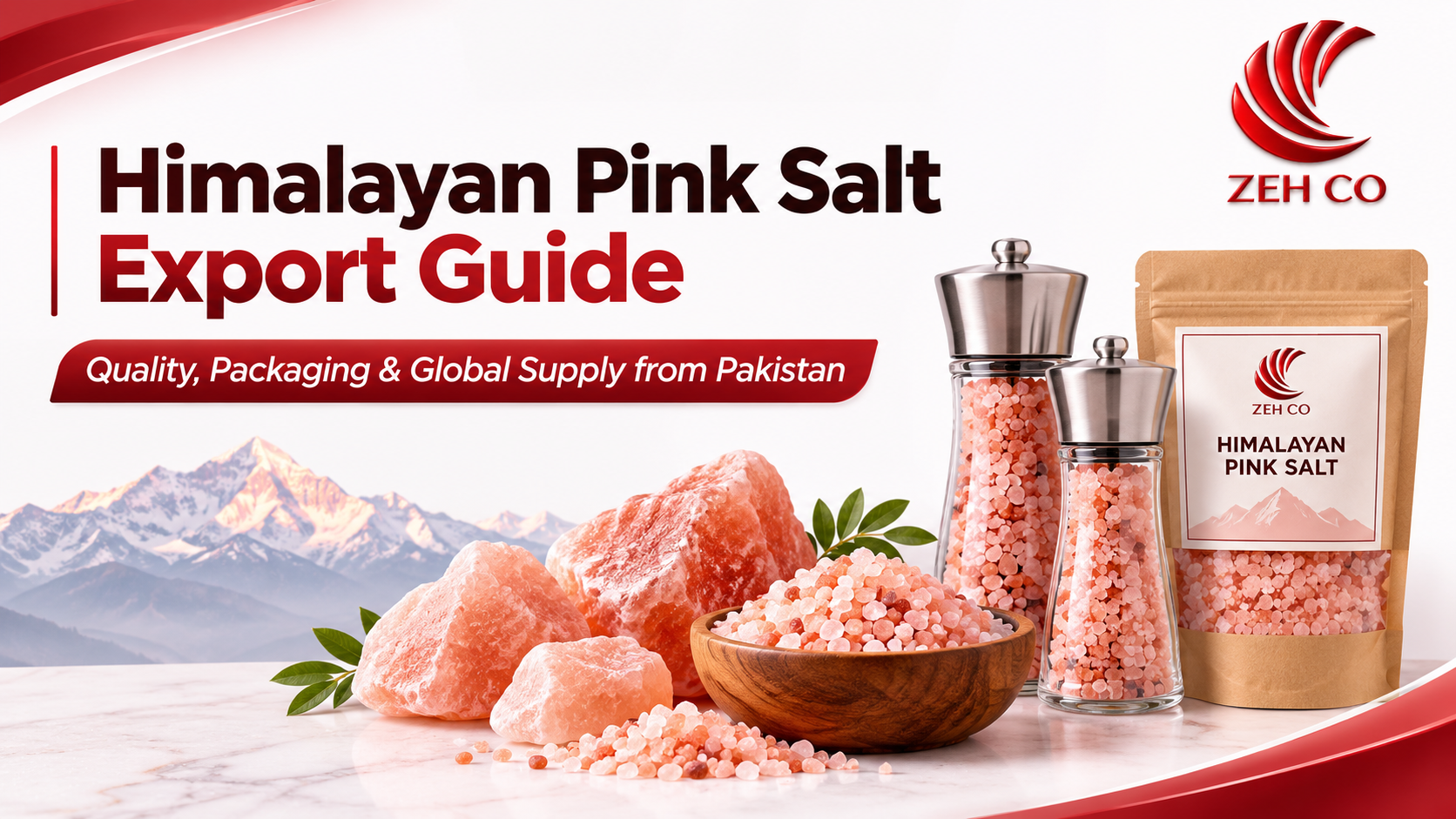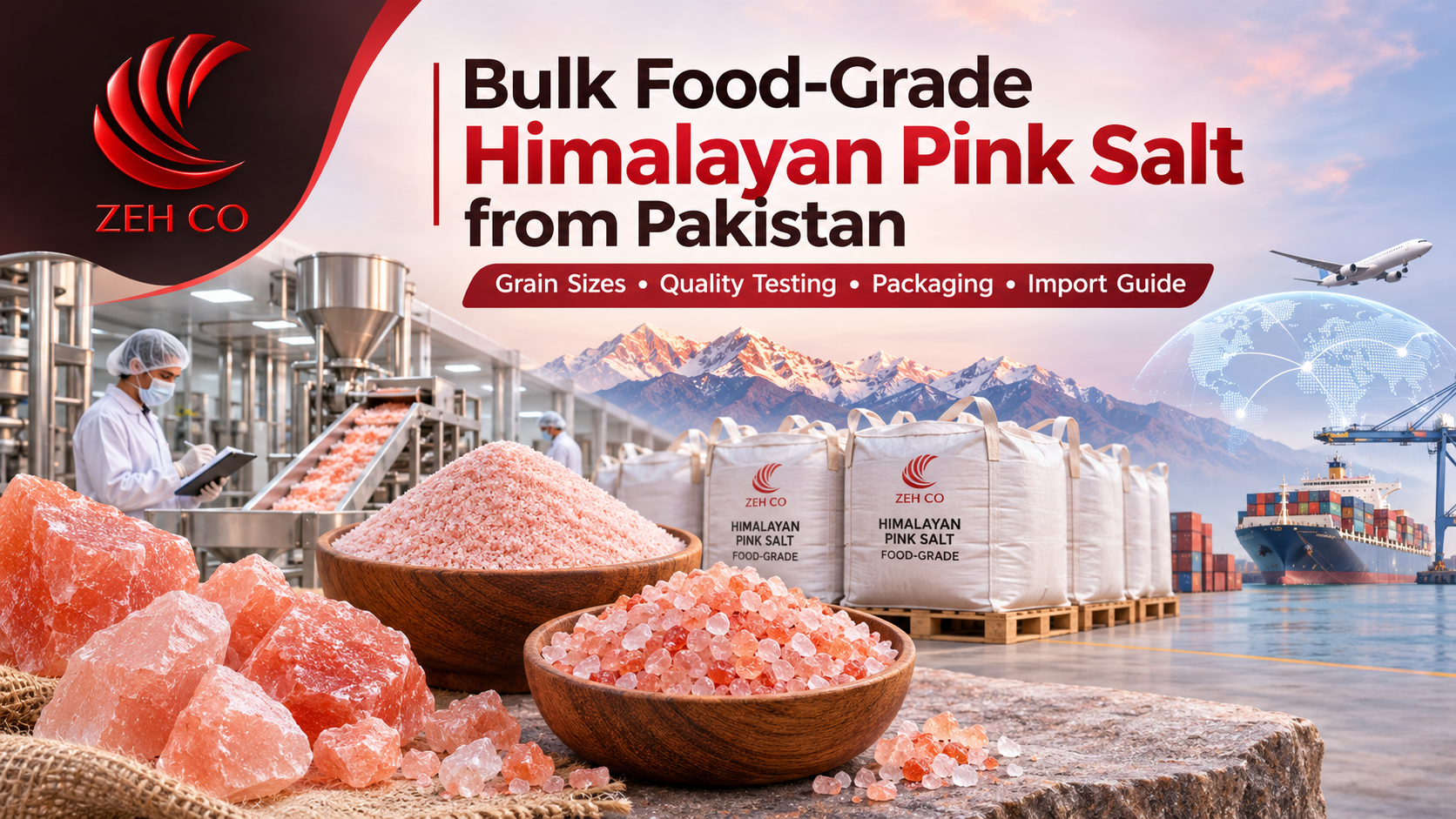
Pakistan is an important sourcing origin for naturally occurring Himalayan pink rock salt, which is processed into various grades for food manufacturers, seasoning brands, wholesalers, restaurants and distributors. For international buyers, however, purchasing bulk food-grade Himalayan pink salt involves considerably more than selecting a pink color and requesting a price per kilogram. The commercial success of an order depends on consistent particle size, verified composition, suitable handling, reliable packaging, traceability and import-market compliance.
This guide explains how to prepare a professional bulk salt specification, assess samples and Certificates of Analysis (COAs), choose appropriate packaging and request realistic shipping quotations from Pakistan. It is designed for importers who want repeatable product quality rather than an attractive sample that cannot be reproduced in later shipments.
What Is Bulk Food-Grade Himalayan Pink Salt?
Himalayan pink salt is a naturally occurring mineral salt commonly sourced from deposits in Pakistan. Its coloration can vary from pale pink to deeper reddish tones because of naturally occurring mineral constituents. Color alone does not establish chemical purity, food safety or compliance with an importing country's legislation.
In a commercial purchasing agreement, food grade should mean that the material has been appropriately processed, handled, assessed and documented for its intended food use. The buyer should agree on measurable acceptance criteria rather than relying on marketing descriptions such as premium, pure or natural.
Common Commercial Applications
- Food processing: Salt incorporated into seasoning mixes, prepared foods and other formulations, subject to the manufacturer's specifications.
- Retail repacking: Bulk salt transferred into consumer packs under an importer's own brand.
- Foodservice: Granular salt supplied to commercial kitchens, restaurants and catering distributors.
- Ingredient distribution: Bulk salt supplied to other manufacturers that require documented composition and batch traceability.
Each application may need different sieve distributions, packaging materials, additive declarations or documentary evidence. Buyers should specify the final intended use before requesting an offer.
Fine, Medium and Coarse Himalayan Pink Salt: Choosing Grain Sizes
Particle size is a major commercial distinction when ordering bulk pink salt. Fine grades can suit recipes requiring relatively uniform distribution. Medium grades are useful for certain seasoning blends and repacking formats. Coarse grades may serve culinary applications where visible crystal texture or subsequent grinding is important.
Descriptions such as fine, medium and coarse are not universal technical standards. One supplier's coarse grade may overlap another supplier's medium grade. Importers should therefore agree on a numerical particle-size range, measurement units and acceptable distribution rather than relying entirely on a product name.
How to Specify Granulation
- Define the desired particle-size range using millimeters, micrometers or an agreed sieve specification.
- State the acceptable percentage of particles outside the target range.
- Ask whether the quotation covers washed or unwashed material and confirm the processing method.
- Specify whether visible dark particles, fines, oversized fragments or foreign matter have particular rejection limits.
- Request a representative production sample and an agreed reference sample for future quality comparisons.
For repeat orders, a retained reference sample and a written sieve tolerance can reduce disputes caused by subjective descriptions. Processing steps and cleaning methods should also be recorded so that the approved sample remains commercially reproducible.
Quality Assurance, Laboratory Testing and COA Review
Food-grade Himalayan salt procurement should include a documented quality-control plan. A Certificate of Analysis can help describe the tested characteristics of a particular sample or batch, but its value depends on sample identity, laboratory competence, testing methods and the relationship between the tested sample and the shipped goods.
Important Quality Parameters
- Sodium chloride content: Review the measured composition and the basis on which results are reported.
- Moisture: Agree on a relevant limit to help manage free-flowing properties and packing performance.
- Water-insoluble matter: Assess the level of material that does not dissolve under the specified test method.
- Contaminants: Establish destination-specific limits and appropriate testing for substances such as relevant heavy metals.
- Particle-size distribution: Verify conformity with the approved sieve specification.
- Additives and iodine: Confirm whether the material is non-iodized, iodized or otherwise formulated and obtain relevant declarations.
The Codex Standard for Food-Grade Salt, CXS 150-1985, is one useful international technical reference. However, it does not replace the importing country's applicable laws or customer-specific specifications. Buyers should not assume that every pink salt batch automatically conforms to Codex or another food-grade requirement.
Representative Sampling and Traceability
Before testing, agree on the sampling process, batch identification, sample retention and responsibility for laboratory costs. Where risk or order value justifies it, the buyer may request independent laboratory testing or pre-shipment inspection. Reports should identify what was actually tested, not imply that unrelated inventory or future batches have already been approved.
Iodized Versus Non-Iodized Salt: Confirm Destination Requirements
Importers must distinguish naturally occurring mineral salt from salt intentionally fortified with iodine. Some markets impose iodization requirements on particular categories of edible salt, while other rules depend on intended use, retail channel or product classification.
Before production or shipment, confirm whether iodine addition is required, permitted or restricted for the specific destination and product use. If iodization is required, the appropriate compound, dosage, declaration and verification method must be agreed with the supplier and checked against applicable requirements. Non-iodized salt should not be marketed as compliant with every market without verification.
Labels should also avoid unsupported therapeutic or nutritional claims. Natural mineral variation does not establish medical benefits, and a certificate for chemical composition is not a substitute for regulatory permission to make health claims.
Bulk Packaging and Private Label Preparation
Packaging should protect salt from contamination, excessive moisture exposure, bag damage and loss during transport or warehouse handling. A suitable bulk configuration may involve food-contact-appropriate inner liners, protective outer sacks and secure closure methods. The final material must be selected for the intended application and destination requirements.
Information to Confirm Before Packing
- Net weight per pack, pack tolerances and number of units per shipping lot.
- Food-contact suitability of liners and any required packaging declarations.
- Sealing method, pallet arrangement and moisture protection.
- Batch or lot number, country of origin and product identification.
- Storage instructions, labeling language and any required date or traceability information.
- Retail or private label specifications if the shipment is intended for repacking or branded sale.
For private label projects, buyers should approve packaging artwork, mandatory statements and final proofs before printing. The importer remains responsible for confirming the destination market's label requirements. A packaging format suitable for industrial ingredients may not be sufficient for direct consumer retail.
Transport and Storage: Protecting the Shipment
Bulk Himalayan pink salt can be transported internationally, but successful delivery depends on the condition of the packaging, the shipping unit and the handling process. Even when the product itself is stable, excessive exposure to moisture can create caking, damaged bags or packaging complaints.
Before loading, verify that the container or other cargo space is clean, dry, structurally sound and free from objectionable odors or residues. Inspect the intended stacking arrangement and consider protective materials where they are justified. Packaging must withstand normal loading, unloading and inland transport without assuming a universal container capacity.
At destination, goods should be stored in a clean, dry environment, away from water exposure, strong odors and potential contamination. Warehouse handling instructions should be shared with the distributor or repacking facility.
Export Documentation for Salt Shipments from Pakistan
Documentation requirements depend on the buyer's country, customs classification, product description, contract and chosen transport method. A typical commercial transaction may require a commercial invoice, packing list and applicable transport document, such as a bill of lading for ocean freight.
Other documents may include a certificate of origin, agreed laboratory report, COA, inspection evidence or additional certificates required by the importing authority. These should be confirmed before shipment rather than promised automatically. The importer or customs broker should verify the applicable tariff classification, duties, taxes, food-import procedures and any required permits.
For example, United States food imports can involve FDA food facility registration and prior-notice requirements where applicable. European Union buyers should verify relevant food safety, traceability and labeling obligations. Requirements may change, so the buyer should confirm the position for the shipment at the time of import.
FOB Karachi, CIF and DDP: Comparing Quotations Correctly
ZEH Co International can discuss export quotations based on FOB Karachi, CIF and commercially feasible DDP arrangements, subject to destination, service availability and agreement. Each basis allocates costs and responsibilities differently, so a low product price should not be mistaken for a fully delivered price.
- FOB Karachi: Clarify the agreed port, loading responsibilities and the buyer's onward freight arrangements.
- CIF: Identify the named destination port and clarify the freight and insurance included in the offer.
- DDP: Confirm whether the seller can lawfully and practically undertake import clearance, duties and delivery in the destination market before quoting.
Ask for the applicable Incoterms version, named place, offer validity, estimated production lead time, packaging specification and exclusions. Freight cost per kilogram can be materially affected by shipment quantity, local charges and destination arrangements. Comparing quotations requires the same product and delivery assumptions.
Sample Approval Before a Commercial Bulk Order
For an initial order, request samples representing the proposed production grade and packaging method. Evaluate grain size, color range, visible cleanliness, moisture-related handling and suitability for your intended use. Where appropriate, obtain independent laboratory results before approving the shipment.
Document the approved sample reference, testing requirements, lot identification procedure and acceptance criteria in the purchase order. Buyers should also agree on how nonconforming goods will be handled, whether additional inspection is permitted and who bears the cost of retesting.
Sampling charges, courier costs and testing fees should be discussed transparently. A small laboratory sample cannot by itself guarantee that every subsequent production lot will match; repeatable quality depends on controlled sourcing, processing and verification.
RFQ Checklist for International Salt Importers
An accurate request for quotation helps the exporter calculate a relevant offer and reduces unnecessary clarification. A professional RFQ should communicate the following:
- Required product: bulk food-grade Himalayan pink salt.
- Preferred color range and particle-size or sieve specification.
- Washed or unwashed grade, iodine status and any additive restrictions.
- Target quality parameters, COA requirements and any independent testing.
- Order quantity, packaging type, pack weight and private label needs.
- Destination country, named port or delivery address and preferred trade term.
- Required documentation, expected delivery window and sample approval process.
Specify any food-manufacturing restrictions or retailer standards at the enquiry stage, not after packing. This allows technical and commercial feasibility to be reviewed before a final price is agreed.
Common Buyer Risks and How to Reduce Them
Unclear granulation: Avoid relying on broad terms without a sieve specification. Unverified food grade: Request batch-relevant evidence rather than accepting appearance or marketing claims. Packaging failures: Review liner suitability, closure, loading conditions and transport handling. Unexpected import costs: Obtain a written breakdown of the quotation basis and applicable destination charges. Labeling errors: Verify iodine status, origin statements and mandatory language before production.
Importers should also distinguish between a supplier's general management-system certification and evidence that a particular shipment meets its food-grade specification. Request certificates only where they apply to the relevant entity, facility, process or consignment.
Conclusion: Build a Reliable Himalayan Pink Salt Supply Chain
Sourcing bulk food-grade Himalayan pink salt from Pakistan is most effective when buyers treat grain size, laboratory verification, packaging, documentary compliance and shipment terms as one connected procurement process. A precise product specification and a traceable, approved reference sample provide a stronger purchasing foundation than a quotation based on appearance alone.
ZEH Co International welcomes B2B enquiries from importers, food manufacturers, distributors and private label brands. Share your required grade, particle-size range, packaging, order volume and destination through https://zehcointernational.com/ to request a specification review, discuss samples and obtain a shipment-specific export quotation.