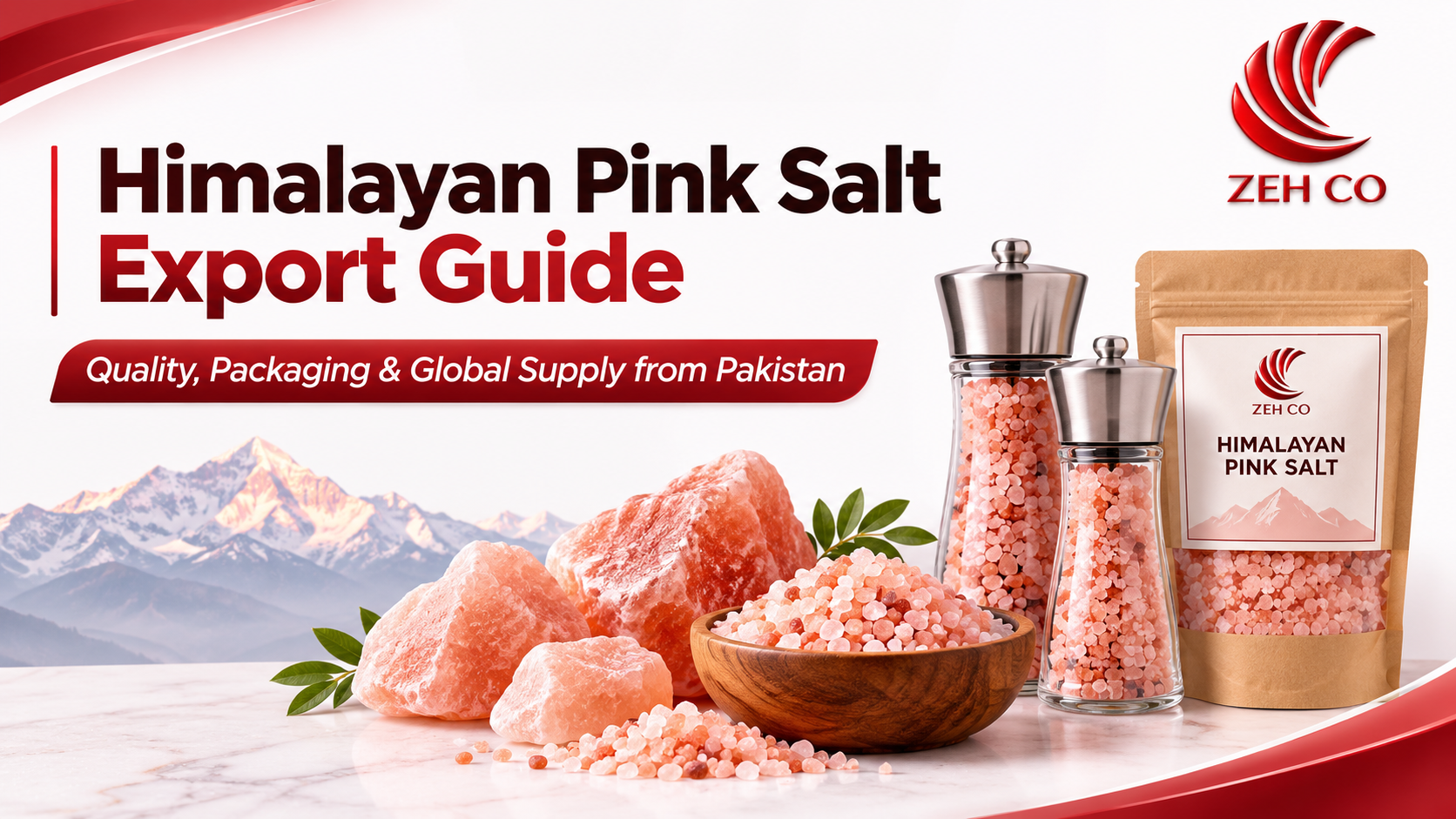
Himalayan pink salt grinders are an increasingly recognizable retail presentation for buyers seeking convenient, ready-to-use seasoning products. For international importers, supermarket distributors, hospitality suppliers and private label brands, Pakistan offers sourcing opportunities for pink rock salt combined with consumer-ready grinding containers. However, successful procurement requires more than choosing an attractive bottle. Buyers must evaluate the food-grade salt itself, crystal size, grinder performance, container materials, packaging quality, labeling requirements and shipment protection.
ZEH Co International supports discussions with international wholesale buyers seeking Himalayan pink salt products from Pakistan. This guide explains the practical differences between glass and PET grinders, how to prepare reliable product specifications, and which quality assurance and commercial considerations should be addressed before placing a bulk or private label order.
What Are Himalayan Pink Salt Grinders?
Himalayan pink salt grinders are consumer containers filled with coarse edible rock salt and fitted with a mechanism designed to crush the crystals when the user turns or operates the grinder. Himalayan pink salt is a natural rock salt associated with Pakistan's salt deposits, particularly the Salt Range region. Its pink appearance comes from naturally occurring mineral constituents, with colour varying between deposits and production lots.
A finished grinder combines two products: food-grade salt and a food-contact packaging system incorporating a dispensing mechanism. Both components must meet the buyer's specifications. Attractive packaging cannot compensate for unsuitable salt quality, and high-quality salt will not provide a satisfactory retail experience if the grinding mechanism jams or breaks.
Glass vs PET Himalayan Pink Salt Grinder Bottles
Glass Grinders for Premium Retail Presentation
Glass bottles can provide a substantial feel, clear product visibility and an attractive presentation for specialty food shops, supermarkets and gift-oriented retail ranges. Glass is relatively rigid and offers useful barrier characteristics, although the complete pack still depends on the cap and seal design. Its principal commercial considerations include packaging weight, breakage risk, freight charges and the need for protective secondary packing.
Buyers should confirm bottle dimensions, empty container weight, glass quality, cap fit, safe handling and carton protection. A premium glass appearance should not be confused with a guarantee that the finished grinder is reusable or refillable.
PET Grinders for Lightweight Distribution
PET containers can offer lower packaging weight and resistance to shattering compared with glass. These characteristics may be valuable for e-commerce distribution, high-volume retail logistics and markets where shipping weight affects landed cost. Nevertheless, PET containers must be appropriate for food contact and compatible with the intended product, filling process and expected storage conditions.
Importers should request relevant material specifications and verify container strength, closure compatibility and resistance to deformation under realistic shipping conditions. Recyclability claims should be assessed according to the complete pack design and local recycling systems, rather than assumed from the PET material alone.
Choosing the Right Container
There is no universally superior option. Glass may suit a premium brand positioning, while PET may support a lighter and potentially more economical distribution model. Buyers should compare samples using the complete delivered cost, shelf appearance, consumer handling, product protection and environmental claims that can actually be substantiated.
Salt Crystal Size and Grinder Compatibility
Crystal size is one of the most important technical specifications for Himalayan pink salt grinders. If crystals are too large for the mechanism, the grinder may jam or require excessive force. If particles are excessively fine, they may pass through without the intended grinding action, alter dispensing consistency or create an undesirable consumer experience.
Instead of assuming a universal crystal range, importers should request a particle-size distribution suitable for the exact grinder design. This may involve specifying minimum and maximum sieve sizes, the acceptable proportion of fines and oversize particles, and the required absence of foreign material.
Representative trials should be conducted using salt from the proposed production specification and the actual grinder assembly. Performance should be evaluated before and, where appropriate, after transport simulation. Salt colour must also be described accurately: light pink, medium pink and darker mixed shades may produce different visual results in transparent packaging.
Grinder Mechanisms, Closures and Product Testing
The grinder mechanism has a direct effect on consumer satisfaction. Buyers may encounter ceramic-based grinding components, polymer components or other designs depending on the selected supplier and product. Material type alone does not establish overall performance; suitability depends on the complete mechanism and its documented food-contact compliance.
Practical Grinder Performance Checks
- Grinding action: Check whether the mechanism operates consistently without excessive effort.
- Particle output: Assess the size and consistency of the ground salt under normal usage.
- Durability: Evaluate performance after repeated operation using a documented test protocol.
- Closure fit: Inspect cap alignment, tightening, tamper-evidence features where specified and leakage resistance.
- Cleanliness: Check for manufacturing residues, loose particles or fragments from the mechanism.
- Consumer safety: Assess foreseeable misuse, breakage and the suitability of every food-contact component.
Retail buyers should also clarify whether the product is sold as disposable, reusable or refillable. Such descriptions require validation against the actual construction and testing results, rather than marketing assumptions.
Food-Grade Salt Specifications and Laboratory Verification
Food-grade Himalayan pink salt should be evaluated against an agreed composition and safety specification. The Codex Standard for Food-Grade Salt, CXS 150-1985, provides an internationally recognized reference for food-grade salt, including composition and relevant quality considerations. However, Codex requirements do not replace destination-country regulations or buyer-specific contractual specifications.
Importers may request lot-linked testing for sodium chloride content, moisture or insoluble matter, particle size and relevant contaminants. The testing program should consider the intended market, applicable limits and results from the actual production source. A Certificate of Analysis should clearly identify the tested batch, parameters, methods, results and laboratory information.
The pink colour does not establish any special health benefit. Promotional claims about detoxification, superior nutrition or treatment of medical conditions should not be made without robust evidence and legal authorization. Iodized and non-iodized products should be identified accurately; requirements for iodine fortification differ between destinations and must be verified before labeling or shipment.
Private Label Himalayan Pink Salt Grinder Packaging
Private label buyers can discuss retail pack sizes such as 100 g or 200 g, subject to actual supplier capabilities and confirmation of fill weights. The nominal net weight must refer to the contents, not the combined weight of salt, grinder and bottle.
Brand customization may involve bottle shape, cap colour, printed labels, tamper-evidence features, barcode placement and retail display cartons. Not every option is necessarily available for every order size, so artwork, tooling and minimum quantities should be clarified during quotation.
Label Approval Before Production
Retail labels should be reviewed for the product name, net quantity, ingredient information where required, origin, lot identification, responsible food business details, storage information and relevant local-language requirements. Any nutrition declaration or exemption must follow the destination market's rules.
For example, European Union buyers need to consider the applicable food-contact materials framework, including Regulation (EC) No 1935/2004 and relevant requirements for plastic components. These obligations apply to the actual materials and articles; their suitability should be established through appropriate supplier documentation and testing where necessary.
Quality Control During Filling and Export Packing
A robust quality assurance process should address both salt preparation and the finished retail pack. Incoming salt can be checked for identity, crystal size, foreign matter and the agreed analytical properties. Empty bottles and grinder closures should be inspected before filling to detect cracks, deformation, contamination or manufacturing defects.
After filling, checks may include net weight, closure security, seal condition, visual cleanliness, label alignment, lot coding and operation of the grinder. Lot records should link relevant salt batches, packaging components and finished products to support traceability.
Buyers requesting ISO 9001:2015 or ISO 22000-related documentation should verify the scope and validity of certification for the actual company, processing site and activities involved. A general corporate certificate should not be presented as certification of every lot or production facility.
Export Cartons, Shipping and Freight Protection
Glass and PET salt grinders have different packing risks. Glass bottles generally require particular attention to impact protection and separation within cartons. PET packs may reduce glass-breakage concerns but still require resistance to crushing, closure damage and carton deformation.
Export packaging should be planned around actual bottle dimensions, gross and net weights, carton configuration, stacking limits and transport conditions. Importers should request a practical carton packing plan rather than relying on assumed container capacities. Palletization, moisture protection, vibration resistance and the risk of shifting during transit should be assessed.
Because salt can be affected by moisture exposure and packaging failures, container cleanliness, dry storage, closure integrity and suitable shipping protection are important. The choice between full-container and consolidated freight should consider order quantity, handling frequency, potential damage and total landed cost.
FOB Karachi, CIF and DDP Quotations
ZEH Co International can discuss FOB Karachi quotations and consider CIF or commercially feasible DDP arrangements based on the destination and available logistics services. Each quotation should identify the named port or place, applicable Incoterms version, included services and any excluded charges.
FOB generally places the main carriage arrangement with the buyer, while CIF involves specified seller obligations for freight and insurance. DDP requires additional care regarding import clearance, duties, taxes and local legal responsibilities, so it may not be feasible for every destination.
For meaningful commercial comparison, buyers should standardize the net salt weight, bottle material, grinder mechanism, labeling, inspection requirements, carton packing, shipment quantity and payment terms.
Documents and Import Compliance
Typical export transactions involve a commercial invoice, packing list and transport document. Additional origin documentation, laboratory reports, product declarations or other records may be needed depending on the importing country, customer, carrier or financing arrangement.
Importers must verify current requirements for food-grade salt, iodine fortification, food labeling, contaminants and food-contact packaging in the destination market. Customs classification and duties should be checked against the actual finished product and the relevant tariff schedule rather than assumed from generic descriptions.
How to Send a Complete B2B Request for Quotation
For an accurate Himalayan pink salt grinder quotation, international buyers should provide:
- Salt: Food-grade pink salt, preferred colour, particle-size range and required analysis.
- Container: Glass or PET, target net fill weight, approximate dimensions and preferred bottle design.
- Grinder: Mechanism specification, cap colour, tamper evidence and intended refillability.
- Branding: Private label artwork, languages, barcode and retail carton requirements.
- Volume: Trial quantity, forecast purchasing frequency and expected annual requirements.
- Compliance: Destination country, testing, packaging declarations and documentation.
- Logistics: FOB, CIF or feasible DDP preference, destination and shipment schedule.
Conclusion: Source Himalayan Pink Salt Grinders with Verified Quality
Reliable Himalayan pink salt grinders require careful coordination between the edible salt specification, crystal sizing, grinder mechanism and retail packaging. Glass and PET both have useful commercial applications, but the right option depends on the buyer's brand positioning, transport costs, consumer expectations and compliance obligations.
ZEH Co International welcomes international B2B inquiries for Himalayan pink salt grinders and private label salt packaging. Wholesale importers and distributors can submit their packaging specifications, target quantities, destination and required documentation through https://zehcointernational.com/ to discuss sourcing feasibility, samples and commercial quotations.