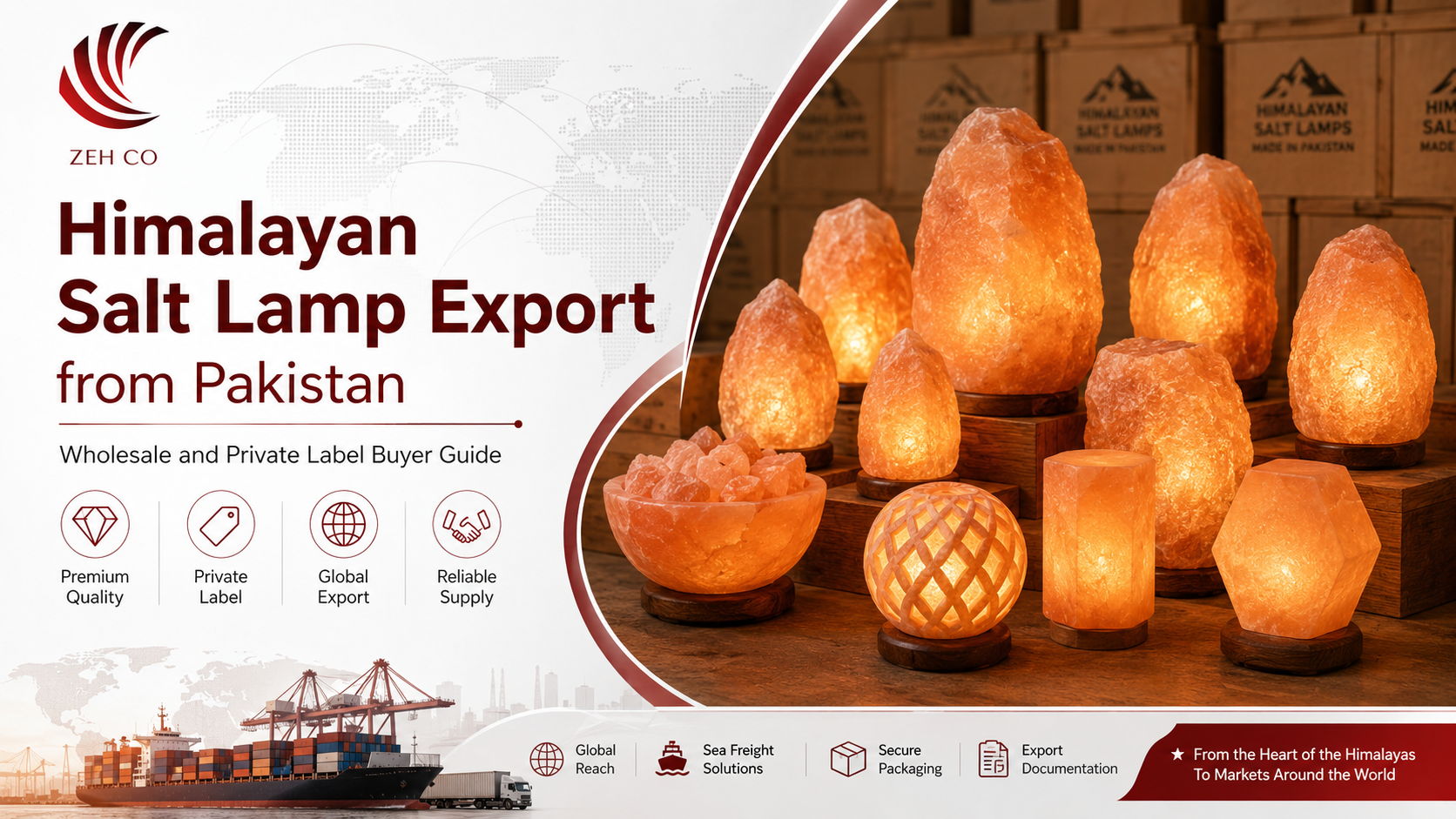
Himalayan salt lamp export from Pakistan serves home décor importers, wellness retailers, gift distributors, hotel suppliers and private-label brands seeking natural salt products in commercial quantities. Pakistan is the primary source of genuine Himalayan rock salt from the Khewra Salt Range and surrounding mining areas, giving international buyers direct access to raw salt material, cutting facilities and finished lamp production.
Purchasing salt lamps for wholesale distribution requires more than selecting an attractive shape. Importers must evaluate the salt source, lamp weight, color consistency, electrical fittings, packaging strength, moisture protection, labeling and destination-country compliance. A reliable sourcing process helps reduce breakage, electrical problems and product inconsistency after the shipment reaches the buyer’s warehouse.
Why Source Himalayan Salt Lamps from Pakistan?
Pakistan offers direct access to the natural rock salt used to manufacture Himalayan salt lamps. Local producers can mine, cut, shape, drill, polish and pack the lamps within the same supply network. This reduces unnecessary intermediary stages and allows buyers to request customized sizes, shapes, bases, electrical fittings and retail packaging.
Importers can source natural rough lamps, geometric designs, carved decorative lamps, fire bowls, basket lamps and custom private-label collections. The ability to combine different styles in one shipment can help distributors serve several retail segments without purchasing from multiple suppliers.
Pakistan also provides established export routes through Karachi ports. Depending on the destination and commercial agreement, buyers may request FOB Karachi, CIF or DDP quotations. The most suitable option depends on shipment volume, customs experience and the buyer’s freight arrangements.
Main Himalayan Salt Lamp Styles for Wholesale Buyers
Natural-Shaped Salt Lamps
Natural-shaped lamps retain the irregular outer form of the salt rock. Each unit has a different contour, color pattern and surface texture. These lamps are widely sold by wellness stores, home décor retailers and online marketplaces because their natural appearance makes every piece visually distinctive.
Buyers should specify the desired weight range rather than expecting identical dimensions. A commercial order may be divided into categories such as 2–3 kilograms, 3–5 kilograms or 5–7 kilograms. Clear weight tolerances are essential because freight cost, retail pricing and packaging dimensions are affected by the actual unit weight.
Geometric and Polished Salt Lamps
Geometric lamps are cut and shaped into forms such as spheres, pyramids, cubes, cylinders and obelisks. These products require more processing and produce a more uniform retail presentation than natural rough lamps.
International buyers should define the dimensions, polishing level, edge treatment and acceptable surface imperfections. Because rock salt is a natural mineral, small inclusions and color variations may remain visible even after polishing.
Salt Fire Bowls
Salt fire bowls usually consist of a shaped bowl containing smaller salt chunks placed around a bulb. The illuminated salt pieces create a decorative glowing effect. Buyers should specify the bowl size, quantity and size of salt chunks, base material and electrical fitting.
The loose salt pieces must be packed securely to prevent damage to the bowl and electrical components. Retail packaging should also include clear assembly instructions when the salt chunks are packed separately.
Metal Basket Salt Lamps
Basket lamps combine salt chunks with a decorative metal cage or basket. Available designs may include cylindrical, spherical, floral and abstract forms. These lamps are popular in contemporary home décor collections and gift assortments.
Buyers should evaluate the metal finish, coating quality, welding, stability and ventilation around the bulb. The salt chunk quantity should be consistent across the order so that each lamp has a similar appearance and retail weight.
Custom-Carved Salt Lamps
Salt rock can be carved into decorative forms such as animals, hearts, moons, stars, houses and cultural symbols. Custom designs can help private-label brands differentiate their product ranges, but detailed prototypes should be approved before mass production.
Complex shapes may have fragile sections, so the supplier should assess whether the design can survive packing, container transport and retail handling. Buyers should prioritize commercially durable forms rather than selecting a design based only on appearance.
Himalayan Salt Lamp Color and Mineral Variation
Natural Himalayan rock salt can range from pale pink and peach to orange, red and darker mineral-rich shades. Color differences occur because of natural mineral composition and geological variation. These differences are not necessarily defects, but international buyers should define the preferred color range for their market.
Some retailers prefer light pink lamps because they produce brighter illumination, while others select darker orange or red lamps for a deeper glow. A mixed-color commercial shipment should be agreed in advance, including the acceptable percentage of each color category.
Buyers should not expect every natural lamp to look identical. However, excessive mixing of very pale, dark or visibly stained units can create an inconsistent retail collection. Sample approval and shipment-level color sorting can reduce this risk.
Electrical Components and Market Compliance
Electrical fittings are among the most important elements of a salt lamp order. The lamp may include a bulb holder, power cord, plug, switch, bulb and removable electrical assembly. These components must match the electrical system and safety requirements of the destination market.
Plug Type
Importers should specify the required plug configuration for the destination country. Plug systems vary across the United States, United Kingdom, European Union, Australia, the Middle East and other markets. Supplying the wrong plug can make the product commercially unusable or require costly replacement after arrival.
Voltage and Bulb Rating
The electrical assembly must be suitable for the local voltage and frequency. Buyers should define the required bulb wattage and lamp-holder specification. Larger lamps may need different illumination than smaller units, but excessive heat should be avoided.
Switch and Cord Quality
Inline switches and cables should be durable and suitable for repeated consumer use. The buyer should define cord length, wire type, switch position and required certification. Cord color can also be selected to match retail or branding requirements.
Certification Responsibility
Electrical-product regulations vary by country. Importers should verify whether testing, certification, registration or conformity markings are required before placing an order. Depending on the market, the electrical components or completed lamp may need to meet specific safety standards.
The purchase agreement should clearly state whether the supplier provides certified components, supporting test reports or only the salt body and base. Buyers should not assume that an electrical fitting accepted in one market will automatically comply in another.
Wooden Bases and Lamp Stability
Many Himalayan salt lamps are mounted on wooden bases. Common base options include natural wood, dark-stained wood and polished finishes. The base should be properly dried, evenly shaped and large enough to support the salt body.
Stability is especially important for tall or irregular lamps. The finished unit should remain balanced on a flat surface and should not tilt when the electrical assembly is inserted. Buyers should inspect the drilling position because an off-center cavity can affect both stability and light distribution.
The underside of the base may include protective pads to reduce scratching on furniture. Screws, fittings and adhesives should be securely installed and should not protrude from the base.
Quality Standards for Himalayan Salt Lamp Export from Pakistan
A detailed quality specification helps both the buyer and exporter evaluate the finished shipment consistently. Wholesale orders should define:
- Product style: Natural, polished, geometric, basket, bowl or carved design.
- Unit weight: Target weight and acceptable tolerance for each category.
- Salt color: Preferred color range and acceptable natural variation.
- Surface condition: Limits for cracks, chips, dark spots and loose sections.
- Base quality: Wood type, finish, dimensions and stability requirements.
- Drilling: Hole diameter, depth, position and compatibility with the electrical fitting.
- Electrical assembly: Plug, voltage, cord, switch, holder and bulb specification.
- Packaging: Inner protection, retail box, master carton and labeling.
- Branding: Logo placement, barcode, instructions and private-label requirements.
Natural mineral products will contain some variation, but functional defects should remain controlled. Lamps with unstable bases, exposed wiring, severe cracks or poorly fitted holders should not be accepted as standard commercial quality.
Common Quality Problems Importers Should Prevent
Cracking and Breakage
Salt is relatively brittle and can break under impact. Cracks may develop during shaping, drilling, internal transport or container handling. Each lamp should be visually checked before packing, and fragile designs should receive additional protection.
Unstable Bases
An uneven or undersized base can cause the lamp to lean or fall. Stability testing should be included in the inspection process, particularly for tall and heavy designs.
Incorrect Weight Classification
Natural lamps vary in shape, making visual size an unreliable measure of weight. Buyers should define whether weight is calculated with or without the electrical fitting and packaging.
Poorly Fitted Electrical Assemblies
The bulb holder should fit securely inside the drilled cavity while remaining removable for bulb replacement. A loose assembly may affect safety and customer satisfaction, while an excessively tight fitting may damage the lamp.
Moisture Damage
Rock salt naturally attracts moisture from humid air. Without suitable protection, lamps may develop surface moisture, salt residue or packaging damage. Moisture control is therefore essential during storage and shipment.
Private Label Salt Lamp Manufacturing
Private labeling allows importers to sell Himalayan salt lamps under their own brand. A private-label program may include customized retail boxes, instruction manuals, barcode labels, warranty cards and printed product information.
Buyers should provide final artwork in the required format and confirm all legal product information before printing begins. Packaging may need to show the importer’s name, country of origin, electrical specifications, safety warnings and recycling information.
For a new brand, it is advisable to approve a complete production sample containing the final lamp, base, electrical fitting and retail box. This confirms that the product and packaging work together before the full order is manufactured.
Retail Packaging and Export Cartons
Packaging must protect the lamp from impact, movement and moisture. A common system includes an inner plastic or moisture-resistant wrapping, molded protection or cushioning material, an individual retail box and a strong master carton.
The lamp should not move freely inside the retail box. Extra space increases the risk of breakage during container handling. Electrical components should be secured separately so that the plug or bulb holder does not strike the salt body.
Master cartons should be suitable for stacking and should display handling marks, carton numbers, gross weight and product identification. Buyers may also request drop testing or trial shipment testing for new packaging designs.
Moisture Protection During Shipping
Salt lamps should be stored in a dry environment before loading. Containers must be clean, dry and free from roof leaks or strong odors. Moisture-control materials may be used when shipments travel through humid climates or experience significant temperature changes.
The packaging should limit direct exposure to humid air while avoiding trapped liquid. Buyers should discuss the expected route and transit time with the exporter so the packing system can be selected accordingly.
After arrival, cartons should be stored off the floor in a dry warehouse. Lamps should remain in protective packaging until they are prepared for sale or inspection.
Pre-Shipment Inspection for Salt Lamps
A pre-shipment inspection can reduce the risk of receiving mixed weights, damaged lamps or incorrect electrical fittings. The inspection should use random sampling across different cartons and product styles.
Recommended checks include:
- Product quantity and model verification
- Individual and carton weight checks
- Color and surface inspection
- Base stability testing
- Electrical fitting verification
- Basic lamp illumination testing
- Plug and voltage confirmation
- Retail packaging review
- Barcode and label verification
- Master carton strength and shipping-mark checks
For large private-label orders, buyers may also request container-loading supervision to confirm that only inspected goods are loaded and that the container is dry and suitable.
Minimum Order Quantity and Pricing Factors
The minimum order quantity depends on lamp design, size, packaging and customization. Standard natural lamps may be available at lower quantities than custom-carved or fully private-label collections.
Main pricing factors include:
- Salt lamp size and weight
- Natural or carved design
- Color selection requirements
- Base material and finish
- Electrical component specifications
- Testing or certification requirements
- Retail packaging complexity
- Printing and private-label quantity
- Inspection requirements
- Freight and delivery terms
Buyers should compare quotations using the same unit weight, electrical components and packaging specification. A lower-priced lamp may contain a lighter salt body, weaker carton or uncertified fitting, making a direct price comparison misleading.
Export Documentation for Salt Lamp Shipments
A typical commercial shipment may require:
- Commercial invoice
- Packing list
- Bill of lading or airway bill
- Certificate of origin
- Insurance certificate when applicable
- Electrical test reports or compliance documents when required
- Inspection certificate when requested
- Destination-specific product declarations
Product descriptions, quantities, carton counts, weights and values should remain consistent across the documentation. The buyer should provide any required customs wording before shipment.
FOB, CIF and DDP Shipping Options
FOB Karachi
Under FOB Karachi terms, the exporter handles production, export packing, inland transport, customs clearance and loading at the port. The buyer arranges international freight, insurance and destination services.
CIF Destination Port
Under CIF terms, the exporter arranges freight and insurance to the named destination port. Buyers should confirm destination handling charges, customs costs and inland delivery separately unless they are included in the written quotation.
DDP Delivery
DDP may be available for selected destinations through established logistics partners. The quotation should clarify whether duties, taxes, customs clearance, inspections, final delivery and unloading are included.
Information Buyers Should Include in an Inquiry
A detailed inquiry enables the exporter to prepare an accurate quotation. Buyers should provide:
- Required lamp styles
- Weight or size categories
- Preferred salt color
- Order quantity per design
- Electrical plug and voltage requirements
- Bulb and cord specifications
- Wooden base requirements
- Private-label artwork needs
- Retail packaging specifications
- Required certifications or test reports
- Destination port or delivery address
- Preferred Incoterm
- Target delivery schedule
Reference photographs or drawings should be included for custom-carved designs. Buyers should also state whether mixed lamp styles can be loaded in one container.
Source Himalayan Salt Lamps with ZEH Co International
ZEH Co International supports international importers, distributors and private-label brands sourcing Himalayan salt lamps and other rock salt products from Pakistan. Established in 2011, the company coordinates product specifications, supplier communication, packaging, inspection and export shipment planning.
ZEH Co offers trade arrangements including FOB Karachi, CIF and DDP, subject to the destination and commercial requirements. Buyers can request standard wholesale designs or customized private-label products prepared according to their branding and electrical specifications.
To obtain a commercial quotation, buyers should provide the required lamp types, weights, quantities, electrical standards, packaging, destination and target delivery date.
Conclusion
Himalayan salt lamp export from Pakistan gives international buyers direct access to natural rock salt products, customized lamp designs and private-label manufacturing. A successful order depends on accurate weight categories, stable bases, suitable electrical fittings, moisture-resistant packaging and destination-market compliance.
Importers should approve complete samples, define acceptable natural variation and inspect finished goods before loading. By combining detailed specifications with proper export packing and clear FOB, CIF or DDP responsibilities, buyers can establish a reliable wholesale supply chain for genuine Himalayan salt lamps from Pakistan.