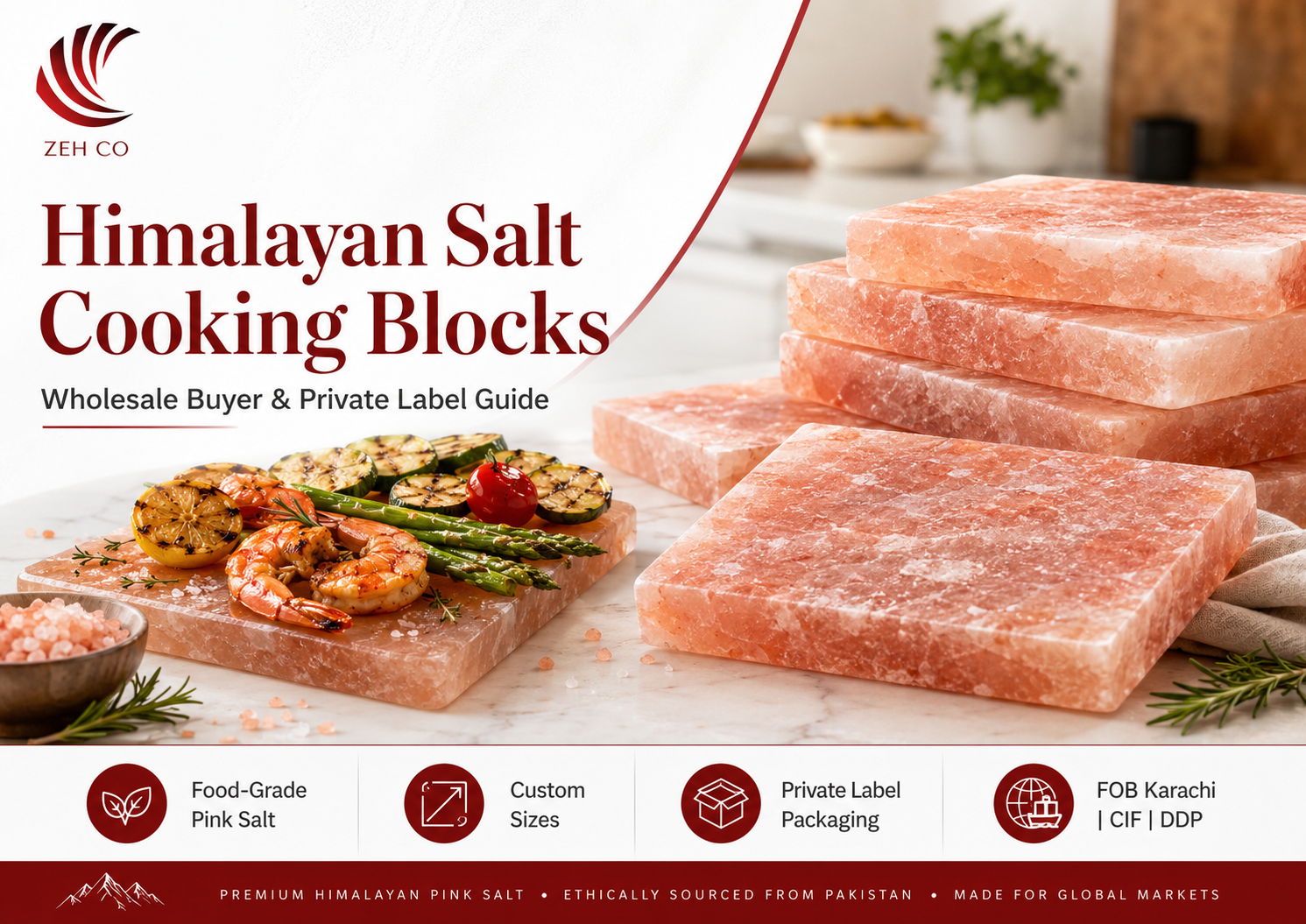
Himalayan salt cooking blocks are increasingly used by restaurants, home chefs, kitchenware brands, hospitality suppliers, and specialty retailers for grilling, serving, curing, chilling, and food presentation. Pakistan is the primary commercial source of authentic Himalayan pink rock salt, particularly from the Khewra Salt Range and surrounding mining regions. For international buyers, successful sourcing requires careful attention to block dimensions, mineral structure, surface finishing, crack tolerance, packaging strength, food-contact suitability, and private-label presentation.
This guide explains how international importers can evaluate Himalayan salt cooking blocks from Pakistan, define a clear product specification, reduce breakage risk, and select suitable packaging and shipping terms. It also outlines how ZEH Co International can support wholesale orders, customized sizes, branded packaging, documentation, and export logistics under FOB Karachi, CIF, and DDP arrangements where available.
What Are Himalayan Salt Cooking Blocks?
Himalayan salt cooking blocks are solid slabs cut from natural pink rock salt. They are commonly used as heated cooking surfaces, chilled serving plates, curing platforms, and decorative food presentation pieces. Depending on their thickness and intended use, the blocks may be placed on grills, stovetops, ovens, serving stands, or chilled surfaces.
The salt naturally transfers a mild salty flavor to food placed directly on its surface. The level of seasoning depends on the food’s moisture content, cooking duration, block temperature, and surface condition. Dry foods generally absorb less salt, while moist foods absorb more.
Cooking blocks are purchased by kitchenware wholesalers, gourmet food stores, barbecue brands, restaurants, hotels, catering companies, cookware distributors, gift retailers, and online sellers. They are also suitable for private-label programs where importers sell the products under their own brand.
Why Source Himalayan Salt Cooking Blocks from Pakistan?
Pakistan contains major deposits of Himalayan pink rock salt with natural color variations ranging from pale pink to deep reddish tones. The stone is extracted in large mineral formations and then transported to cutting and finishing facilities where it is shaped into slabs, tiles, bricks, lamps, serving plates, and other products.
Direct sourcing from Pakistan allows buyers to access a wide range of block sizes, thicknesses, surface finishes, packaging options, and customization services. Importers can purchase standard retail products or develop exclusive dimensions and packaging for their target markets.
Pakistan-based finishing facilities can also provide value-added services such as precision cutting, edge smoothing, polishing, logo engraving, individual wrapping, printed cartons, instruction inserts, and pallet preparation. These capabilities are particularly important for private-label brands and retail distributors that require ready-to-sell products rather than unprocessed stone.
Himalayan Salt Cooking Blocks Quality Requirements
Salt blocks are natural mineral products, so color patterns, veins, and crystal structures vary from piece to piece. Buyers should not expect every block to look identical. However, commercial quality can still be controlled through clear standards for size, structural integrity, finish, cleanliness, and packaging.
Structural Integrity
A cooking block must be strong enough to withstand normal handling, packaging, shipment, and gradual heating. Large cracks, loose sections, deep fractures, or weak corners can cause the block to break during transport or use.
Small mineral lines and natural veins are common and may not affect performance. Buyers should define the acceptable level of visible lines and determine whether the product is intended for premium retail, standard retail, hospitality use, or promotional sales.
Surface Flatness
The cooking surface should be sufficiently flat to provide stable contact with food and cooking equipment. Uneven surfaces may create poor presentation, unstable placement, or inconsistent heat transfer.
Buyers should specify whether the top and bottom surfaces must both be cut and polished or whether only the food-contact surface requires finishing. Precision requirements may differ for cooking slabs, serving plates, salt bricks, and decorative products.
Edge and Corner Finish
Sharp edges can damage packaging, create safety concerns, and increase the chance of chipping. Most retail cooking blocks are supplied with smoothed edges or lightly rounded corners.
Premium products may require polished edges and symmetrical corners, while lower-cost hospitality blocks may use a simpler machine-cut finish. The required edge style should be shown in drawings, photographs, or approved samples before mass production.
Color and Appearance
Himalayan salt blocks naturally vary in color. Some pieces may be light pink, while others may contain red, orange, white, or darker mineral veins. Importers should decide whether they prefer natural mixed colors or a more uniform appearance.
Retail brands often accept natural color variation because it emphasizes authenticity. However, buyers selling matched product sets may require closer visual sorting. Color grading increases labor and may affect pricing, especially when lighter or darker shades are specifically requested.
Cleanliness
Blocks should be free from loose dust, oil, chemical residue, dirt, and foreign material. The finishing facility should use clean cutting, grinding, washing, drying, and packaging procedures appropriate for a product intended to contact food.
Blocks must be fully dried before wrapping. Packaging salt products while moisture remains on the surface can weaken cartons, damage printed labels, and create visible salt residue.
Common Sizes and Thicknesses
Himalayan salt cooking blocks can be produced in multiple dimensions. The best size depends on the intended cooking method, retail price, packaging design, and shipping cost.
- Small serving plates: Suitable for appetizers, sushi, cheese, desserts, and individual food presentation.
- Medium cooking blocks: Commonly used for home grilling, stovetop cooking, and restaurant presentation.
- Large grilling slabs: Designed for barbecue equipment, commercial kitchens, shared serving, or premium retail sets.
- Salt bricks: Used for cooking, curing, presentation, construction features, and decorative walls.
- Custom shapes: Round, rectangular, square, oval, grooved, handled, or branded designs may be produced subject to manufacturing feasibility.
Thickness is one of the most important specifications. Thin blocks are lighter and less expensive to ship, but they can be more vulnerable to thermal stress and breakage. Thicker blocks offer greater durability and heat retention but increase product weight, packaging requirements, and freight cost.
Importers should define length, width, thickness, weight tolerance, and dimensional tolerance. A specification such as “large salt block” is not sufficient for commercial production. Exact measurements should be provided in millimeters or inches.
Surface Finishing Options
Machine-Cut Finish
A machine-cut block has flat surfaces created through sawing and basic grinding. It is typically more economical and may be suitable for wholesale foodservice, hospitality, or value-oriented retail programs.
Polished Finish
Polishing creates a smoother, more premium appearance. Polished blocks are often preferred for retail packaging, gift sets, serving plates, and higher-value kitchenware products.
The degree of polishing should be approved through samples because natural salt does not always produce the same appearance as marble or granite. Over-polishing may also add unnecessary production cost without improving functional performance.
Textured or Grooved Finish
Some buyers request grooves to collect liquids, improve food presentation, or create a unique branded appearance. Grooves must be carefully designed because deep cuts can weaken the block or create areas where moisture accumulates.
Engraved Branding
Logos, brand names, patterns, or product identifiers may be engraved into the block. Engraving depth and location should be tested to ensure the process does not weaken the slab.
Importers should provide high-resolution artwork and approve a physical or photographic sample before mass production. Engraving is more suitable for thicker blocks and premium products.
Food-Contact and Testing Considerations
International buyers should confirm the testing and documentation required in their destination market. Requirements may vary depending on whether the item is classified as cookware, kitchenware, tableware, mineral food-contact material, or decorative stone.
Buyers may request laboratory testing related to mineral composition, heavy metals, hygiene, food-contact safety, or material authenticity. The required test method should be identified before production because different markets and retailers may follow different standards.
Testing should be conducted on representative material from the actual production source where possible. Importers should also confirm whether reports must come from a specific accredited laboratory or testing organization.
Product packaging should not make unsupported medical or health claims. Marketing should focus on legitimate uses such as cooking, grilling, serving, chilling, curing, and food presentation.
Packaging Himalayan Salt Cooking Blocks
Packaging is critical because salt blocks are heavy, brittle, and sensitive to impact. Weak packaging can lead to cracked corners, broken slabs, damaged cartons, and customer returns.
Individual Protective Wrapping
Each block should be wrapped separately to protect the surface and prevent movement inside the carton. Protective materials may include foam sheets, shrink wrapping, bubble protection, paper cushioning, molded inserts, or layered corrugated supports.
The packaging material should keep the block stable without trapping moisture. Blocks must be dry before wrapping.
Inner Cartons
Retail blocks are commonly packed in printed or plain inner cartons. The carton should match the product dimensions closely enough to reduce movement. Reinforced corners and internal separators may be required for heavier sizes.
Printed packaging can include product dimensions, net weight, country of origin, usage instructions, heating guidance, cleaning information, warning statements, brand details, barcodes, and importer information.
Master Cartons
Several individual units may be placed inside a stronger master carton for export. The number of units per carton should be based on safe lifting weight, product thickness, and pallet configuration.
Overloaded master cartons are more likely to burst or become difficult to handle. Buyers should approve carton weight limits, carton dimensions, board strength, and internal packaging method.
Wooden Crates and Pallets
Large blocks, bulk hospitality orders, and heavy commercial shipments may require wooden crates or reinforced pallets. Wood packaging must comply with applicable international treatment and marking requirements.
Pallets should be stable, balanced, wrapped securely, and protected against moisture. Corner guards and strapping can help prevent cartons from moving during transport.
Private Label Opportunities
Himalayan salt cooking blocks are suitable for private-label kitchenware and gourmet retail programs. Importers can develop a branded product without operating their own cutting or packaging facility.
- Custom retail cartons
- Printed instruction booklets
- Brand labels and barcodes
- Logo engraving on the block
- Custom dimensions and thicknesses
- Branded wooden or metal holders
- Gift-set packaging
- Custom master cartons and shipping marks
- Marketplace-ready packaging
Private-label buyers should provide final artwork, legal text, barcode information, country-of-origin requirements, and packaging language before production. The supplier should produce a pre-production sample for approval.
Importers selling through online marketplaces should also consider drop-test performance, individual parcel shipping, carton presentation, and customer instructions. Packaging designed only for palletized wholesale transport may not protect the block during courier delivery to individual consumers.
Safe Heating and Usage Instructions
Salt blocks should be heated gradually. Rapid temperature changes can cause cracking because natural salt contains mineral lines and internal variations. Retail packaging should provide clear heating and cooling instructions.
- Begin heating at a low temperature.
- Increase heat gradually in controlled stages.
- Avoid placing a cold block directly onto intense heat.
- Do not place a hot block on a cold or wet surface.
- Allow the block to cool naturally after use.
- Do not wash the block under running water.
- Clean gently with minimal moisture and dry completely.
- Store in a dry location away from humidity.
Instructions should make clear that natural salt blocks may develop surface lines, color changes, or minor cracks during repeated use. These changes do not always mean the product is defective, but the block should not be used if it becomes structurally unstable.
Pre-Shipment Quality Inspection
Inspection should take place after finishing and before final packing or loading. A practical quality-control checklist may include:
- Verify length, width, thickness, and weight.
- Check surface flatness and polish quality.
- Inspect edges and corners for chips.
- Reject blocks with major structural cracks.
- Confirm color selection and visual grading.
- Check engraving, labels, barcodes, and printed artwork.
- Confirm that blocks are clean and dry.
- Test inner-carton and master-carton strength.
- Verify product count and carton count.
- Record loading with photographs and inspection notes.
Buyers may arrange third-party inspection for large or first-time orders. Inspection criteria should be agreed in writing before production so the factory and inspector use the same acceptance standards.
Managing Breakage Risk During Shipping
Salt blocks are dense and fragile. Breakage can occur during factory handling, inland transport, container loading, ocean movement, unloading, warehousing, or final delivery.
Risk can be reduced through thicker product designs, rounded corners, strong protective inserts, reinforced cartons, stable pallets, careful container loading, and appropriate shipment insurance. Empty space inside cartons should be minimized, and heavy cartons should not be stacked above their safe compression limit.
Importers should agree on a reasonable breakage tolerance and claims procedure. Photographs of production, packing, palletization, container condition, and loading can help determine where damage occurred.
For e-commerce products, buyers should request packaging specifically tested for parcel delivery. Individual courier networks involve repeated drops and handling that differ significantly from palletized wholesale distribution.
Export Documents for Salt Cooking Blocks
The required documentation depends on the destination, buyer, payment method, and product classification. Common export documents may include:
- Commercial invoice: Shows product description, quantity, price, currency, buyer, seller, and Incoterm.
- Packing list: Lists cartons, units, net weight, gross weight, and packaging details.
- Bill of lading or airway bill: Provides the main transportation details.
- Certificate of origin: Confirms Pakistani origin.
- Laboratory test report: Supplied when required for mineral composition or food-contact assessment.
- Inspection certificate: Provided when contractual or third-party inspection is requested.
- Fumigation certificate: May be required when wooden crates or pallets are used.
- Insurance certificate: Relevant when insurance is included under the agreed trade term.
Product descriptions should remain consistent across all documents. The buyer should verify the applicable customs classification and import rules in the destination country before shipment.
FOB, CIF, and DDP Shipping Terms
FOB Karachi
Under FOB Karachi terms, ZEH Co can coordinate production, packaging, inland transportation, export clearance, documentation, and loading onto the nominated vessel. The buyer arranges ocean freight, destination clearance, duties, local charges, and final delivery.
CIF Destination Port
Under CIF terms, the exporter arranges ocean freight and cargo insurance to the named destination port. The buyer remains responsible for import clearance, destination charges, duties, taxes, and onward transport.
DDP Delivery
DDP may be offered for selected destinations, subject to customs regulations, product classification, importer-of-record requirements, taxes, local logistics, and delivery access. Buyers requesting DDP should provide a complete delivery address and detailed order specifications.
How to Request an Accurate Quotation
International buyers should provide complete specifications so the exporter can calculate stone selection, cutting, finishing, packaging, inspection, inland transport, and freight costs.
- Required block length, width, and thickness
- Dimensional and weight tolerance
- Machine-cut or polished finish
- Edge and corner style
- Preferred color range
- Acceptable natural veins and crack tolerance
- Quantity per size
- Individual packaging requirements
- Private-label artwork and labeling requirements
- Master-carton quantity and maximum weight
- Pallet or wooden-crate requirements
- Testing and inspection requirements
- Destination port or delivery address
- Preferred Incoterm
- Required shipment date
Salt-block pricing depends on raw stone quality, dimensions, thickness, cutting yield, polishing, customization, packaging strength, order quantity, and freight conditions. Large blocks may cost more because they require larger crack-free sections of stone and produce more cutting waste.
Why Source Through ZEH Co International?
ZEH Co International is a Pakistan-based wholesale exporter established in 2011. The company supports international importers, distributors, retailers, hospitality suppliers, and private-label brands sourcing products from Pakistan.
For Himalayan salt cooking blocks, ZEH Co can coordinate raw-material selection, cutting, finishing, polishing, engraving, retail packaging, quality inspection, export documentation, and international shipment. Customized sizes and branded packaging can be developed according to buyer requirements and production feasibility.
ZEH Co offers FOB Karachi, CIF, and DDP arrangements where available. Its management systems are supported by ISO 9001:2015 and ISO 22000 certifications. Buyers can request wholesale quotations for standard cooking slabs, serving plates, salt bricks, grilling blocks, and customized private-label products.
Conclusion
Himalayan salt cooking blocks offer strong wholesale opportunities for kitchenware distributors, gourmet retailers, hotels, restaurants, gift companies, and private-label brands. Their commercial success depends on selecting structurally sound salt, defining accurate dimensions, applying suitable surface finishing, and using packaging strong enough to protect the product throughout international transport.
Importers should approve samples, establish clear crack and size tolerances, confirm food-contact documentation, and test packaging before placing large orders. By combining controlled production with strong retail presentation and reliable shipping procedures, buyers can create a distinctive natural kitchenware product for international markets. ZEH Co International supports wholesale and customized Himalayan salt cooking block orders from Pakistan under FOB Karachi, CIF, and DDP terms.