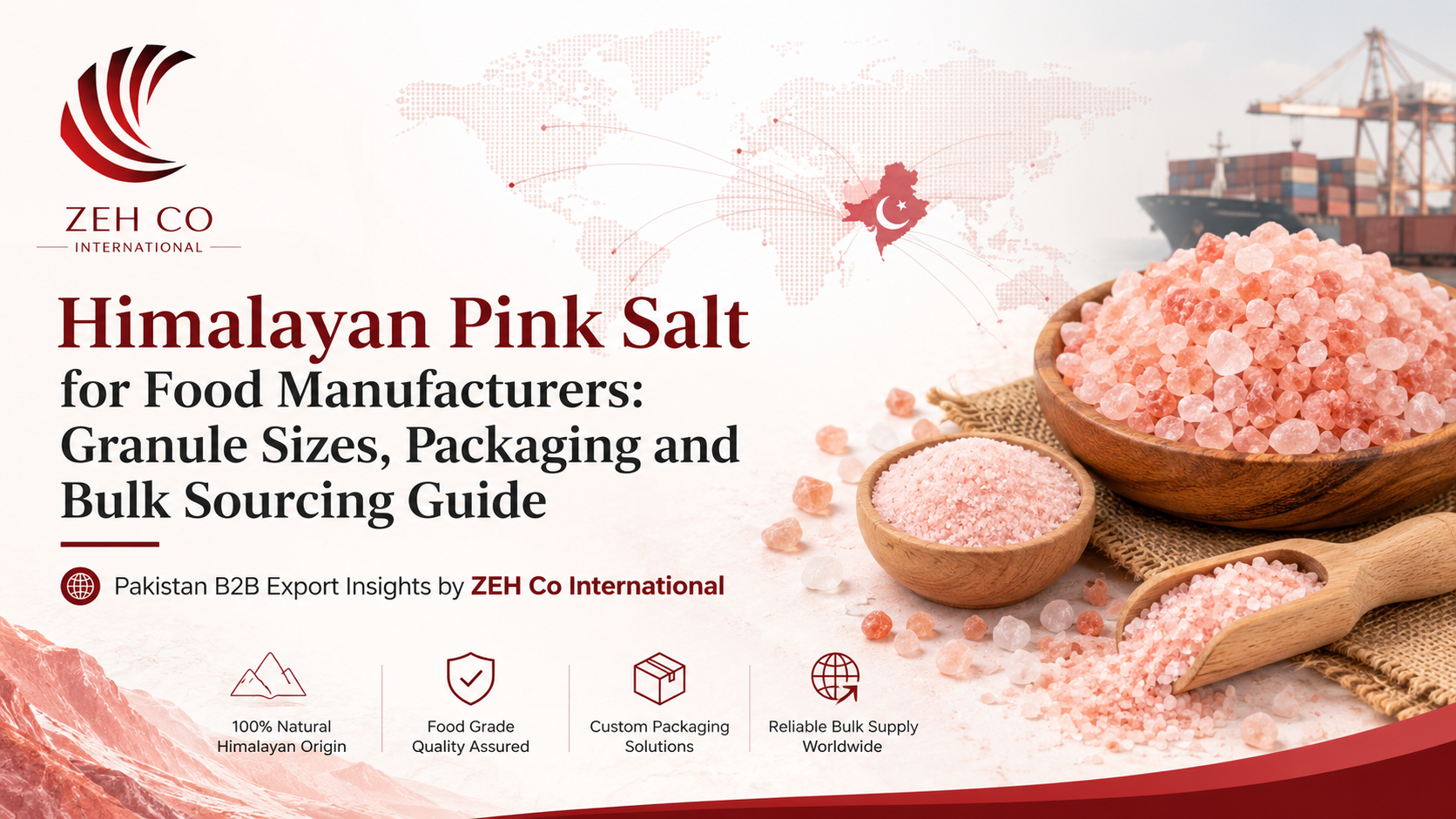
For seasoning companies, food processors, wholesalers and private-label brands, sourcing Himalayan pink salt for food manufacturers requires much more than comparing a price per metric ton. Granule consistency, cleanliness, food-grade handling, packaging strength, moisture protection and documentation can directly affect production efficiency and finished-product quality. Pakistan is the natural sourcing origin for Himalayan pink rock salt, and professional importers increasingly require suppliers that can prepare the material according to defined industrial specifications rather than offering a single generic grade.
ZEH Co International, a Pakistan-based B2B exporter established in 2011, supplies international buyers with export-oriented sourcing solutions for Himalayan pink salt and other Pakistani products. For food manufacturers, the most successful purchasing process begins with a detailed specification covering particle size, intended application, packaging format, required documentation, destination and shipping terms.
Why Himalayan Pink Salt for Food Manufacturers Requires Precise Specifications
Retail consumers often judge Himalayan pink salt mainly by appearance, but industrial food buyers have different priorities. A food factory needs a repeatable raw material that can be integrated into mixing, grinding, seasoning, filling or packaging operations without creating unnecessary production problems.
Two shipments may both be described commercially as Himalayan pink salt while differing significantly in particle size distribution, dust percentage, color variation and packaging. These differences become important when salt is used in automated production systems or blended with other ingredients.
Before placing a commercial order, buyers should define the characteristics that matter for their particular process. Important purchasing considerations normally include:
- Particle or granule size: fine powder, table-grade crystals, medium granules, coarse crystals or custom mesh requirements.
- Intended application: seasoning blends, snack foods, bakery products, table salt, grinders, meat processing or repacking.
- Food-grade handling: processing, storage and packing procedures suitable for food-related supply chains.
- Foreign-material control: cleaning and sorting requirements appropriate to the buyer's specifications.
- Moisture protection: packaging capable of protecting salt during storage and international transportation.
- Color range: acceptable natural variation between lighter pink, medium pink and darker mineral-rich crystals.
Choosing the Right Granule Size for Industrial Food Applications
Granule size is one of the most important commercial specifications when importing Himalayan salt. Buyers should avoid simply requesting "fine" or "coarse" salt when their production line requires a more controlled particle range. Providing the supplier with a target mesh range, sample reference or application description can significantly reduce misunderstanding.
Fine Himalayan Pink Salt
Fine salt is commonly required where rapid dispersion and consistent blending are important. Food seasoning manufacturers, spice companies and dry-mix producers may prefer finer particles because they distribute more evenly throughout powdered formulations. Fine material may also be suitable for direct consumer table-salt products depending on the final packaging format.
For industrial blending, buyers should discuss acceptable powder content and particle distribution. Excessive variation can influence flow characteristics and the visual appearance of the finished blend.
Medium Granules
Medium-grain Himalayan pink salt is useful for products where visible salt crystals are desirable while the material still needs to remain manageable during filling and food preparation. It can be selected for seasoning products, specialty culinary applications and repacking into consumer containers.
Importers should clarify whether they require a narrow granule range or whether a broader commercially available size distribution is acceptable. Narrower specifications may require additional screening or processing.
Coarse Salt and Grinder Crystals
Coarse Himalayan salt is particularly relevant for grinder products, gourmet food lines and specialty retail packaging. Crystal dimensions must be compatible with the grinding mechanism used by the buyer's packaging system. Crystals that are excessively large or irregular may create filling or grinder-performance problems.
Private-label brands should ideally test representative samples with their intended bottles and grinders before confirming large-volume production.
Natural Color Variation in Himalayan Pink Salt
Himalayan pink salt is a natural mineral product, so color should not be treated like an artificial manufactured pigment. Commercial lots can contain crystals ranging from pale pink to deeper reddish or orange-pink tones. The exact appearance can vary according to the mined material and subsequent sorting.
For food processors where salt will be blended into another product, moderate natural variation may have little commercial importance. Retail and private-label brands, however, may require tighter visual consistency because consumers can see the crystals through transparent packaging.
Buyers should therefore specify whether color is primarily a technical consideration or a marketing consideration. Reference samples, photographs and agreed commercial tolerances are useful tools for aligning expectations before shipment.
Cleaning, Crushing and Screening Requirements
Raw rock salt must undergo appropriate preparation before it becomes suitable for many food-market applications. Depending on the required finished form, processing may include selection, crushing, screening and cleaning steps.
The screening stage is especially important for industrial buyers because it separates salt into different particle-size ranges. A professional purchase specification should identify the required grade rather than relying only on a generic product name.
International buyers may also request product samples or pre-shipment documentation to confirm that the supplied material corresponds to the agreed commercial specification. For recurring orders, retaining an approved reference specification can make future procurement more consistent.
Bulk Packaging Options for Food Manufacturers
Packaging requirements depend heavily on how the salt will be used after arrival. A food factory purchasing salt as an ingredient usually requires different packaging from a distributor purchasing finished private-label consumer packs.
Industrial Bulk Bags
Food processors and ingredient distributors may select industrial-size bags because they reduce packaging cost per kilogram and are efficient for warehouse handling. Buyers should specify bag weight, inner lining requirements, palletization preferences and any destination-market labeling requirements before production.
Smaller Wholesale Packs
Importers serving restaurants, foodservice customers or smaller processors may prefer manageable wholesale bag sizes. These formats can simplify redistribution while still providing economies of scale compared with consumer retail packaging.
Private-Label Retail Packaging
Brands intending to sell Himalayan pink salt directly to consumers may require retail pouches, jars, grinders or other packaging formats. In these projects, packaging artwork, net weight, labeling requirements, barcode placement, carton configuration and destination-market compliance should all be settled before mass packing begins.
Importers should provide final approved artwork and regulatory labeling instructions based on the laws of their target market. The importer remains best positioned to confirm destination-specific retail compliance requirements with the relevant regulatory authorities.
Quality Documentation and Supplier Evaluation
Professional food-industry buyers should evaluate more than a supplier's quotation. Documentation capability, traceability procedures, consistency and responsiveness can be equally important for long-term sourcing.
ZEH Co International operates with ISO 9001:2015 and ISO 22000 certifications as part of its quality and food-safety-oriented business framework. Depending on the buyer's requirements and shipment structure, documentation requirements should be communicated during the quotation stage so that both parties understand what is expected before the order is finalized.
Importers may request commercially relevant documentation such as product specifications, packing details, invoice documentation, packing lists and other shipment-related certificates or records applicable to the transaction. Destination-country import requirements vary, so buyers should confirm mandatory regulatory documents with their customs broker or local authority before shipment.
What Information Should Buyers Include in an RFQ?
A detailed request for quotation helps exporters calculate a more accurate commercial offer and reduces repeated communication. Instead of sending only a message such as "send your best Himalayan salt price," professional procurement teams should provide the main purchasing parameters.
- Required product: food-grade Himalayan pink salt.
- Particle size or mesh specification.
- Estimated order quantity in kilograms or metric tons.
- Required bag or retail pack size.
- Private-label requirement, if applicable.
- Required palletization or carton configuration.
- Destination port, city and country.
- Preferred Incoterm or shipping basis.
- Required documentation or testing specifications.
- Expected order frequency for recurring supply.
Providing these details allows the supplier to distinguish between an industrial ingredient order, wholesale distribution order and finished consumer-brand project. Each requires a different quotation structure.
FOB Karachi, CIF and DDP Purchasing Options
International buyers should evaluate product price together with the shipping term used in the quotation. ZEH Co International can work with common international trade structures including FOB Karachi, CIF and DDP, subject to shipment requirements and destination conditions.
FOB Karachi
FOB is suitable for importers that already have established freight-forwarding arrangements. The buyer can control the international freight portion while the export shipment is prepared for loading through Karachi under the agreed terms.
CIF
CIF quotations can be useful for buyers who want the exporter to arrange freight and insurance to the named destination port. When comparing CIF offers, importers should confirm the exact destination port and shipment quantity because freight rates can materially influence the landed cost.
DDP
DDP can provide a more comprehensive delivery structure where commercially and legally feasible. Because customs duties, import taxes, destination regulations and local logistics vary significantly between countries, DDP requirements need to be reviewed for the specific market before confirmation.
Calculating the Real Landed Cost of Imported Himalayan Salt
The lowest factory-level price does not always create the lowest landed cost. Importers should compare the complete supply-chain expense associated with the order.
Factors that may influence landed cost include product processing, packaging, inland movement to the port, export handling, ocean freight, destination charges, customs duties, import taxes, warehousing and domestic transportation after arrival. Packaging density and shipment utilization can also affect cost efficiency.
For recurring buyers, purchasing larger commercial volumes may improve freight efficiency, but only if inventory turnover and warehouse capacity justify the quantity. Procurement teams should balance unit cost against storage expenses and working-capital requirements.
Private-Label Opportunities for Himalayan Pink Salt Brands
Himalayan pink salt offers opportunities beyond bulk commodity trading. Importers can build differentiated product lines around packaging format, granule size and customer segment. Examples include gourmet cooking salt, grinder crystals, restaurant packs, seasoning ingredients and private-label grocery products.
A distributor can source bulk salt for local packing, while another buyer may prefer a more complete export-ready private-label solution. The appropriate model depends on local packaging costs, labor expenses, labeling regulations, minimum order quantities and brand strategy.
Before placing a private-label order, buyers should finalize artwork, packaging material, product weight, carton quantity and labeling information. Physical packaging samples or pre-production proofs are useful for reducing printing errors on commercial runs.
Why Pakistan Is a Strategic Source for Himalayan Pink Salt
For international buyers, sourcing close to the mineral's origin provides commercial advantages. Pakistan has an established salt mining and processing ecosystem that can support products ranging from industrial bulk salt to value-added finished items.
Working with a Pakistan-based exporter also allows buyers to consolidate sourcing communication, export documentation, packaging requirements and shipment coordination within the origin market. This can be valuable for companies building long-term supply programs rather than purchasing occasional spot quantities.
ZEH Co International serves international importers, wholesalers and procurement buyers across multiple markets and can discuss shipment structures according to order quantity, packaging requirements and destination. The company works with buyers from regions including the UAE, China, Germany, Italy, the United Kingdom, the United States, Russia, South Korea, Vietnam and Turkey.
Common Sourcing Mistakes International Buyers Should Avoid
One common mistake is choosing salt exclusively on price without confirming granule specifications. A cheaper material that requires additional screening or processing after import can become more expensive than a correctly prepared grade.
Another mistake is approving a sample without defining acceptable commercial tolerances. Natural mineral products may show variation, so the final purchase agreement should describe which characteristics are critical.
Importers should also avoid leaving packaging decisions until the last stage. Bag strength, inner liners, pallet configuration and labeling can affect container loading, warehouse handling and product condition on arrival.
Finally, buyers should confirm destination import requirements before dispatch. Food import regulations, labeling rules and documentation requirements differ by market and may change over time. Coordination between the exporter, importer, customs broker and logistics provider helps reduce avoidable clearance problems.
Building a Long-Term Himalayan Pink Salt Supply Program
Large food manufacturers and distributors often benefit from treating salt procurement as a supply program rather than a series of isolated purchases. Once a suitable specification is established, both buyer and supplier can work from the same reference for future orders.
A long-term procurement plan can define granule size, packaging, expected annual volume, shipment frequency and preferred trade terms. Forecast visibility may also help with production planning and container scheduling.
For buyers operating multiple brands or distribution channels, specifications can be developed for different applications. One company may import fine food-grade salt for industrial seasoning production, medium crystals for foodservice customers and coarse crystals for private-label grinders.
Conclusion: Source Himalayan Pink Salt from Pakistan with Clear Specifications
Successful sourcing of Himalayan pink salt for food manufacturers depends on specification control, reliable packaging, appropriate documentation and a commercially efficient logistics plan. International buyers should define their required granule size, intended food application, quantity, packing format and destination before requesting a final quotation.
ZEH Co International supports B2B importers, wholesalers, food processors and private-label buyers seeking Himalayan pink salt from Pakistan under FOB Karachi, CIF and DDP arrangements where applicable. Buyers planning a trial shipment, container order or recurring supply program can visit https://zehcointernational.com/ and share their product specification, required quantity and destination to begin a detailed sourcing discussion.