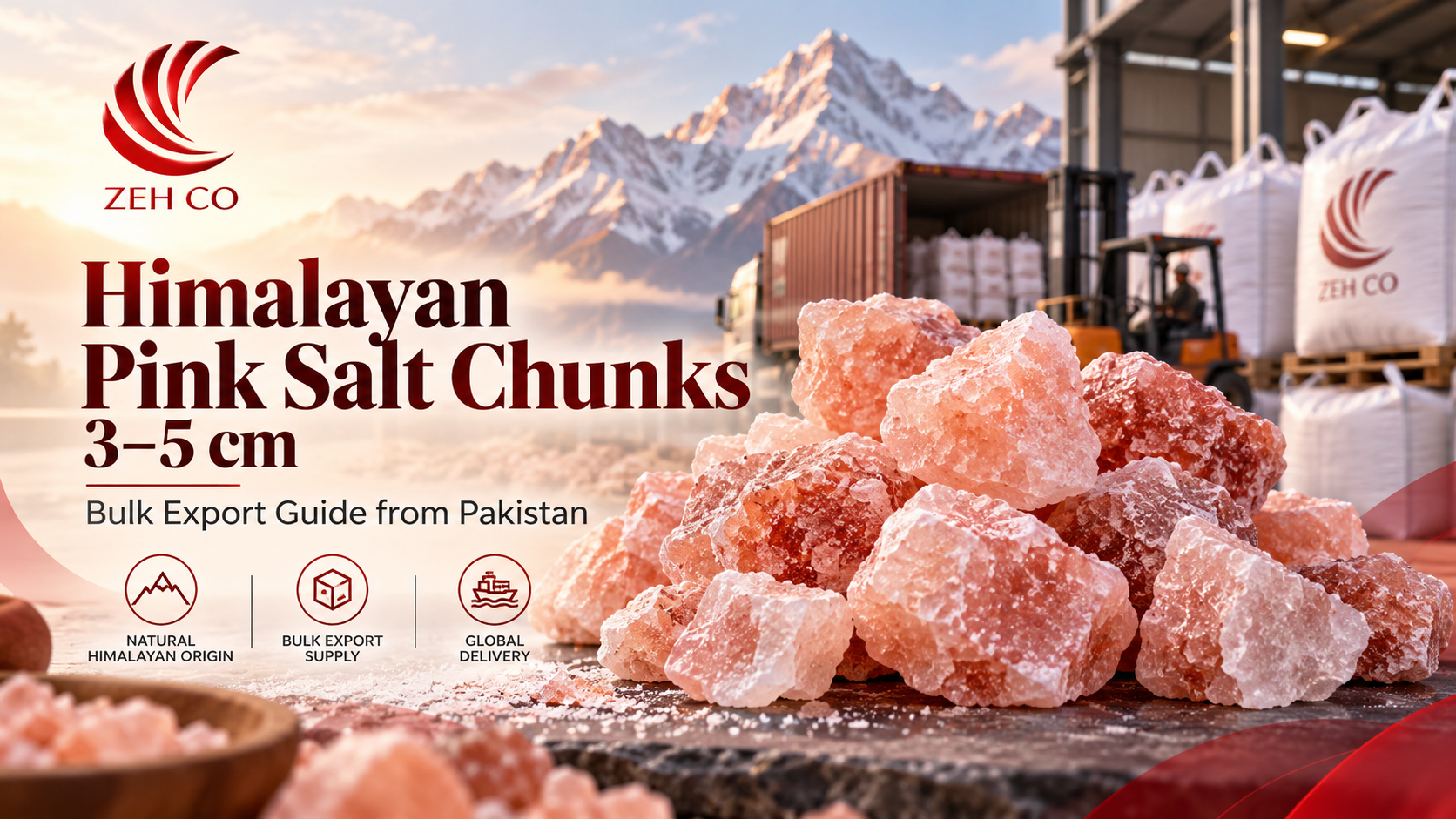
Himalayan Pink Salt Chunks 3–5 cm: An Emerging Opportunity for International Bulk Buyers
Himalayan pink salt is among Pakistan's most recognizable natural mineral export products. Extracted from geological deposits in the Salt Range of Punjab, this distinctive rock salt is valued by international buyers for its characteristic pink coloration, crystalline appearance and versatility across food manufacturing, retail packaging, hospitality and industrial applications.
Although finely ground Himalayan salt and retail salt grinders are familiar products, demand for larger unprocessed or partially processed rock salt pieces creates opportunities for wholesalers and manufacturers seeking flexibility in their production operations.
Himalayan pink salt chunks measuring approximately 3–5 cm are especially relevant to businesses that require identifiable natural crystalline pieces for subsequent crushing, grinding, repackaging or other approved applications.
ZEH Co International, a Pakistan-based B2B export company established in 2011, works with international procurement requirements across its product portfolio. The company reports ISO 9001:2015 and ISO 22000 certifications and serves buyers in markets including Germany, Italy, the United Kingdom, the United Arab Emirates, the United States and Asia.
This guide explains the specifications, color variations, processing methods, packaging requirements, quality considerations and export logistics that importers should evaluate before purchasing Himalayan pink salt chunks from Pakistan.
What Are Himalayan Pink Salt Chunks?
Himalayan pink salt chunks are naturally occurring rock salt pieces produced by breaking larger salt formations into selected size ranges. Unlike refined table salt, these chunks retain the physical appearance of natural crystalline rock salt.
The principal chemical component is sodium chloride, while smaller quantities of naturally occurring minerals and other constituents influence the coloration and composition of individual deposits.
For commercial procurement, chunks can be sorted into different size categories. These may include smaller fragments for further grinding and larger pieces for decorative or specialized applications.
A nominal 3–5 cm size specification means that buyers generally expect the selected rock salt pieces to measure within this range, subject to an agreed measuring method and manufacturing tolerance.
Because naturally broken rock salt is irregular rather than perfectly spherical, buyers should define whether the size requirement refers to the longest dimension, an average dimension or a screening specification.
Understanding Light Pink, Medium Pink and Dark Pink Salt Chunks
One important consideration when sourcing Himalayan salt chunks is color consistency. The appearance of natural rock salt varies, and international buyers frequently request particular shades for their intended products.
1. Light Pink Himalayan Salt Chunks
Light pink chunks have a predominantly pale pink, translucent or almost white appearance. Their softer coloration may appeal to brands producing products with a subtle natural mineral aesthetic.
Light-colored pieces are suitable for buyers who specifically require pale shades or a relatively uniform visual presentation.
2. Medium Pink Himalayan Salt Chunks
Medium pink chunks display more prominent pink and orange-pink tones. These shades are frequently associated with the traditional appearance of Himalayan pink salt.
They can be attractive for retail mineral salt products, visible packaging, further processing and wholesale distribution.
3. Dark Pink Himalayan Salt Chunks
Dark pink chunks typically exhibit deeper orange, reddish-pink or mineral-rich visual characteristics. These shades can be particularly appealing where stronger color contrast is desirable.
However, darker coloration should not automatically be interpreted as evidence of higher purity, superior food safety or greater nutritional value.
Procurement recommendation: Importers should request photographs, videos and representative samples of their preferred color category before approving a commercial shipment. Color expectations, acceptable variation and sorting arrangements should be documented in the purchase specifications.
Washed Versus Unwashed Himalayan Salt Chunks
Another major purchasing decision concerns whether the material should be supplied washed or unwashed.
Washed Himalayan Salt Chunks
Washed salt chunks undergo a cleaning process intended to reduce loose surface dust and other removable material associated with handling, extraction and size reduction.
Depending on the processing facility, the operation may involve controlled washing, drainage, drying and subsequent sorting.
For buyers requiring washed chunks, important considerations include:
- Clean water suitable for the intended processing application.
- Appropriate drying before packing.
- Separation from dirty or untreated material.
- Measures to prevent foreign-material contamination.
- Consistent sorting to the agreed 3–5 cm size range.
- Hygienic handling and packaging for food-intended shipments.
Washing alone does not establish that a product meets food-grade requirements. Food-intended shipments should be supported by appropriate testing, traceability and compliance documentation.
Unwashed Himalayan Salt Chunks
Unwashed chunks may be purchased for suitable downstream industrial processing where the buyer operates its own cleaning, sorting or refining facilities.
The selection between washed and unwashed salt should be based on the intended end use, importing-country rules and the processing capabilities of the customer.
Technical Specifications for 3–5 cm Pink Salt Chunks
International procurement teams should prepare a written technical specification rather than relying exclusively on a general product description.
A typical commercial inquiry may include the following requirements:
- Product: Natural Himalayan pink rock salt chunks.
- Country of origin: Pakistan.
- Nominal size: 3–5 cm, with tolerance and measurement method to be agreed.
- Color: Light pink, medium pink, dark pink or an approved natural mixture.
- Processing: Washed and dried, or unwashed as specified.
- Material condition: Free from unacceptable visible foreign matter under agreed inspection criteria.
- Chemical composition: Supported by relevant laboratory analysis where required.
- Packaging: Bulk sacks, jumbo bags or customized arrangements subject to availability.
- Quantity: Trial consignments or commercial container loads, subject to supplier confirmation.
- Intended application: Food manufacturing, further refining, retail repackaging or another permitted use.
Buyers should also specify whether fragments below the minimum size, oversized pieces, excess powder or mixed shades are acceptable and, if so, within what limits.
Food-Grade Quality Testing and Import Compliance
When Himalayan pink salt chunks are intended for food production, quality verification becomes especially important.
The supplier and importer should identify the applicable food safety requirements in the destination country before shipment.
Depending on the intended use and destination market, relevant verification may include:
- Sodium chloride content and other applicable composition criteria.
- Moisture and water-insoluble matter.
- Lead, arsenic, cadmium and other regulated contaminants, as applicable.
- Foreign-material control and hygienic handling.
- Appropriate testing by a qualified laboratory.
- Lot identification and product traceability.
- Documentation required by the importing authority.
Importers should request a current certificate of analysis for the relevant production lot where necessary, rather than relying on an unrelated historical test report.
Buyers supplying Germany and other European Union markets should confirm applicable European food legislation and contaminant requirements. Importers in the United States, United Kingdom and other markets must similarly verify local regulatory obligations.
ISO management-system certifications may support confidence in business processes, but they do not replace product-specific testing or demonstrate automatic compliance with every importing market's requirements.
Bulk Packaging Options for Himalayan Salt Chunks
Packaging choices influence cargo protection, container utilization, unloading efficiency and the customer's subsequent processing operations.
25 kg and 50 kg Bags
Smaller industrial sacks may be suitable for wholesalers, processing units and customers who prefer manageable handling quantities.
Packaging material should be selected for sufficient strength, cleanliness and compatibility with the intended application.
Jumbo Bags for Bulk Shipments
Flexible intermediate bulk containers, commonly called jumbo bags, may be suitable for larger volumes where the buyer has appropriate material-handling equipment.
Final fill weights, lifting arrangements and bag specifications should be agreed with the packing facility and assessed against safe working-load requirements.
Customized Packaging
Some importers may require specialized packing, buyer-specific labels, batch identification or additional protective liners.
ZEH Co International can discuss requested packaging arrangements during the quotation process, subject to manufacturing and packaging availability.
Important: Buyers should establish net weight, gross weight, bag dimensions and handling requirements before shipment planning to minimize discrepancies during loading and customs clearance.
FOB Karachi, CIF and International Freight Considerations
International buyers frequently compare different Incoterms when sourcing Himalayan pink salt from Pakistan.
FOB Karachi
Under an agreed FOB Karachi arrangement, the seller generally delivers the goods on board the nominated vessel at the named port, while the buyer arranges the main sea carriage and assumes risk in accordance with the applicable Incoterms rules.
FOB pricing is useful for importers with existing shipping contracts or preferred freight forwarders.
CIF Destination Port
Under CIF terms, the seller arranges and pays for carriage and the contractually required insurance to the named destination port. Risk nevertheless transfers when the goods are loaded on board the vessel at the port of shipment.
Buyers should verify the precise named port, insurance coverage and costs excluded from the quotation.
LCL Versus FCL Shipments
For smaller orders, less-than-container-load shipping may appear convenient. However, LCL consignments may attract consolidation, handling and destination charges that materially increase the landed cost per kilogram.
For larger recurring procurement requirements, a full-container-load arrangement may offer better logistical efficiency.
Salt is a dense commodity, so container selection must consider cargo weight, container payload limits, road transport restrictions and proper load distribution rather than volume alone.
Importers considering deliveries to Hamburg, Rotterdam, Dubai, Port Klang or other international destinations should request shipment-specific freight quotations.
Freight rates depend on cargo weight, route, vessel schedules, port charges, available capacity and the commercial terms agreed between the parties.
How to Evaluate a One-Ton Trial Order
A trial purchase of approximately 1,000 kg may help importers evaluate product quality and the commercial suitability of a new supplier before moving to container-scale procurement.
For example, a manufacturer seeking 3–5 cm Himalayan pink salt chunks could begin by requesting representative samples across the light, medium and dark pink categories.
The buyer can then examine color uniformity, cleanliness, size distribution and compatibility with its downstream processing equipment.
A structured trial-order assessment should consider:
- Approved reference samples and product photographs.
- Laboratory testing where required.
- Actual delivered quantity and packaging integrity.
- Size distribution and the presence of smaller fragments.
- Freight costs and import clearance requirements.
- Supplier communication and documentation quality.
- Suitability for repeat commercial orders.
Importers should compare total landed costs rather than evaluating the FOB commodity price in isolation.
Documents International Importers May Require
Commercial documentation requirements vary by destination country, product use and shipping arrangements.
Commonly requested documents may include:
- Commercial invoice.
- Packing list.
- Bill of lading or other applicable transport document.
- Certificate of origin when required.
- Product specifications.
- Certificate of analysis where applicable.
- Additional food safety or regulatory documents required for the destination market.
Importers should confirm the applicable customs classification and documentation obligations with their customs broker or competent authority before placing an order.
Why Consider ZEH Co International for Himalayan Salt Procurement?
ZEH Co International, also known as Zawar-E-Hussain Company, is a Pakistan-based export business established in 2011. Its international trading portfolio includes Himalayan pink salt, salt products, agricultural commodities, textiles, leather and other merchandise.
The company focuses on serving international wholesalers, distributors, sourcing managers and commercial buyers.
For Himalayan salt procurement, discussions may cover the required chunk dimensions, preferred natural shade, washing requirements, packaging configuration, testing expectations and destination-port arrangements.
ZEH Co International offers commercial discussions involving FOB Karachi, CIF and DDP arrangements where feasible and agreed, allowing buyers to evaluate shipment structures appropriate to their markets.
Buyers can also discuss representative samples and larger-volume sourcing requirements before finalizing purchase terms.
Frequently Asked Questions About Himalayan Pink Salt Chunks
Can Himalayan pink salt chunks be supplied in 3–5 cm sizes?
Yes. Natural rock salt can be broken and sorted into an agreed nominal 3–5 cm size range. Buyers should confirm the measurement method, acceptable tolerance and proportion of undersized or oversized pieces.
Can buyers select light, medium or dark pink salt?
Color-based sorting may be discussed with the supplier. Because Himalayan salt is naturally variable, buyers should approve reference samples and define acceptable color variation.
Are washed salt chunks automatically food grade?
No. Washing is a processing step, not proof of food-grade compliance. Food-intended shipments require appropriate controls, testing and compliance with the applicable destination-market requirements.
Can one metric ton be shipped internationally?
A one-ton shipment may be arranged where supplier availability, freight arrangements and applicable import rules permit. Buyers should compare LCL and other transport options with the cost of larger shipments.
What information is needed to receive a quotation?
Importers should provide the required quantity, chunk size, color preference, washing requirements, end use, packaging specification, destination port and preferred Incoterm.
Can Himalayan salt chunks be used for further processing?
Yes. Subject to suitability and applicable requirements, appropriately specified chunks can serve as input material for crushing, grinding, sorting and repackaging operations.
Request a Bulk Himalayan Pink Salt Quotation from Pakistan
Successful Himalayan pink salt procurement begins with clearly defined technical requirements, representative product samples and transparent shipping arrangements.
Whether purchasing a trial quantity or planning ongoing wholesale imports, international buyers should evaluate product quality, color consistency, size tolerance, packaging and regulatory requirements alongside the commercial price.
ZEH Co International welcomes inquiries from importers, distributors, food manufacturers and procurement teams seeking Himalayan pink salt chunks measuring 3–5 cm.
Share your preferred color category, required tonnage, destination port and packaging expectations to discuss available sourcing arrangements and obtain a commercial quotation.
For international B2B procurement inquiries, visit https://zehcointernational.com/.