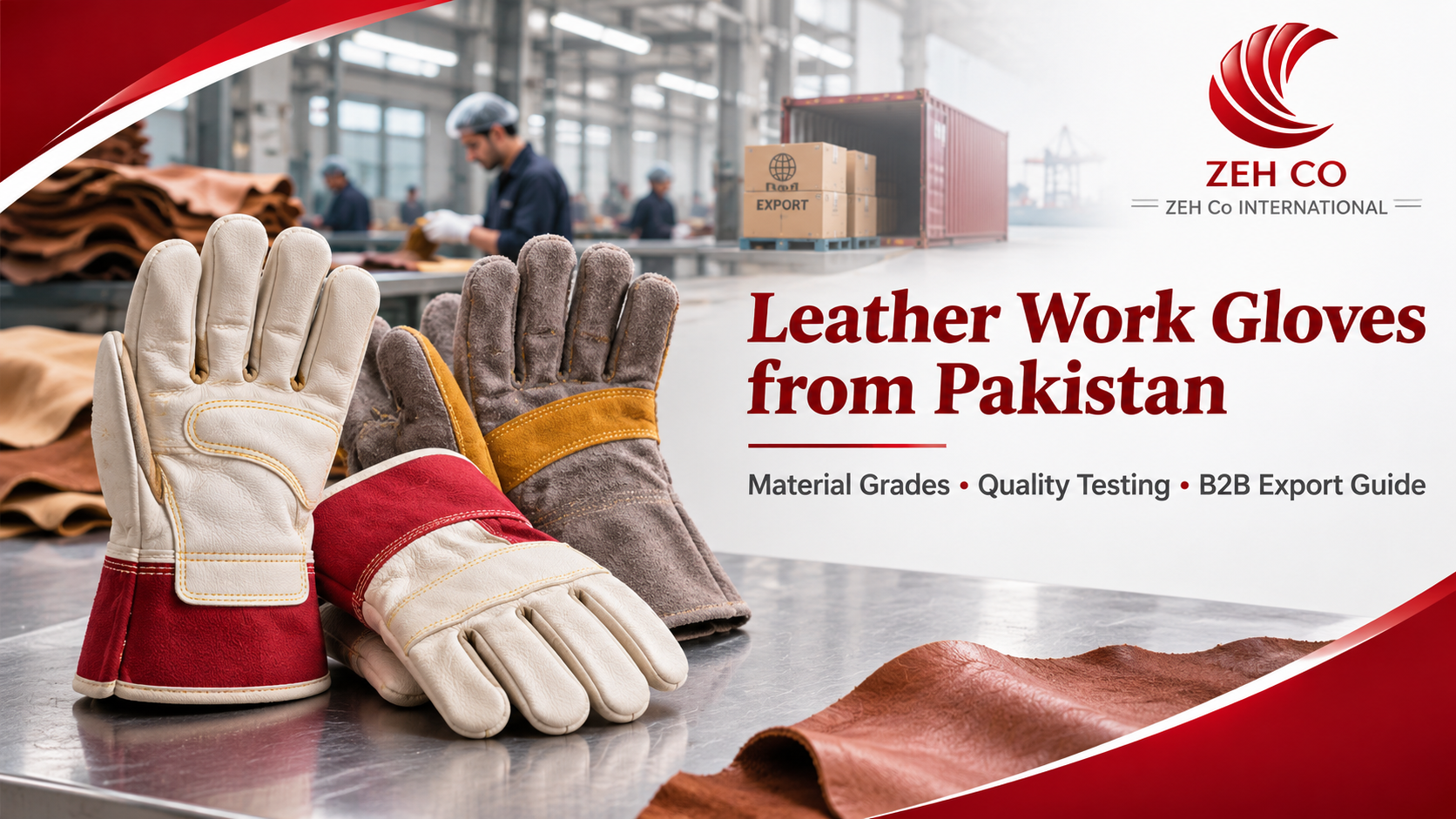
International distributors of industrial safety equipment require work gloves that deliver consistent construction, appropriate protection, reliable sizing and commercially sustainable procurement costs. Pakistan offers an established leather processing and manufacturing supply chain capable of supporting different glove designs for construction, agriculture, logistics, workshops and industrial maintenance. Importers sourcing leather work gloves from Pakistan should, however, evaluate more than the appearance or unit price of a product. Leather selection, seam strength, reinforcement, testing documentation and manufacturing consistency directly influence the suitability of gloves for their intended applications.
Why Source Leather Work Gloves from Pakistan?
Pakistan's leather industry supports the production of finished leather goods and industrial accessories through interconnected tanning, cutting, stitching and finishing operations. For international wholesalers, this creates opportunities to source standardized work gloves as well as customized products manufactured against buyer-approved technical specifications.
Procurement opportunities may include bulk unbranded gloves, distributor-branded products, customized retail packaging and recurring supply arrangements. Buyers should evaluate manufacturing capabilities, material availability and production controls before committing to long-term contracts.
Understanding Leather Types and Commercial Grades
Grain Cowhide Leather
Grain cowhide is commonly selected for gloves requiring a balance between flexibility, durability and handling comfort. Driver-style gloves and general-purpose work gloves frequently use this material. Buyers should specify the leather thickness range, surface finish, softness, acceptable natural markings and color consistency.
Split Cowhide Leather
Split leather is obtained from the lower layers of the hide and is commonly used in general industrial gloves, reinforced palm designs and heavy-duty handling products. Its suitability depends on thickness, processing, construction and verified performance rather than material designation alone. Buyers should define acceptable thickness variation and reject excessively weak, brittle or damaged sections.
Goatskin and Other Leather Options
Goatskin may be considered for applications requiring greater flexibility and tactile control. Other leather options can be evaluated according to the intended working environment, material availability and target price. A more expensive leather does not automatically provide better protection against every occupational hazard.
Glove Construction and Industrial Applications
- Driver gloves: Close-fitting designs intended for handling, equipment operation and general maintenance where suitable.
- Leather palm gloves: Leather palm construction combined with textile backs for selected general handling applications.
- Reinforced work gloves: Additional material at high-wear areas such as palms, thumbs and fingertips.
- Long-cuff gloves: Extended wrist coverage designed according to specific working requirements.
- Lined gloves: Internal textile layers intended to improve comfort or provide particular performance characteristics when verified.
Importers should communicate the intended task and relevant workplace hazards before selecting a design. General-purpose leather gloves must not be marketed as suitable for welding, chemical exposure, electrical work, extreme heat or other specialized hazards without appropriate evidence and applicable conformity assessments.
Technical Specifications for Wholesale Orders
A detailed technical specification reduces disagreements between buyers and suppliers. Instead of requesting only premium-quality gloves, importers should establish measurable acceptance criteria covering materials, dimensions, construction and packaging.
- Leather type, thickness range, color and surface finish.
- Glove pattern, overall length, palm width and finger dimensions.
- Size range and allowable dimensional tolerances.
- Stitching thread, seam design and reinforcement locations.
- Cuff construction, closure system and lining material.
- Required mechanical performance and applicable testing methods.
- Labeling, branding, packaging and carton identification.
Leather naturally varies in texture and appearance. The purchase specification should distinguish acceptable cosmetic variation from defects affecting durability, fit or protective performance.
Quality Assurance and Performance Testing
Incoming Material Inspection
Leather should be inspected before cutting to identify inconsistent thickness, excessive stiffness, tears, holes and weak sections. Textile components, lining materials, elastic closures and stitching threads should also be checked against the agreed specification.
Production and Final Inspection
Production inspections should examine pattern accuracy, matching glove pairs, seam integrity, finger alignment and reinforcement placement. Finished gloves should be checked for loose stitching, exposed sharp components, contamination, incorrect labels and inconsistent sizing.
For larger orders, buyers may establish an agreed sampling plan and acceptance quality limits. Critical, major and minor defects should be defined in advance. An approved sample and a documented inspection checklist provide a practical reference for resolving quality disagreements.
Laboratory Testing and Regulatory Compliance
Depending on the destination market and intended application, buyers may require mechanical performance testing for abrasion, cut, tear or puncture resistance. Standards such as EN 388 and EN ISO 21420 may be relevant to certain protective gloves, while specialized applications may require additional assessments.
For products marketed as personal protective equipment in the European Union, importers should verify the applicable requirements under Regulation (EU) 2016/425, including conformity assessment, documentation and marking obligations. Other markets may apply different requirements.
Laboratory reports must correspond to the actual glove design, materials and performance claims. A test report for a different construction should not be treated as evidence for the purchased product. Where chemical safety testing is required, buyers should define relevant restricted substances and destination-market requirements.
Samples and Pre-Production Approval
Sampling is particularly important because leather thickness, softness and construction can influence both comfort and performance. Buyers should request representative samples in the intended materials and sizes before approving mass production.
The evaluation process should include fit checks, movement assessment, seam examination, material verification and any required laboratory testing. Once approved, a reference sample should be retained by both parties. Changes to leather sources, patterns or construction should be documented and reviewed before implementation.
Private Label Branding and Export Packaging
Industrial distributors may require private-label gloves featuring customized cuff labels, hang tags, barcodes or retail packaging. Branding methods should be selected according to glove construction and must not compromise protective performance or obscure mandatory product information.
Bulk packing may involve paired gloves grouped into inner cartons or protective packaging and consolidated into export cartons. Carton dimensions, pair counts, net and gross weights, moisture protection and shipping marks should be agreed before dispatch. Buyers should request a final packing list rather than assuming a fixed container loading quantity.
Export Documentation and International Shipping
Commercial documentation typically includes a commercial invoice, packing list and transport document. A certificate of origin, inspection report, laboratory documentation or other conformity records may also be required depending on contractual terms and destination-market regulations.
Sea freight is commonly considered for recurring wholesale shipments, while air freight may be suitable for samples or urgent replenishment. Leather products should be protected against moisture, condensation, contamination and excessive compression during storage and transport.
ZEH Co International can evaluate FOB Karachi, CIF and commercially feasible DDP arrangements according to shipment requirements. The named port or destination, insurance arrangements, customs responsibilities and applicable charges should be confirmed in the quotation.
Managing Procurement Risks and Preparing an RFQ
Buyers should avoid purchasing solely on the basis of photographs, unsupported performance claims or unusually low quotations. Common procurement risks include material substitution, inconsistent sizing, weak seams, inaccurate labeling, moisture damage and test reports that do not match the supplied product.
A complete request for quotation should include the intended application, reference photographs or technical drawings, leather specification, required size distribution, quantity per model, testing requirements, branding instructions, packaging configuration, destination and preferred shipping terms.
ZEH Co International, a Pakistan-based international wholesale trading and export company established in 2011, can coordinate sourcing requirements for international buyers. ISO 9001:2015 and ISO 22000 certification information should be reviewed for its applicable scope and supply source. These management-system certifications do not replace product-specific protective equipment testing or conformity documentation.
Conclusion
Sourcing leather work gloves from Pakistan can support international distributors seeking customized industrial hand-protection products and recurring wholesale supply. Successful procurement depends on matching leather selection and glove construction to the intended application, approving representative samples, verifying performance claims and establishing clear inspection and shipping requirements. Contact ZEH Co International at https://zehcointernational.com/ with your technical specifications, required quantities and destination to discuss a tailored export quotation.