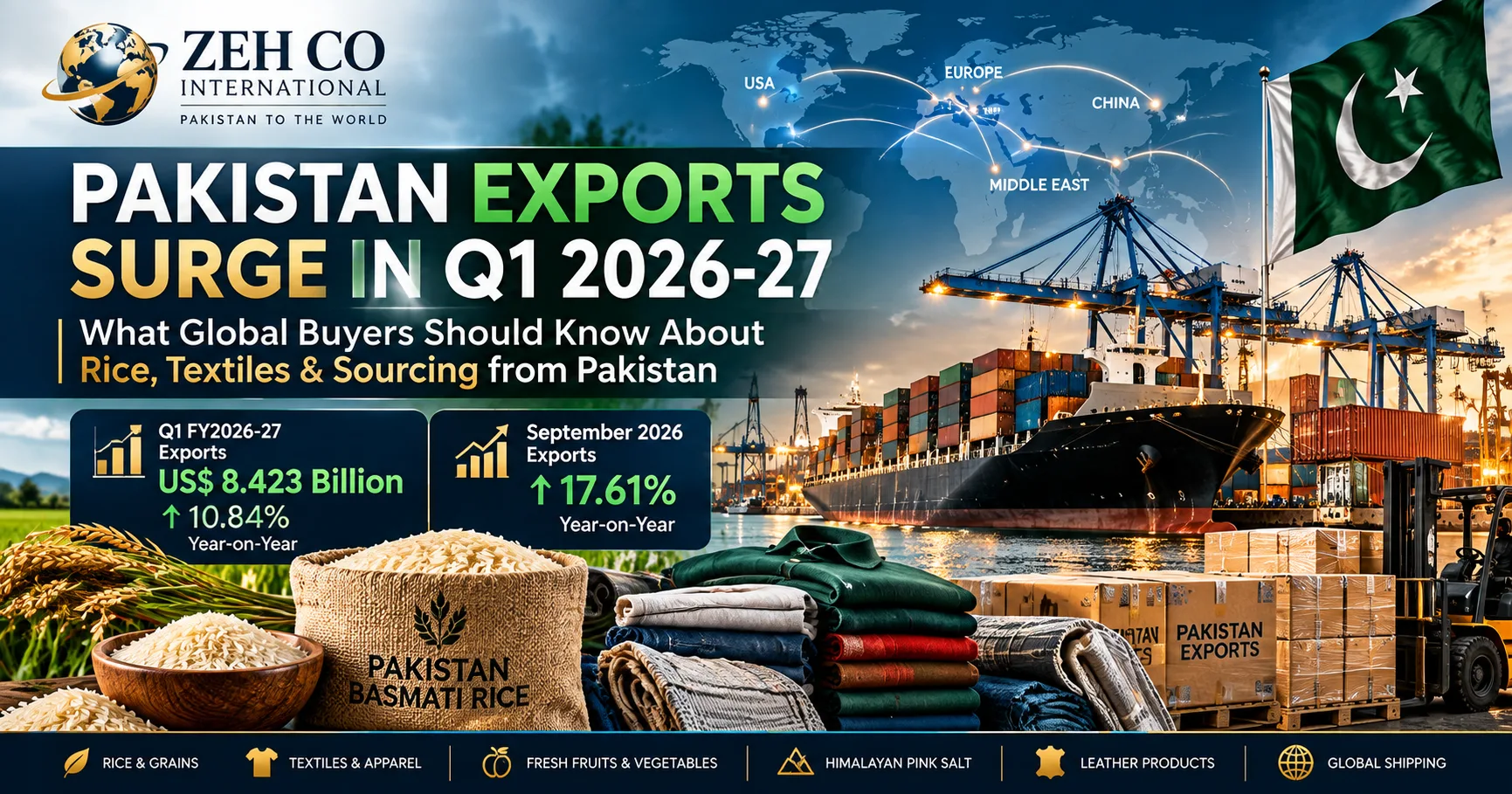
Pakistan’s export performance strengthened in the first quarter of fiscal year 2026–27, giving international buyers fresh reasons to reassess sourcing opportunities from the country. According to Pakistan Bureau of Statistics data reported on 3 October 2026, Pakistan exported goods worth approximately US$8.423 billion during July–September 2026, up 10.84% from US$7.599 billion in the same period a year earlier. September alone recorded exports of about US$2.939 billion, a 17.61% year-on-year increase and a 16.07% rise compared with August 2026.
Why this matters for global buyers
For importers, distributors and sourcing teams, headline export growth matters because it can signal stronger production utilization, greater supplier activity and deeper participation in international trade. It does not automatically mean every product category is expanding at the same rate, but the latest figures suggest that Pakistan’s export base is entering the new fiscal year with stronger momentum.
ZEH Co International works with overseas buyers sourcing products from Pakistan across food, agricultural commodities, textiles, leather products and Himalayan pink salt. For buyers considering Pakistan as a new or secondary sourcing market, the current export trend is relevant to procurement planning, supplier diversification and long-term supply relationships.
Rice remains an important export category
Rice is one of Pakistan’s most recognized agricultural exports. Separate official data for July–August 2026 showed total rice exports rising 24.68% year-on-year to roughly US$391.741 million. Basmati rice performed particularly strongly, with export value increasing 53.04% to around US$164.091 million during the same period.
For wholesale rice buyers, strong export activity can improve market visibility and supplier competition, but buyers should still assess specifications carefully. Variety, grain length, broken percentage, moisture, crop year, packaging, fumigation, phytosanitary requirements and destination-specific documentation can materially affect the final offer.
Textiles and apparel continue to support Pakistan’s export base
Pakistan’s textile sector also entered FY2026–27 with positive momentum. During July–August 2026, textile exports were reported at about US$3.379 billion, up 5.55% year-on-year. Ready-made garments rose 13.59%, while knitwear exports increased 4.79% over the comparable period.
This is relevant to international brands, wholesalers and private-label buyers because Pakistan has an established manufacturing base for knitwear, garments, cotton products and other textile categories. Buyers evaluating suppliers should compare fabric composition, GSM, stitching quality, color fastness, labeling, MOQ, sampling process, inspection standards and repeat-order capacity rather than relying only on unit price.
Fresh produce and food exports: specification control is critical
Pakistan also exports a wide range of food and agricultural products. Food-group exports during July–August 2026 were reported at approximately US$833.023 million, an increase of 7.67% year-on-year. For fresh fruits and vegetables, however, commercial success depends heavily on seasonality, grading, cold-chain control and destination compliance.
Importers of mangoes, citrus, potatoes, onions and other produce should confirm product size, maturity, packing format, temperature requirements, treatment certificates and expected transit time before finalizing a shipment. Reefer planning and port schedules can be as important as the FOB commodity price.
What buyers should evaluate before placing an order in Pakistan
Export growth can create opportunity, but professional sourcing still requires due diligence. International buyers should verify the supplier’s legal identity, product specifications, production capability, export documentation, inspection process, payment terms and Incoterms. Samples and pre-shipment inspections are especially useful for products where color, texture, grading or finishing can vary between batches.
Buyers should also compare FOB, CIF and DDP quotations carefully. A lower FOB price does not necessarily produce the lowest landed cost once freight, insurance, customs duties, destination handling and local delivery are included.
Pakistan as a supply-diversification market
Many importers now prefer to avoid dependence on a single sourcing country. Pakistan can form part of a broader supply-diversification strategy because it combines agricultural production, textile manufacturing, leather processing, minerals and export-oriented industrial clusters.
The latest Q1 export figures do not remove the need for supplier verification or commercial safeguards. They do, however, indicate stronger participation in global trade at the beginning of FY2026–27. For buyers already sourcing from South Asia, the data provides a useful reason to compare Pakistani suppliers on quality, lead time, pricing and product specialization.
How ZEH Co International supports overseas buyers
ZEH Co International is a Pakistan-based export company serving international buyers across multiple product categories. Depending on the product and destination, shipments may be structured on FOB Karachi, CIF or DDP terms. The company supports wholesale and commercial inquiries for products including rice and grains, textiles and apparel, fresh fruits and vegetables, Himalayan pink salt and selected leather products.
For serious sourcing inquiries, buyers should provide the required product, specification, quantity, destination port or delivery address, preferred Incoterm and any certification or packaging requirements. This allows a more accurate commercial offer and shipment plan.
Sources: Pakistan Bureau of Statistics external trade statistics and October 2026 reporting based on PBS data.
This article is for commercial and market-information purposes and does not constitute a guarantee of future export performance, commodity availability, freight rates or pricing.