International food importers increasingly require clearly specified fruit products rather than loosely described agricultural commodities. For buyers sourcing pitted and unpitted dates from Pakistan, the commercial decision involves much more than choosing whether the fruit contains a stone. Variety, texture, maturity, moisture, processing conditions, cleanliness, packaging integrity and destination-market compliance all influence whether a shipment is suitable for retail sale or industrial food production.
Pakistan produces several commercially recognized date varieties, including Aseel, Begum Jangi and Dhakki. These dates can serve different wholesale requirements, depending on their characteristics and available processing arrangements. This guide explains how procurement managers can compare pitted and unpitted products, establish practical quality specifications and request a reliable export quotation.
Pitted and Unpitted Dates from Pakistan: Understanding the Difference
What are unpitted dates?
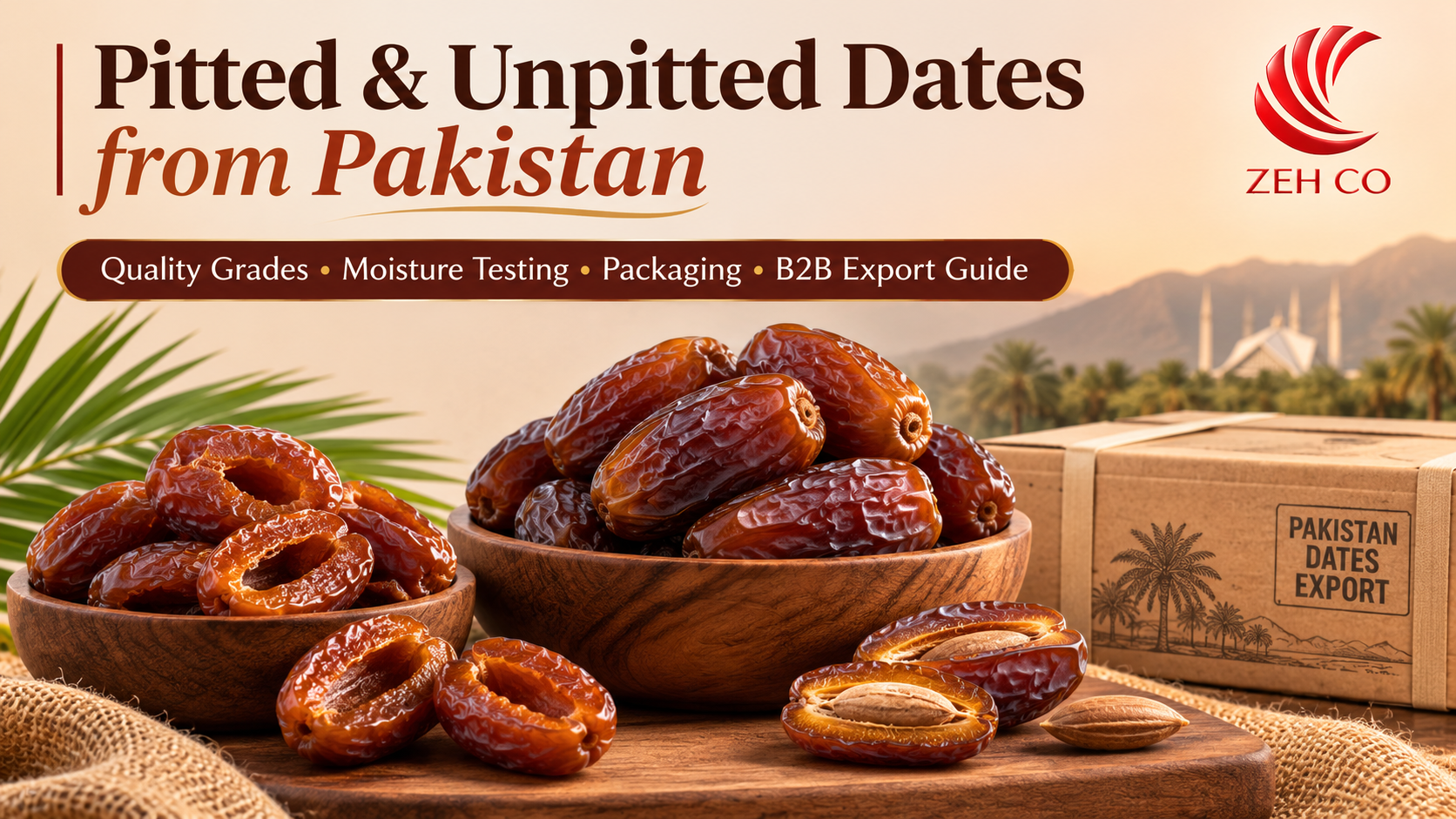
Unpitted dates are whole fruits with their natural stones retained. They are frequently preferred for traditional consumption, gift assortments and retail products where the buyer wishes to maintain the fruit's original form. However, unpitted does not automatically mean premium quality. Fruit must still be evaluated for appearance, consistency, cleanliness, damage and suitability for the intended storage conditions.
What are pitted dates?
Pitted dates have their internal stones removed during processing. They are useful for bakeries, confectionery manufacturers, snack producers, foodservice businesses and consumers seeking convenience. Buyers should pay particular attention to the effectiveness of pit removal, the presence of stone fragments, fruit deformation and hygiene during handling. The absence of visible stones in a small sample cannot guarantee that every fruit in a commercial shipment is stone-free.
Pitted dates may undergo additional handling and mechanical processing, potentially affecting their appearance and exposing more fruit surfaces. Importers should therefore establish separate acceptance criteria for whole unpitted fruit and processed pitted products.
Important Pakistani Date Varieties for Wholesale Buyers
Aseel dates
Aseel is a commercially significant Pakistani date variety associated particularly with Sindh, including the Khairpur production area. It is used in whole-date commerce and in processed date products. Depending on the supplied lot, buyers may encounter differences in color, softness, fruit dimensions and moisture. Aseel should be purchased against an agreed specification rather than an assumed universal grade.
Begum Jangi and other varieties
Begum Jangi is associated with date-growing areas of Balochistan and is relevant to the market for processed and pitted dates. Dhakki is another recognized Pakistani variety, while additional regional varieties may be available through specific suppliers. Commercial availability, uniformity and processing suitability must be confirmed before an importer commits to a particular variety.
Variety names should not be treated as automatic guarantees of origin, grade or processing quality. Ask for lot identification, sourcing information, representative photographs and physical samples wherever possible.
Quality Grades and Technical Specifications for Bulk Dates
A useful purchase specification should identify the botanical variety, pitted or unpitted presentation, maturity, color, expected texture, size classification and permitted defects. Buyers may also specify whether dates should be loose, pressed or arranged in retail packs.
- Fruit size: Establish an agreed count per unit weight or average fruit weight instead of relying only on terms such as large or premium.
- Color and appearance: Define acceptable natural variation, discoloration, broken skins, crushing and visible blemishes.
- Texture: Determine whether the application requires soft, semi-dry or comparatively firm dates.
- Foreign material: Specify controls for dust, stems, stones, insects and other unwanted matter.
- Defect tolerance: Agree on measurable limits, sampling methodology and rejection procedures before production.
The Codex Alimentarius Standard for Dates, CXS 143-1985, provides an international reference for commercially prepared whole dates in pitted and unpitted forms intended for direct consumption. Its scope does not automatically cover date paste, pieces or industrial ingredients. Buyers should identify which standards apply to the specific product and destination market rather than assuming a Codex reference replaces local legal requirements.
Moisture Content, Shelf Stability and Storage Conditions
Moisture is one of the most important purchasing considerations for dates. Excess moisture or poor moisture management can contribute to fermentation, spoilage, undesirable texture changes and reduced storage performance. At the other extreme, overly dry fruit may not meet the intended eating or manufacturing requirements.
The appropriate moisture specification depends on the fruit variety, processing style, intended shelf life and distribution environment. Buyers should request measured moisture results for the relevant production lot rather than accepting a general claim that the dates are naturally dry.
Storage instructions should address temperature, humidity, protection from condensation, pest prevention and expected transit duration. Some softer or higher-moisture products may require temperature-controlled transportation. A shelf-life claim should be supported by the producer's product-specific evidence and packaging conditions, not copied from an unrelated variety.
Food Safety, Hygiene and Certificate of Analysis
Importers should review the supplier's hygiene procedures from raw-fruit reception through cleaning, sorting, pitting, packing and dispatch. Dates can be affected by insect infestation, mold, fermentation, foreign matter and contamination introduced during processing.
A Certificate of Analysis (COA) should identify the tested lot, testing laboratory, methods, results and applicable specifications. Depending on the buyer's requirements and destination regulations, testing may cover moisture, microbiological parameters, pesticide residues, contaminants and other agreed food-safety indicators.
Buyers should request information about traceability, sanitation, pest-control procedures, foreign-body detection and corrective-action systems. Particular attention is necessary for pitted dates because residual stones or fragments may present a physical hazard. A validated inspection process is more meaningful than an unsupported claim of completely stone-free production.
ZEH Co International references ISO 9001:2015 and ISO 22000 within its company profile. Buyers should separately verify the certification scope, validity and applicability of any specific processor or supply facility. Company-level credentials must not be interpreted as certification of every individual lot.
Packaging Options for Pitted and Unpitted Dates
Bulk and food-manufacturing packaging
Wholesale and industrial buyers may request food-grade lined cartons, sealed bags or other packaging appropriate to the fruit's texture and moisture characteristics. The selected packaging should limit contamination, crushing, leakage and unwanted exposure to ambient humidity.
Carton net weight, inner liners, palletization, stacking strength and container-loading methods should be agreed before pricing is finalized. Large pack sizes are not always appropriate for very soft dates, which can deform under pressure.
Private-label and retail packaging
For supermarket and e-commerce channels, packaging decisions include retail weight, tamper evidence, barcode placement, language requirements, country-of-origin declarations, ingredient information and date marking. Claims such as organic, preservative-free or certified Halal should only be used when properly substantiated and permitted in the destination market.
Samples and Pre-Shipment Inspection
Representative samples are essential when evaluating a new Pakistani dates supplier. A buyer should request both pitted and unpitted examples when comparing formats, preferably from identifiable lots with documented handling conditions.
Sample approval should cover taste, color, texture, size variation, visible defects, packaging and the quality of pit removal. The contract should define whether the approved reference sample remains the benchmark for subsequent production.
Pre-shipment inspection may examine carton counts, net weights, packaging integrity, lot labels and conformity with the agreed specification. Independent testing or inspection can be arranged when commercially justified. Clear acceptance rules reduce disputes arising from subjective descriptions such as excellent quality or export grade.
Export Documentation and Destination-Market Requirements
A typical export documentation package may include a commercial invoice, packing list, bill of lading or air waybill, certificate of origin where required, relevant food-safety documentation and any phytosanitary or other certificates mandated for the particular product and importing country.
Requirements vary across jurisdictions. Importers must verify tariff classification, customs duties, labeling language, food import registration, pesticide maximum residue limits, permitted treatments and documentary requirements with competent authorities or qualified import agents before shipment.
Dates are commonly traded under the international HS heading for fresh or dried dates, but the final tariff classification and national subdivisions should be confirmed for the importing market. A shipping document describing pitted dates as unpitted, or providing inconsistent weights, may create preventable clearance problems.
FOB Karachi, CIF and DDP Shipping Considerations
FOB Karachi can suit buyers who control ocean freight and destination clearance, provided the shipment is appropriate for the selected Incoterms rule. CIF may be suitable when the exporter arranges the contracted ocean freight and required insurance to a named destination port. DDP requires a separate feasibility assessment because import licensing, taxes, customs representation and local compliance obligations differ across countries.
Freight planning should consider packaging dimensions, cargo sensitivity, port transit time, heat exposure and potential delays. Temperature-controlled transport should be evaluated where the product's validated storage requirements justify it. Container quantities and freight rates must be calculated from the confirmed packing plan rather than assumed as fixed figures.
How to Request a Wholesale Dates Quotation
A complete request for quotation helps exporters identify a suitable product without repeated clarification. Procurement teams should include:
- Required variety, such as Aseel or Begum Jangi, or permission to propose an equivalent.
- Pitted or unpitted format and the intended retail or manufacturing application.
- Required quantity, approximate shipment schedule and delivery destination.
- Preferred fruit size, texture, color, moisture parameters and defect tolerances.
- Bulk carton or private-label packaging specifications.
- Requested COA, inspection scope, supporting documents and certifications.
- Preferred commercial term: FOB Karachi, CIF named port or feasible DDP destination.
- Payment terms, sample requirements and any destination-specific import conditions.
ZEH Co International can review the stated procurement requirements and coordinate commercially feasible sourcing and export quotations according to the applicable product availability, processor capability, documentation and shipping arrangements. Specifications and certifications should be confirmed for the actual offered lot.
Common Buyer Risks and How to Reduce Them
The most frequent sourcing risks include mixed fruit grades, inconsistent moisture, ineffective pit removal, unidentified treatment methods, insect contamination, packaging failure and differences between approved samples and delivered cargo. Buyers should also consider the risk of delays caused by missing import documents or incompatible product labeling.
Risk reduction begins with a written technical specification, traceable samples, agreed laboratory requirements and documented pre-shipment checks. Contracts should define tolerances, responsibilities and a practical claims procedure. A lower quoted unit price is not necessarily economical if the shipment generates rejection, reworking or storage losses.
Conclusion: Source Pakistani Dates with Clear Specifications
Successful sourcing of pitted and unpitted dates from Pakistan depends on matching the right variety and processing format to the buyer's final application. Importers should evaluate physical quality, moisture, food-safety evidence, pit-removal performance, packaging and logistics as part of one integrated procurement decision.
For wholesale requirements, private-label development or manufacturing supply, ZEH Co International welcomes detailed inquiries covering quantity, destination, required grade and quality documentation. A transparent RFQ and representative sample approval provide a stronger foundation for repeat business than relying on variety names or promotional quality claims alone.